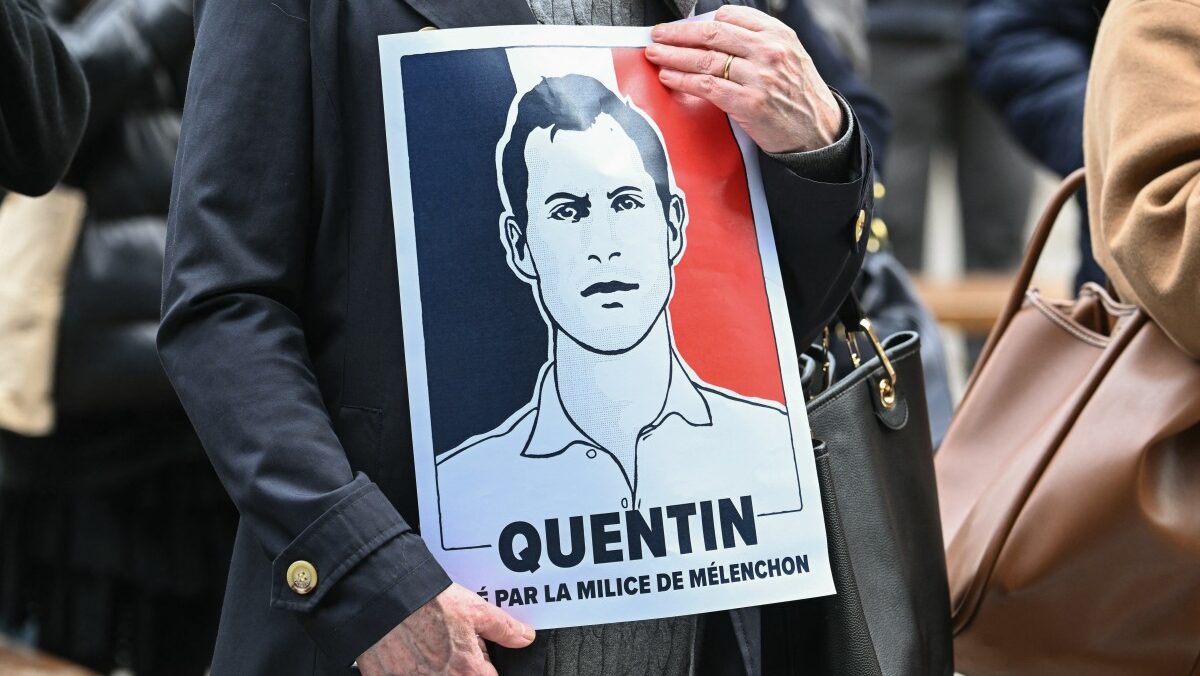
A protester holds a placard during a rally in tribute to Quentin Deranque (portrait), who died after being attacked on the sidelines of a protest against a La France Insoumise (LFI) event, near the “Sciences Po” Institute of Political Studies (IEP), in Strasbourg on February 22, 2026. “Killed by the militia of Mélenchon,” the poster reads
SEBASTIEN BOZON / AFP
Since Quentin Deranque’s death, his family and loved ones have been subjected to constant harassment, which has made their grief even more difficult to bear. Their lawyer has spoken out in defence of the young man, whom he now considers to be the victim of a “lynching of memory.”
It has been almost a month since Quentin, 23, was killed, lynched in Lyon by ‘anti-fascists’ while he was there to assist feminist activists from the Collectif Némésis, on the sidelines of a conference by pro-Palestinian MEP Rima Hassan.
For his family and loved ones, the mourning period is particularly long and painful because, in addition to the pain of his absence, there is media and political pressure tarnishing his memory. The lawyer for Quentin’s parents, Fabien Rajon, spoke to Le Figaro to express their distress as their son is being dragged through the mud by the press, labelled a ‘neo-Nazi’ or ‘neo-fascist.’ The portrait painted of Quentin is a thousand miles away from the reality of this religious and peaceful young man.
The family’s lawyer recounts in detail what the parents saw on the night of the tragedy—a far cry from the often fearful and watered-down account that has been reported in the press. Videos of the February 12th attack quickly circulated on the web. These highly violent videos were sometimes broadcast in truncated form. The parents, contacted during the night so that they could go to the hospital where their son was, discovered an even more terrible reality: “the footprints of their child’s attackers visible on his skull,” as observed by the emergency doctors.
Since Quentin’s death, his parents have been living in hell. Their names are repeated endlessly in the press. Attempts are being made to approach their employers and the schools their children attend. Some investigators have even gone so far as to track down Quentin’s mother’s family, who live in Peru. Pseudo-investigations are being conducted to learn more about a young man who is being portrayed in a way that does not reflect who he really was: as a far-right activist, a member of a security service trained in street fighting… “Quentin weighed 63 kilos, and some people want to turn him into an ultra-violent skinhead,” says Rajon indignantly. Defamatory articles accuse him of belonging to movements he has never been involved with. The press is playing a particularly harmful role in this massive smear campaign. Rajon points out that a journalist from Radio France—a public service broadcaster—went so far as to draw a parallel between Quentin and a member of the Hitler Youth. “This indecency makes his family sick,” laments the lawyer.
None of this is accidental: it is a deliberate strategy aimed at exonerating those responsible for his death from their exact role. If the victim was a bastard, he is no longer a victim. Quentin’s death must be covered up and the guilty parties whitewashed. The nine suspects are all members or associates of the ‘anti-fascist’ movement La Jeune Garde, founded by far-left MP Raphaël Arnault, who has disappeared from the radar since Quentin’s death. Among them is Jacques-Elie Favrot, his parliamentary assistant and closest collaborator. The family wonders: what was he doing in Lyon on a weekday, far from his workplace—the National Assembly—or even his constituency—Vaucluse, in Southern France?
The lawyer’s final revelation allows us to gauge, if further proof were needed, the savagery of the murder. Quentin, his consciousness impaired, was slow to get to the hospital. But the doctors who welcomed the dying young man there explained to the family that even if he had been treated more quickly, it would not have changed his fate, as the blows he had received left him with no chance of survival.