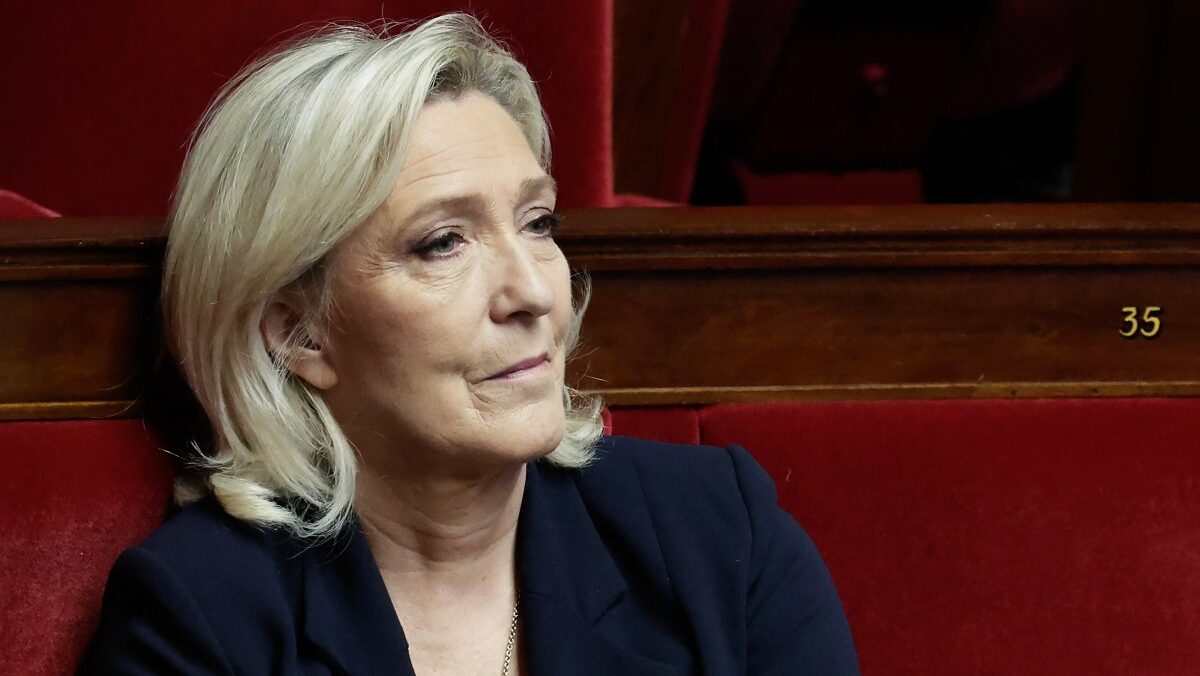
President of Rassemblement National parliamentary group Marine Le Pen
STEPHANE DE SAKUTIN / AFP
Marine Le Pen’s appeal trial concerning the alleged fictitious employment of National Front (Front National, the former name of the Rassemblement National) parliamentary assistants at the European Parliament is now in its tenth day, and things are looking complicated for France’s leading opposition party. Facing the risk of having her ineligibility sentence upheld and being barred from the 2027 presidential election, Marine Le Pen has chosen to abandon the confrontational strategy she used in the first instance and to partially acknowledge her responsibilities. The testimonies coming before the court, which are sometimes contradictory, are gaining in sincerity but weakening her defence.
Marine Le Pen has been heard. Other leading figures in her party have also come forward to give their version of events once again.
On Monday, January 19th, Nicolas Bay, now a MEP for the Identité-Libertés party alongside Marion Maréchal, acknowledged a form of “negligence.”
Bay concedes that his assistant did “some of the work” for the party. His view of the facts will come as no surprise to anyone who has ever been involved in the leadership of a political party: he was “caught up” in his national responsibilities, and his assistant simply helped him. He describes this shift as a “grey area,” as it is indeed difficult to separate his activities as a party executive from his role as a MEP.
On January 20th, it was Marine Le Pen’s turn to be heard. Her argument focused on the notion of “good faith,” formally contesting “the idea that there was anything organised” in the use of European parliamentary assistants for party-related tasks. At the end of the hearing, she said she was satisfied to have been able to explain herself in detail, even though the exercise was “physically demanding” for her.
“The analysis must be done on a case-by-case basis. The situations depending on the assistants are extremely different. Some parliamentary assistants did their work within the framework of their job as parliamentary assistants. Others used their energy to benefit the party,” due to the party’s undeniable “disorganisation.” “I am convinced that neither group intended to commit a crime. Did the party intentionally commit a crime? I don’t think so either,” she insisted.
The former presidential candidate made a key statement in her new strategy: “If we had to do it again, we obviously wouldn’t do exactly the same thing.” These words are important because it was the risk of reoffending that led to the immediate enforcement of the ineligibility sentence in the first judgement.
On Monday, January 26th, Bruno Gollnisch, Marine Le Pen’s former rival for the succession of Jean-Marie Le Pen as party leader, gave his testimony and conceded certain mistakes, such as making his parliamentary assistants available to Jean-Marie Le Pen: “I probably shouldn’t have done that,” he acknowledged.
But at the end of the hearing, despite these partial admissions, the underlying political dimension of this trial remains intact for him, as nothing was ever concealed by the National Front at the time: “I believe that I have clarified a number of things, namely that the parliamentary administration was informed of the situation and the activities of my assistants,” he said, confirming that “the origin of the proceedings is political and is the work of opponents, of disloyal political enemies.”
While inconsistencies are bound to appear in a report of events that, in some cases, took place ten years ago or even longer, fuelling the courts’ suspicions against the RN, the fact remains that the appeal trial highlights, once again, the absurdity of tracking the schedules of political figures down to the smallest detail in order to find out exactly who is behind this or that task.
As Catherine Griset, a friend and parliamentary assistant to Marine Le Pen, who is also accused of working for the party while on contract as a European parliamentary assistant, defended herself on Tuesday, January 27th: “I didn’t count my hours. It’s a job I’m passionate about; I was the only one with access to the agenda. When I answer the phone, I don’t ask what kind of appointment it is.”
She added: “It’s true that this is the part where I worked with her as she was president [of the party]. As for the emails, I had to read them to know whether to deal with them myself or forward them to someone else.” Common sense, but that may not be enough in a trial with such high political stakes.
The trial is set to continue until February 11th. For now, the court seems to show little sign of leniency.