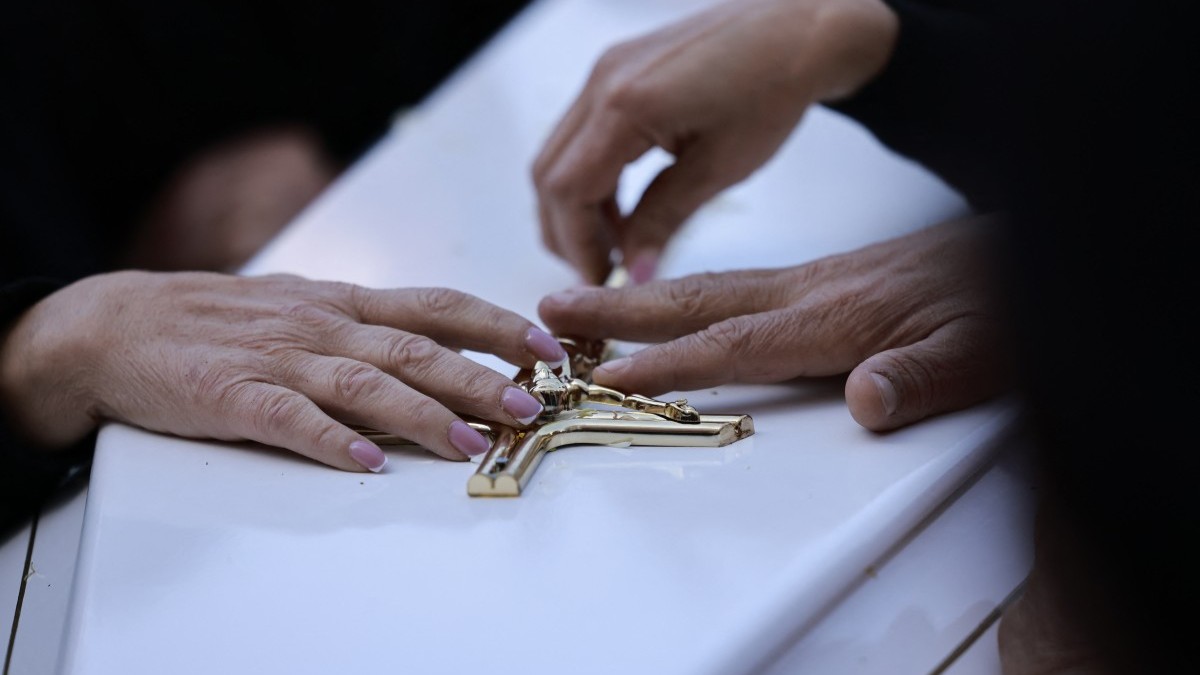
Residents of the Christian Lebanese border village of Qlaya’a mourn over the coffin of their village’s priest, Father Pierre El Raii during his funeral on March 11, 2026.
RABIH DAHER / AFP
Much focus is being given to the current military manoeuvres made by the warring nations in the Middle East, but as ever an overlooked factor is the deleterious impact on long-standing Christian communities.
On March 10th, Lebanon’s Minister of Foreign Affairs and Expatriates Youssef Raji called his counterpart at the Vatican, appealing for the Church’s aid in maintaining the Christian community in Lebanon. Raji’s call with Archbishop Richard Gallagher, the Vatican’s Secretary for Relations with States, was publicized by both the Lebanese government and the Holy See’s in-house news room.
“I asked the Holy See to intervene and mediate to help preserve the Christian presence in those villages, whose residents have always supported the Lebanese state and its official military institutions, and have never departed from this commitment,” Raji said of the call.
According to the Lebanese Foreign Ministry, Gallagher affirmed the Holy See’s already active commitment to “making all the necessary diplomatic contacts to halt the escalation in Lebanon and to prevent the displacement of citizens from their lands.”
Concern about the Christian population in Lebanon has increased following the renewed volatility in the region, in light of the current U.S.-Israel war with Iran. As of March 2nd, reciprocal missile strikes renewed between Israel and cells of Iranian-backed Hezbollah, after rockets were fired at Israel.
Israel has stated its attack on Hezbollah forces is a critical factor as part of its wider attack on Iran. In turn, Lebanon’s government has condemned the strikes coming from Hezbollah as actions taken outside the authority of the Lebanese state, and which endanger the entire nation.
In a striking move on March 9th, the Lebanese government called for direct negotiations with Israel to effect “permanent security and stability arrangements on our borders,” and at the same time condemning Hezbollah as looking to destabilize the nation. However, the Lebanese president, Joseph Aoun stated that such negotiations could not happen while Lebanon is under Israeli attack.
Meanwhile the death-toll continues to grow. Local authorities state that as of March 11th around 600 people have been killed in Lebanon as a result of the strikes, and around 15 people have been killed in Israel.
Human Rights Watch has accused the Israeli military of illegally using white phosphorus in residential areas–something expressly forbidden by international humanitarian law, although Israel has not signed onto the 1980 agreement outlawing such actions. Israeli military told Reuters that “it was unaware and could not confirm the use of shells that contain white phosphorus in Lebanon.” It added that it had not reviewed the same videos as HRW and could not comment on the claims. Human Rights Watch has previously accused Israel of using white phosphorous against civilians in Lebanon in 2023, something Israel denied at the time.
The Holy See via its diplomatic corps, and Pope Leo himself, have both voiced criticism of Israeli military tactics in recent months. In the face of Israel’s criticism during the autumn Leo supported his Cardinal Secretary of State’s description of the October 7th attacks on Israel, and Israel’s own response, as both being a “massacre.” Then when meeting with young people as part of his voyage to Lebanon, Leo informed them to “be assured of the support of the whole Church in the decisive challenges in your lives and in the history of your beloved country.”
But renewed international and ecclesial attention has been drawn to Lebanon this week after Maronite priest Father Pierre El Raii was killed by an Israeli artillery strike on his village of Qlaya’a in the south of the country. Fr. Pierre had refused to leave his community and was well known for encouraging them to remain in their Christian town, pushing back against the wider phenomenon of Christians fleeing the Middle East.
The Pontifical Mission Society documents that on Monday Israeli military fired upon a house, claiming Hezbollah militants were inside, and thus wounding the owner and his wife. Fr. Pierre entered the house to assess the wounded, at which point it was hit by another artillery shell. He later died in hospital from his wounds.
The response from the Holy See has been notably strong. Pope Leo XIV was swift to issue a message that same day, noting his “deep sorrow for all the victims of the recent bombings in the Middle East, for the many innocent people, including many children, and for those who were helping them, such as Father Pierre El-Rahi.”
At his General Audience on Wednesday, Leo then added how the priest “was a true shepherd, who always stayed beside his people, with the love and sacrifice of Jesus the Good Shepherd. As soon as he heard that some parishioners had been wounded in a bombing, he rushed to help them without hesitation. May the Lord grant that the blood he shed be a seed of peace for beloved Lebanon.”
Two papal messages in just three days is incredibly notable. On Thursday morning, Leo met with Archbishop Giorgio Lingua, Papal Nuncio in Israel and Apostolic Delegate in Jerusalem and Palestine—a meeting which sent a message even just by its timing.
Fr. Pierre’s superior, the Maronite Patriarch Cardinal Béchara Boutros Raï, called the priest’s death a “martyrdom,” adding that it “is a deep wound in the heart of the Church” which highlights “the tragedy for which innocents pay the price in the cycle of violence and war, against which we have long warned, urging everyone to keep our nation out of its tragedies and to embrace negotiation, dialogue, and diplomacy.”
Lebanon is enshrined in Christian history and has the largest proportion of Christians in the Middle East, ranking just behind Egypt in actual numbers. Yet the future of Christianity in Lebanon has appeared fragile in recent years, and much concern has been expressed that the latest conflict will be yet another instigation for Catholics in the region to flee for safer shores.
Just-retired Cardinal Raphael Sako warned this week that if the Nineveh Plains in Iraq are attacked now, “where there are 50,000 Christians, these people will leave their homes—and this time, they will not return.”
Indeed this was a key concern raised by Leo XIV during his recent Apostolic Voyage to Lebanon in November and December. “A challenge, not only for Lebanon but for the entire Levant, is what can be done to ensure that young people in particular do not feel compelled to leave their homeland and emigrate?,” he asked during his meeting with diplomats and civil authorities in the country. “How can we encourage them not to seek peace elsewhere, but to find guarantees of peace and become protagonists in their own native land?”
But it seems that despite everything, some Catholics are determined to cling to their native Lebanon and ensure that Christianity is not extinguished. Speaking to the Pontifical Foundation Aid to the Church in Need, one Maronite cleric commented that if the community leaves now then they might never return. “We believe that if we go again, for any reason, we will not be allowed to return and that whatever is left behind will be destroyed once more,” said Chorbishop Maroun Youssef Ghafari.
Fr. Ghafari is well aware of the dangers involved in staying: his own brother was killed by an airstrike on his village just days ago. The Christian communities there face a terrible choice between staying and risking death, or leaving (sometimes through forced evacuation by Israeli military) and never returning to their home.
Director of the local Jesuit Refugee Service, Father Daniel Corrou, attested to this also. Christians fear that if they leave, they might “never be able to get their land back again, that it would be occupied by some group—whether it was Israeli, or whether it was other local groups here,” he told EWTN News on March 10th.
It is not just direct danger from the war which forces Christians out of their homes in the contested lands in the region, but also the use of forced evacuation for false purposes, the denial of work or residence permits thus dividing families. Sources with direct knowledge of the matter have informed this correspondent that such tactics are frequently used against Christians, and thus fragment the communities.
The dangers of every sort are therefore real and present. The future of Christianity in Lebanon should not be taken for granted, yet the faith of the communities is strong and active–serving as a testament to the link they have with their land and the depth of their faith. “We trust in divine providence and in the intercession of the Virgin Mary, our protector,” Fr. Ghafari said.