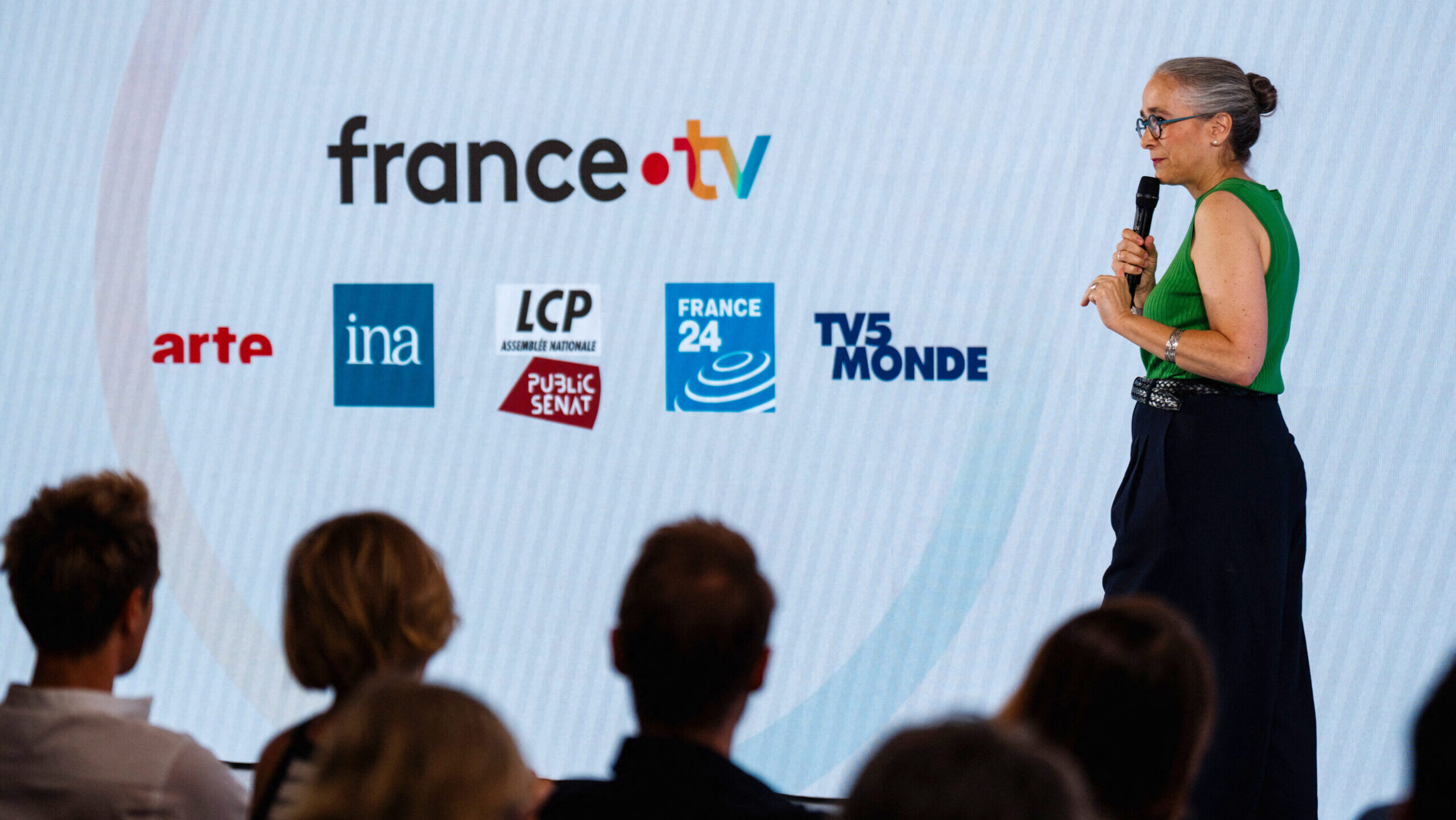
French Television chief executive Delphine Ernotte speaks during a press conference to present the new season of France Televisions audiovisual group in Paris on July 8, 2025.
Dimitar Dilkoff / AFP
The revelation to the French public of the close ties between certain public service journalists and the Left by the conservative magazine L’Incorrect sent shockwaves through the small world of French media, the effects of which are still being felt. Under these circumstances, reform of public broadcasting is more urgent than ever, especially since a report by the Court of Auditors has revealed its catastrophic management and the financial drain it represents for the public purse.
In early September, L’Incorrect magazine published a recording made in a Parisian café, revealing a conversation between France Inter state radio journalists Patrick Cohen and Thomas Legrand and Socialist Party executives, leaving no doubt about the degree of collusion between these figures and their concerted strategy to use the public media to push their electoral advantage at the expense of the Right.
Since then, the journalists in question, and behind them the management of the public broadcasting service—Radio France and France Télévisions—have been struggling painfully to restore their reputation, between attacks on whistleblowers and denials of bad faith.
Their defence strategy has so far been unsuccessful. The journalists in question, Legrand and Cohen, have, for example, attempted to discredit L’Incorrect by accusing the newspaper of “truncated” and “distorted” reporting—before a bailiff came to prove, with supporting evidence, that the conversation had been published raw and unedited. The media regulatory authority, ARCOM, has been asked to conduct an investigation into whether or not public radio and television channels are complying with the requirement of ideological neutrality in their approach to news and in their choice of guests. This is not a new request; it was already raised in 2024, without however being implemented. For its investigation, ARCOM has announced that it intends to draw inspiration from the practices implemented by the BBC in the United Kingdom.
Given the scale of the scandal, the radio station France Inter, while not dismissing its commentator Legrand, had no choice but to suspend him from one of its programmes. Defending its soldiers, France Télévisions’ ethics committee, on the other hand, ruled that journalist Cohen “is not at fault”—even though he openly admits, in the conversation made public, to “doing what is necessary against Rachida Dati,” the right-wing candidate in the 2026 Paris municipal elections.
The war is raging. Delphine Ernotte, the controversial president of France Télévisions since 2015, has long been known for her outspoken left-wing activism. She has chosen to counterattack by targeting the media system’s favourite adversary, the conservative channel CNews, owned by Catholic billionaire Vincent Bolloré, whom she accuses of exaggerating the Legrand-Cohen affair and of being an “opinion-based media outlet, a far-right channel.”
In a press release, CNews denounced the attacks as “illustrating the discomfort caused by the success of CNews” among its competitors, saying it welcomes “all opinions” in “dialogue and debate.” In the media world, no one is fooled. Delphine Ernotte’s attacks appear to be an attempt at diversion and victimisation in order to hide the real problems behind a smokescreen, namely the ideological compromise of the public audiovisual service and its catastrophic management by Ernotte.
Indeed, at a time when the Legrand-Cohen controversy is in full swing, the public body of the Court of Auditors has just published a critical report on the exorbitant cost of France Télévisions to the public purse. The organisation has a deficit of €40 million. The Court of Auditors considers the situation to be “critical” and demands structural reforms “without delay.” The report reveals major dysfunctions: unreasonable bonuses and allowances, exorbitant expense accounts, and a disproportionate salary scale that unduly benefits a few senior positions and are out of step with their actual responsibilities.
At the Rassemblement National (RN), Marine Le Pen seized on the subject to reiterate one of her party’s recurring demands: the privatisation of broadcasting, also called for by other voices on the Right. On X, she makes a ruthless assessment of the institution:
Public broadcasting definitely lives in a parallel world.
Its annual budget of billions is financed by all French taxpayers, including the millions of voters of the RN. Despite this, the ideology it defends every day on its channels, in violation of its duty of neutrality, is that of a politicised minority on the Left and, increasingly, on the far Left. Public funds, private ideology. Spot the mistake.
A petition calling for the privatisation of public broadcasting has been launched on the RN website.