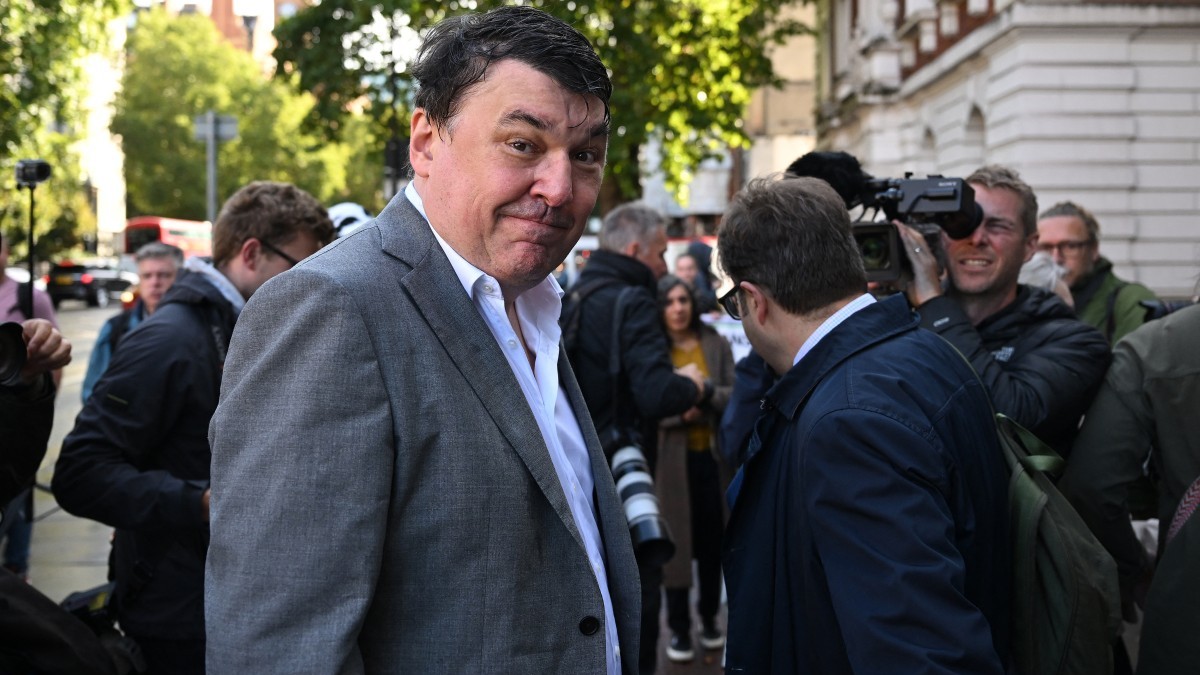
Irish writer and director Graham Linehan arrives at Westminster Magistrates’ Court in London on September 4, 2025.
Justin Tallis / AFP
As charges against comedy writer Graham Linehan were ditched on Monday, October 20th, the London Metropolitan Police announced that it would provide a “clearer direction for officers” by no longer treating “non-crime hate incidents” (NCHI) as the reason for a direct criminal investigation.
Both developments are to be welcomed.
Irish citizen Linehan, co-creator of the beloved sitcom Father Ted (among others) was arrested by armed police over three non-recent gender-critical posts on X, formerly Twitter, as he passed through London’s Heathrow Airport last month. (He was on his way to a separate trial for alleged offences in what the Met police are now calling “toxic culture war debates,” specifically relating to a confrontation between Linehan and a trans activist at the annual Battle of Ideas event.)
Rightly, the arrest of a writer for a small sliver of social media activity that was treated by police as an NCHI prompted international outrage. It also put Linehan in hospital with high blood pressure and means he will now sue the Met for wrongful arrest. Dropping these egregious charges is a victory for free speech.
Subsequent statements issued on behalf of Met commissioner Sir Mark Rowley also call into question the future of the quasi-criminal category of an NCHI, defined as “an incident that falls short of being criminal but which is perceived to be motivated by hostility or prejudice towards a person with a particular characteristic.” Whereas the legal standard for incitement is (or at least should be) relatively high, the ‘non-crime’ aspect meant that so-called suspects were being investigated and recorded as criminals—with implications for their employment and more—because their perceived ‘hatred’ of something had brought the coppers to their door.
Now the Met appears to be arguing that such allegations, which often originate online, should not get in the way of focusing on ‘real’ criminal investigations—coinciding with, in relation to his Heathrow arrest, Graham Linehan becoming once again a free man. However, let’s not get overoptimistic. ‘Careful now,’ as Linehan’s character Father Dougal might say.
While the largest police force in England and Wales, the Met is one of many and its regional counterparts may well continue to investigate NCHIs as before. (Even amid the headlines about no longer investigating such non-crimes, Rowley’s rep did make background noises about auditing such allegations to keep tabs on evolving social trends—unwitting evidence of the rise of the graduate officer.)
Secondly, Met officers have previously shown a mutinous commitment to pursuing NCHIs even when their top brass encouraged them to cease and desist (sometimes encouraged by government figures or Labour’s ‘common sense’ guidance, after political vacillation on the issue). Thirdly, the College of Policing—where the disastrous concept of NCHIs was dreamt up and made policy—remains intact. Little wonder that as recently as last weekend did Linehan’s Arizona co-writer Andrew Doyle reiterate his call for it to be abolished.
Despite the important victory for Graham Linehan, the ambition that the British bobby should ‘police the streets, not our tweets’ remains unrealised.