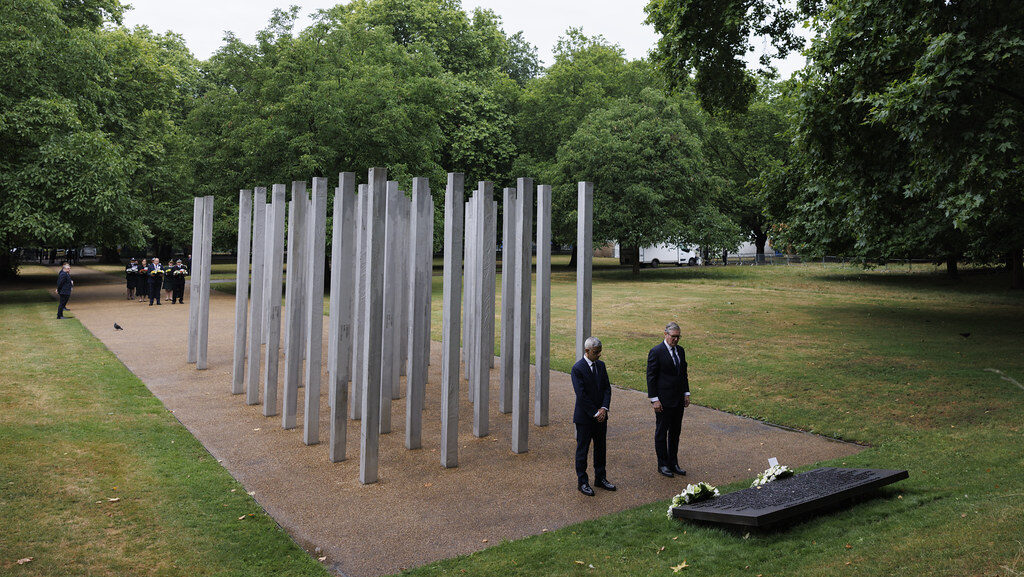
Prime Minister Keir Starmer lays a wreath at the 7/7 memorial in Hyde Park to remember the victims of the July 7th terror attacks in 2005.
Simon Dawson / No 10 Downing Street

As Britain’s official events to commemorate the 20th anniversary of the July 7th attack on London trundled on, two trends became increasingly apparent. Firstly, the official message was hammered home: “we will not let these people—the suicide bombers—divide us.” Secondly, the people paying attention became increasingly divided from the government itself.
7/7 itself was the second most lethal single terror attack on British territory—the worst being the bombing of Pan Am Flight 103 over Lockerbie, Scotland in 1988—inflicting 52 fatalities, Uniquely at the time, the mass casualty assault on London was known to have been initiated by at least four British citizens, three of them born in England.
The increasingly inept-looking Prime Minister Keir Starmer commemorated the atrocity with these anodyne words, accompanying a similar official statement from his office:
Twenty years on from the 7/7 attacks, we remember all those whose lives were lost and those whose lives were changed forever.
We honour the bravery of the first responders, and the strength of the survivors.
Those who try to divide us will always fail.
While this affirmed his own worldview, other commentators on social media started bristling immediately. The problem is that the 52 dead didn’t simply ‘lose their lives’ as if a particularly virulent strain of influenza hit them: they were murdered by Islamists. Ben Cobley, author of The Progress Trap, likely said what a lot of Brits were thinking when he posted at length on X:
They have laundered mass murder into a progressive event, showing how *strong and united* we are, how we *overcame division*: celebrating how *their words* healed us all.
It’s really all about them and how their sociology and slogans were right and still are right. Commemoration as self-praise.
They have basically recast the dead as soldiers for multiculturalism. It’s quite an achievement.
In short, Starmer adheres to a form of multiculturalism where white and working-class British citizens are viewed as a dormant race riot. The anonymous-sounding suicide bombers sought to provoke conflict, but, this time at least, the citizens gave political Islam a break and turned the other cheek. Well done everyone—and thanks again for your restraint on the issue of predominantly Muslim organised Pakistani paedophile rapists. What we can’t have is what London Mayor Sir Sadiq Khan called a ‘wedge’ driven between communities—allegedly the goal of the terrorists (albeit with no evidence to support this in their suicide videos).
Claiming that the 2005 bombings ‘brought Britain together’ reveals two awful establishment assumptions, where the majority is primed to attack British Muslims because British Muslims are an undifferentiated bloc which Islamists seem to convincingly claim to represent. Proven wrong, the great and good gather in London to congratulate themselves on these doomsday predictions being proven wrong.
While Starmer led the way in platitudes, Home Secretary Yvette Cooper set out the policy, reflecting in a Sunday newspaper on post-7/7 national counter-terrorism strategy. Predictably, she claimed that “extreme far-right terrorism” is a major threat:
Communities across the nation were determined that hatred would not win. The work done at that time has endured and evolved. Islamist extremist terrorism remains the greatest threat, followed by extreme right-wing terrorism.
The problem with these arguments about equivalent threat levels is that, to date, the sheer volume of Islamist violence, including mass murder, far exceeds anything committed by the alleged far right. No doubt this skewed account of radical Islam is helped by Cooper’s political co-thinkers thinking along the same lines: former London Metropolitan Police Assistant Commissioner Neil Basu weighed in to say of the suicide bombers that
A driver of the 7/7 attacks was foreign policy and Iraq. That does not excuse in any way what they did. That foreign policy decision has radicalised and made extremists of people who might not have been radicalised or extreme. And if they were on the pathway, it’s pretty much guaranteed … All terrorists will have a freedom fighter story.
While the authorities congratulate themselves (and public self-restraint) on the lack of a backlash against Islamists, the Islamists can’t help but choose to murder their fellow citizens (because of foreign policy, or something). In 20 years since 7/7, this pattern has repeated itself time and time again, albeit with fewer casualties in each individual attack (to date, anyway).
Meanwhile, the ‘useful idiots’ of the British political class run away from even daring to name the murderous motives of the Islamist terrorists in the midst. The real lessons of 7/7 have yet to be learned.