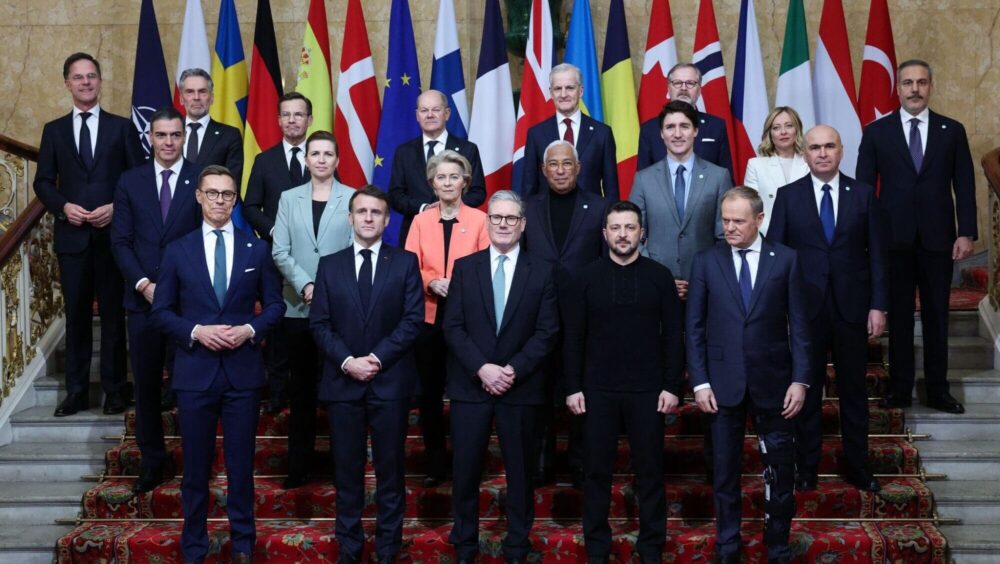
European leaders at the London summit
The meeting held on Sunday, February 2, in London with the participation of European leaders and Turkey has once again highlighted Europe’s lack of a clear strategy regarding the war in Ukraine.
While the United States and Russia have begun bilateral negotiations to reach a peace agreement without inviting Ukraine or its European allies, leaders of the Old Continent have opted to double down on their support for Kyiv by supplying weapons and promising a general rearmament.
British Prime Minister Keir Starmer has taken the initiative, alongside France, to push for an alternative peace plan, emphasizing that “Europe must do the heavy lifting” in Ukraine, but with the backing of the United States.
Starmer dubbed the group of leaders a “coalition of the willing”—a term borrowed from, among others, the US-led multinational invasion force against Iraq in 2003—and boldly announced that the UK is ready to put “boots on the ground, and planes in the air” as security guarantees enforcing the peace.
However, the illusion of unity quickly falls apart at a second glance, as barely any other country (besides France) is willing to go that far. Outgoing German Chancellor Olaf Scholz reportedly even stormed out of the meeting, and said the idea of deploying European troops was “completely premature [and] highly inappropriate.”
What’s more, it was revealed soon afterward that there are disagreements even between London and Paris when it comes to the proposed one-month ceasefire in the conflict. “There is no agreement on what a truce would look like,” admitted Luke Pollard, the UK’s Minister of State for the Armed Forces.
For her part, European Commission President Ursula von der Leyen spoke of the need for “urgent rearmament” of Europe to guarantee the continent’s security and avoid exclusive dependence on U.S. support. “We are ready together, with you, to defend democracy, to defend the principle that there is a rule of law,” she declared at the end of the meeting. On Thursday, 6 March, von der Leyen will present a plan to strengthen the European defense industry.
This new plan supplements the one presented during the previous legislative term, which included an investment of over 100 billion euros to boost the European military industry and create national champions capable of handling the build-up.
The EU is ready to work with all our European partners and other allies in a peace plan for Ukraine that ensures a just and lasting peace.
— António Costa (@eucopresident) March 2, 2025
We must learn from the past. Peacemaking goes hand in hand with peacekeeping.
Follow my press statement after the leaders’ summit in… pic.twitter.com/fuvA7sLBtl
Italian prime minister Giorgia Meloni is attempting to position herself as a bridge between Europe and the United States to ease tensions with Trump. “It is essential that Europe and the United States work together within a common security framework. We cannot allow divisions that weaken the position of the West,” Meloni stated, seeking to balance the interests of both sides.
Her closeness to Donald Trump and other conservative forces could boost her standing, especially given the unconvincing posturing of Scholz, Macron and Starmer as leaders of a unified Europe.
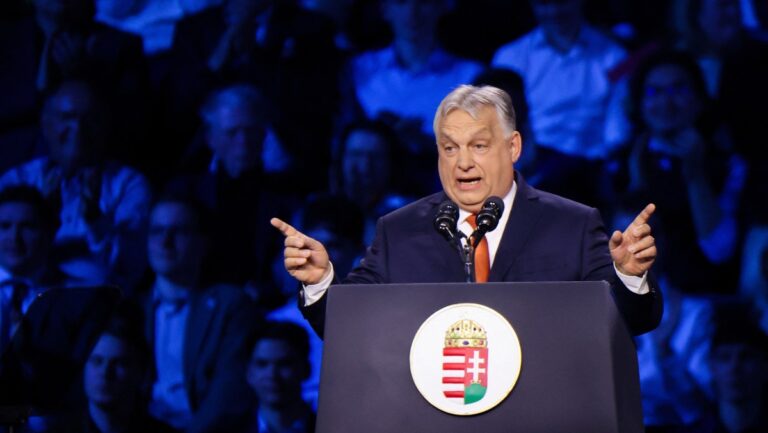
Hungarian Prime Minister Viktor Orbán, staying true to his previous takes on the war, is openly critical of the stance taken in London. “What we saw on Sunday is a grave mistake. Persisting in the military approach only prolongs suffering and distances us from a viable solution. Europe should be advocating for a diplomatic solution instead of continuing with a failed strategy,” Orbán told the press.
Marine Le Pen, leader of Rassemblement National, also spoke along these lines on March 1 in an interview with Le Figaro:
I hope this difficult moment will be a step towards peace that I consider inexorable, while some would like to continue the war.
Regarding the absence of European leaders at the negotiating table, the French politician pointed out that:
As young people would say, we were ‘ghosted’ from these negotiations when our country could have intervened positively.
A veiled jab at Macron for the informal summits in Paris that have yielded no results.
The recent showdown in the Oval Office between Trump and Zelensky has made it clear that Washington’s patience is not infinite and that a diplomatic solution may be imposed sooner than expected. The question is whether Europe will be able to adapt to this new reality or continue to pursue a strategy that, so far, has failed to end the conflict.