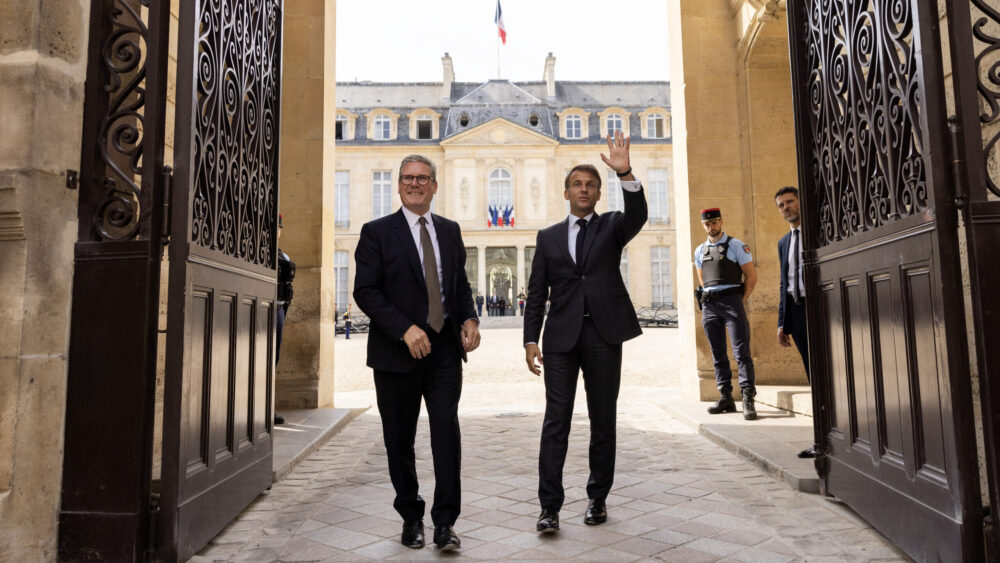
Keir Starmer meets Emmanuel Macron at the Elysee
Number 10, CC BY 2.0, via Wikimedia Commons
There has been less news from the so-called ‘coalition of the willing’ in recent weeks, no doubt because it is becoming harder to pretend that Europe’s—in particular, Britain and France’s—Ukraine ‘peacekeeping’ promises are anything but empty.
Behind the overstated press conferences, European defence officials had a far more frank talk in Brussels on April 10th, during which the UK’s suggestion of a 64,000-strong force appears to have been dismissed out of hand.
The Times of London cites a source “privy to discussions in Brussels” who says defence ministers agreed there is “no chance” a force of that size can be assembled.
Not only that, ministers also believe that even a 25,000-strong force would “be a push for a joint effort.”
France’s Emmanuel Macron and Britain’s Keir Starmer have pledged between 5,000 and 10,000 troops to defend a possible peace deal in Ukraine, although reports last suggested that the UK could pull out of plans altogether, likely because of a lack of resources.
And while it has yet to completely rule out sending ground forces of its own, Germany is also understood to be against the idea.
Lithuanian Defence Minister Dovile Sakaliene apparently told her counterparts that failing to get 64,000 troops together “doesn’t look weak—it is weak.”
Not that any of this should come as a surprise. “It has always been clear to anyone willing to be honest with themselves that the coalition of the willing was performative,” writes Eliot Wilson in The Spectator:
It has been a bizarre exercise in wish-fulfillment from start to finish, thinking about a military force we cannot provide to perform a mission of which we have no details to enforce a peace settlement which does not exist.
‘Coalition’ leaders are set to meet next in Kyiv on May 9th.