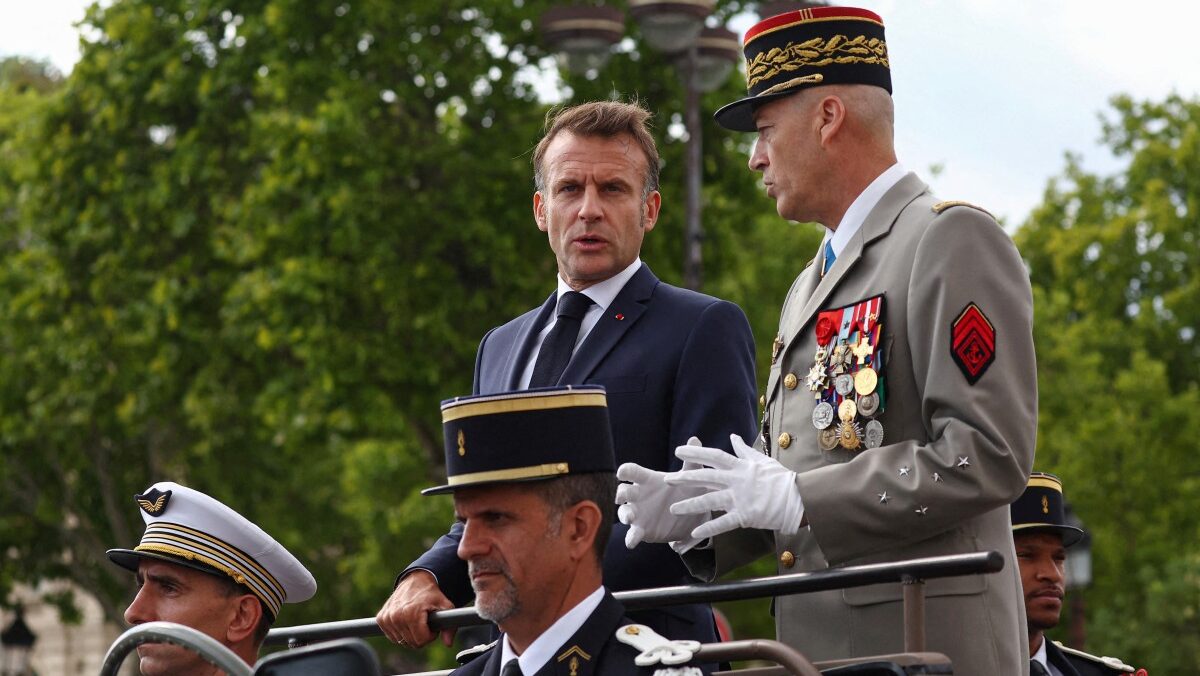
France’s President Emmanuel Macron (Top L) and Chief of the Defence Staff General Thierry Burkhard (Top R) review troops as they stand in the command car during the annual Bastille Day military parade on the Champs-Elysees Avenue in Paris on July 14, 2025.
Abdul Saboor / POOL / AFP
Every year, the national holiday on July 14th is an opportunity for France to remember that it has an army and that it can take legitimate pride in it. Every year, during the parade on the Champs-Elysées, the President of the Republic takes centre stage as commander-in-chief of the armed forces and sets out the strategic guidelines for France’s defence policy. This year, Emmanuel Macron chose to adopt a serious and alarmist tone for this customary exercise, announcing a substantial increase in the defence budget to respond to a “Russian threat” that he said was specifically targeting France.
The tone was set by an unusual press conference held by French chief of staff Thierry Burkhard on Friday, July 11th—the first such event since 2021. The aim of this statement, ordered by the President while he was on a state visit to England, was to prepare the ground for his own speech, scheduled to take place two days later, on the eve of the traditional armed forces parade.
The general gave an overview of the threats facing France since the start of the war in Ukraine, focusing in particular on the Russian threat. According to him, Russia has identified France as “its main adversary in Europe,” citing in particular the submarine offensive carried out by Russia against French ships in the North Atlantic and as far as the Mediterranean. In this context, the planned defence budget—€400 billion by 2030, according to the terms of the military programming law passed in 2023, which doubled the budget between 2017 and 2023—is already insufficient and must be supplemented by new investments.
On the evening of Sunday, July 13th, Emmanuel Macron therefore presented his roadmap to the armed forces, to clarify the general guidelines presented by his chief of staff. “To be free in this world, we must be feared. To be feared, we must be powerful,” summarised the president of the republic, echoing the advice of Donald Trump: “Let’s be clear: we Europeans must now ensure our own security.” But for France, this “European” defence first requires autonomous national defence: “To achieve this, the nation must be stronger, because it is the nation above all that must defend the nation,” Macron said.
In terms of the current situation, the president explained that today’s threats are multifaceted and require military responses to be adapted to new challenges such as “the advent of artificial intelligence, the emergence of drones, the return of electronic warfare, new areas of confrontation such as space, cyberspace and the seabed, but also the quantum shift.” The main enemies identified are Russia and Islamist terrorism.
In terms of responses, considerable budgetary efforts are expected. Macron announced a “review” of military pay by the end of the year. He then announced additional defence spending of €3.5 billion in 2026 and €3 billion in 2027, with an update to the military programming law planned for the autumn.
The president has put pressure on the prime minister, who is soon to present his 2026 budget and must find a way to achieve further savings of €40 billion. Delays and censure votes have direct consequences for the country’s defence capabilities, Macron pointed out with undisguised irritation. He remained tight-lipped about the ability of debt-ridden France to afford these military budget increases.
Despite criticism in France of the U.S. president, Emmanuel Macron has therefore endorsed Donald Trump’s call for NATO member countries to increase their defence budgets to 3.5% of GDP by 2035. For France, this represents a considerable effort, since the current budget—which is nevertheless on an upward trend—represents only 2% of GDP.
In his speech, Macron praised the role played by Paris in forming a “coalition of the willing” that now brings together 30 nations determined to coordinate their defence action on the European continent. The action programme of this coalition and the resources it will have at its disposal remain very vague.
Macron could not resist resorting to a certain grandiloquence to highlight the importance of the issues at stake, explaining that France intended to remain “free” in a world that had not been this dangerous since 1945. Quick to resort to exaggeration in order to highlight his role as saviour, the French president seems to have forgotten the dark hours of the Cold War when claiming today is the most challenging time France has faced since the end of WWII.
“Let us remain faithful to the people of the Revolution who proclaimed their greatness and the universal freedom of peoples,” he declared in conclusion. But it is important to remember that under his presidency, France’s position has never been so weakened or discredited.