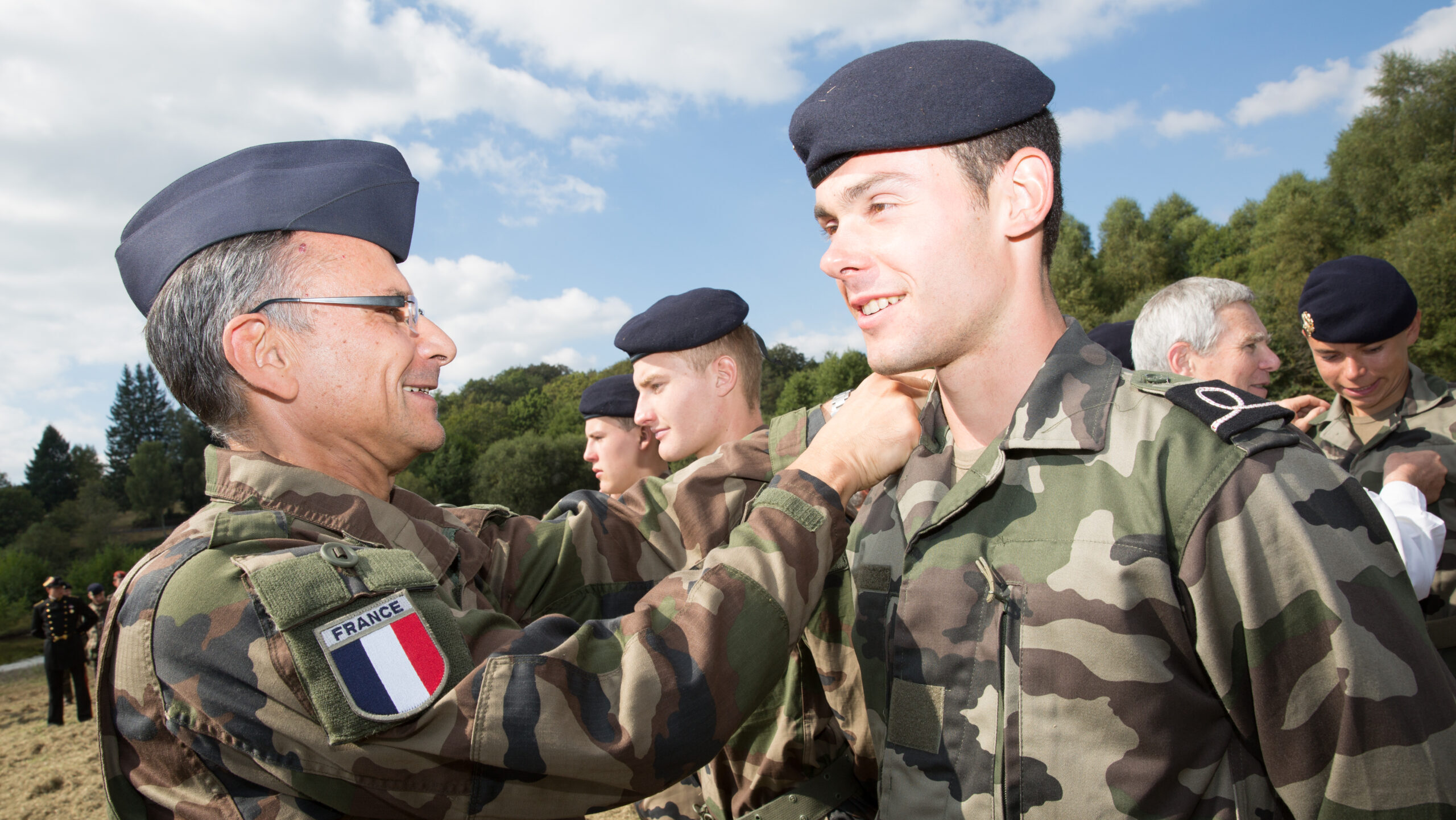
Initial military training for École Polytechnique students at the La Courtine military camp
Since President Jacques Chirac abolished compulsory military service almost thirty years ago, in 1997, many people in France have been calling for its return, in one form or another. Emmanuel Macron seems determined to take this path and made the announcement on Thursday, November 27th, during a visit to the Varces military base in Isère. According to him, the deteriorating international situation and the fear of a Russian attack justify the return to military service, which would be on a voluntary basis.
Several options have been tried since 1997, including a universal civic service programme set up by Édouard Philippe in 2019, during Emmanuel Macron’s first term, aimed at all young people, girls and boys, aged 15 to 17, to offer them a “great collective experience.” The formula has never been considered very convincing, either by the political class or by the French people, who have long been, according to opinion polls, largely in favour of reinstating military service in its previous form—around three-quarters of French people, according to the latest polls.
During a visit to a mountain infantry regiment, Macron announced the introduction of a ten-month military service for both girls and boys, on a voluntary basis, starting in the summer of 2026. This service will be “exclusively military,” unlike the universal civic service, and will take place only on national territory. As a result, universal civic service, now considered unsuitable, will be abolished.
The scheme will be phased in gradually: in the first year, it will involve 3,000 young people, with a target of 10,000 per year by 2030, then an ambition of 50,000 by 2035. Volunteers will receive a minimum salary of €800 per month, as well as accommodation, food and equipment. Of the ten-month commitment, one month will be devoted to training, and nine months will be spent in the units.
He explained that in a major crisis, the contingent could be expanded to include people who had not volunteered. This defence effort will be financed by the update of the 2026-2030 defence spending plan, which provides for an additional €2 billion to be devoted to national service.
General Vincent Desportes, former director of the War College, interviewed by Europe 1 during the President’s trip, justified the President’s decision by citing what he saw as the French population’s total unpreparedness for the new global security situation and the level of threats facing the country, foremost among which is the Russian threat. The challenge is to establish a “new model of army.” According to the officer, though the French army is considered one of the best and most effective in Europe, it is too small due to strategic and budgetary choices made in recent decades. But today’s threats require greater numbers.
During the interview, prompted by a listener who said he was in favour of military service with strict supervision for young offenders, the general refused to consider that military service could remedy all the ills afflicting French society today: delinquency, idle youth engaging in various types of criminal activity, and loss of values.
“Military discipline has a meaning, and that meaning is the nation,” he insisted. “You don’t build an army by recruiting only riff-raff,” he exclaimed. The lack of a sense of sacrifice and attachment to the nation is clearly the challenge facing this measure, which runs counter to years of public communication portraying the army as a civic or sporting commitment without consequences, sometimes even presented in a playful light—closer to a video game than to the Russian front.
The president’s announcement was obviously eagerly awaited, following the controversial remarks made by the Chief of Staff, General Fabien Mandon, who was suspected of wanting to send young French people to die in Ukraine in one of his latest public statements. Macron assured that there is a “strong desire for commitment” among young French people.
For his part, General Vincent Desportes insists that the main risk today is that there will be too many candidates rather than too few. But the 18-24 age group seems to be the least enthusiastic about the introduction of the measure. Le Parisien gave young high school students the opportunity to express their views on the prospect of a return to military service. The reactions are clear: “Fight against Putin? No way, that’s death,” exclaims one of them, while another does not want to end up as “cannon fodder.”
There is undoubtedly much to be done to rebuild a sense of military duty among young French people.