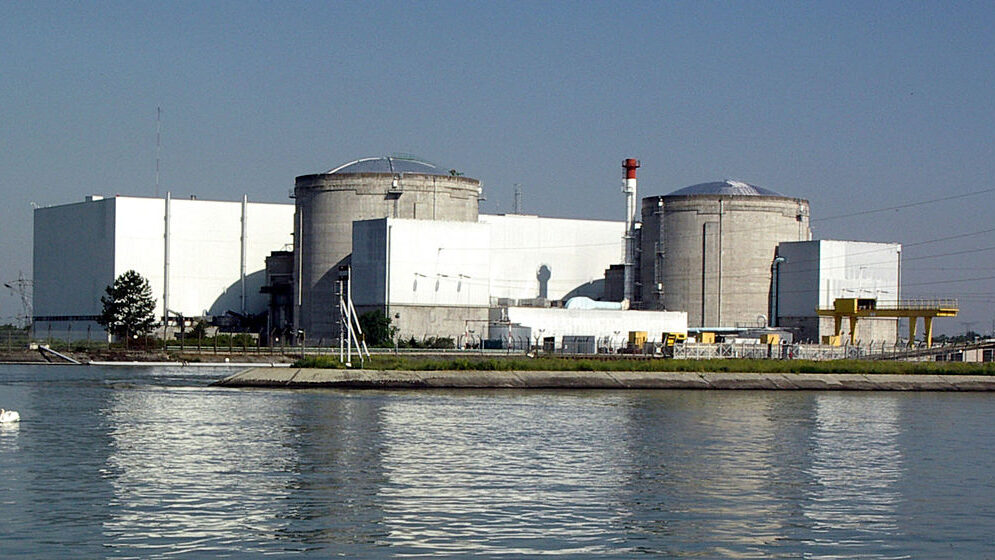
Nuclear power plant Fessenheim, Haut-Rhin, Alsace, France, in 2012.
César, CC BY-SA 3.0 <>, via Wikimedia Commons
On Tuesday, March 10th, the international summit on civil nuclear power opened in Paris, announced by President Macron during his speech on nuclear deterrence delivered on March 2nd at the Île-Longue naval base. After having been the architect of France’s abandonment of nuclear power, one of the country’s great successes, Macron is now forced to admit, in the words of Ursula von der Leyen, that he made a major strategic “mistake” by not committing wholeheartedly to the country’s nuclear future.
Social media is flooded with web archives of all the media and political footage in which the president, ministers, and advisers announced, during Macron’s first term of office, mainly between 2017 and 2019, to close nuclear reactors and end research programmes—in short, to abandon, with irresponsible enthusiasm, seventy years of French nuclear policy in the name of energy transition. Today, of the approximately 450 nuclear reactors in operation worldwide, 57 are French.
Quand E. Philippe affirmait vouloir fermer la centrale de Fessenheim et proposer de réduire la part du nucléaire à 50% d’ici 2035 avec le développement massif du renouvelable et de l’éolien.
— Bleu Blanc Rouge ! 🇫🇷 (@LBleuBlancRouge) March 11, 2026
Les archives sont cruelles, n’est-ce-pas @EPhilippe_LH ? 😉
pic.twitter.com/UydhZj2yfe
The start of the war in Ukraine in February 2022 forced Macron to rethink his plans. In September 2022, he announced his intention to double the pace of wind power development and to plan the construction of new nuclear reactors, with six EPR2 reactors to be built by 2035. It was about time—or too late. Other stimulus measures were added to the package: extending the life of existing plants, supporting smaller reactors, and modular reactors (SMRs), which are lower in power and easier to start up because they can be mass-produced in factories before being transported and installed on site.
Since the 2022 revival, no fewer than five nuclear policy councils have been organised by the Élysée Palace. Today, echoing von der Leyen’s admission of “strategic errors” at the European level on nuclear power, Macron is beating his breast: “We have been very bad,” he explained at the international summit, recalling that “nuclear energy gives us what our era needs more than ever: independence, resilience in the face of crises, competitiveness and the ability to meet our climate ambitions.” Very bad at the European level, and at the French level: it is therefore a question of making up for lost time.
To this end, on Thursday, March 12th, Macron staged a visit to Penly, in Normandy, where France’s largest industrial construction project in 30 years is due to start soon, with the construction of the first pair of EPR2 reactors. The site is ready, but construction is not due to start before 2029.
The estimate for the first six reactors was approved in December, at an estimated cost of €78 billion. The question is being raised at the highest levels of government as to whether to build four more—even though, for the time being, France has enough capacity to cope with a sharp rise in electricity demand. The government is also working on another strategic objective: to “close the fuel cycle” by 2100, i.e., to guarantee France complete sovereignty over nuclear power by freeing itself from any supply of natural uranium, thanks to the ability to run the future generation of French nuclear reactors solely on its own waste (plutonium and depleted uranium). This involves the construction and commissioning of fourth-generation reactors. The Astrid programme, which was halted in 2019, had already made some progress in this direction. Its shutdown was met with widespread criticism from political and scientific circles—to no avail.
In French public opinion, the mood today is one of irritation, as energy bills continue to rise. The French are, on the whole, attached to nuclear energy, one of the last symbols inherited from the time when France gave itself the means to be a power. The return to an ambitious nuclear policy is therefore well received, but this is tempered by a feeling of immense waste, as Xavier van Lierde, editorialist on Radio Courtoisie, bitterly sums up:
My butcher, my grocer, my postman, my plumber, my own children and my children’s friends all knew that closing our nuclear power stations was a stupid move. They were all right, unlike the President of the Republic, the President of the European Commission, all the ministers, almost all the media and the whole bunch of pretentious pontificators in the so-called circle of reason.
What a waste of time. But resignation of those responsible is not on the menu.