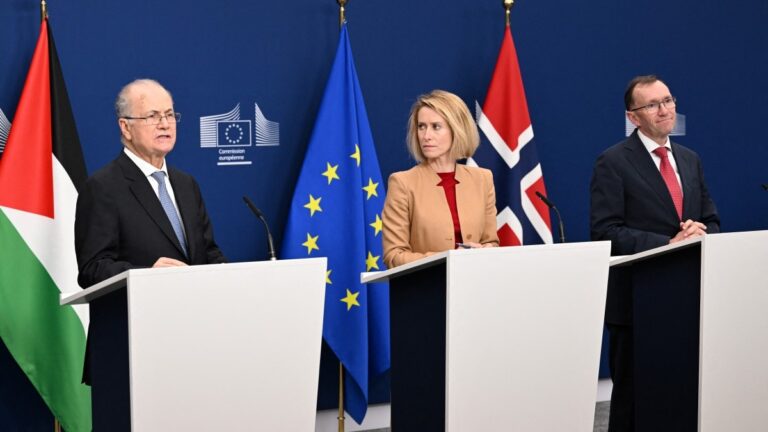
Manfred Weber (2L) embraces Ursula von der Leyen during the European People’s Party congress in Valencia
JOSE JORDAN / AFP
The European People’s Party (EPP) Congress, which began this Tuesday, April 29, in Valencia, started by reaffirming the status quo. The re-election of Manfred Weber as group president—with 502 votes in favor and 61 against—reflects both the lack of real alternatives and the consolidation of a leadership that keeps power firmly centered in Berlin.
The event, co-organized by Spain’s center-right opposition Partido Popular (PP), followed closely on the heels of a major power outage in Spain. With 800 delegates, 1,200 guests, and figures such as Ursula von der Leyen and Roberta Metsola in attendance, the meeting aims to show the party’s strength and defend its relevance at a time when more people are losing trust in EU leadership.
Weber, at the helm of the EPP since 2022, used his closing speech on the first day to celebrate the group’s recent electoral successes—including in Poland and Moldova—and predicted a future victory for the PP in Spain.
He also boasted about expanding the parliamentary bloc through negotiations with external parties, such as his recent visit to Hungary to use opposition leader Péter Magyar against national conservative prime minister Viktor Orbán—one of the few challengers to German power in Europe.
The Congress agenda includes key issues such as the conflict in Ukraine, the migration crisis, demographic decline, and economic competitiveness. Forza Italia, led by Antonio Tajani, presented a proposal for a “Pact for Competitiveness” aimed at reviving economic growth and addressing the housing emergency.
Congratulazioni Manfred per la tua riconferma come Presidente del Partito Popolare Europeo. Nel cammino di una costruzione comune dell’Europa, @forza_italia ti sarà sempre leale. Buon lavoro!#EPPCongress pic.twitter.com/pGzZ3ARI1C
— Antonio Tajani (@Antonio_Tajani) April 29, 2025
On migration policy, the EPP insists on “concrete and humane” solutions and new regulations on returns. Although security and order are discussed, root causes go unexamined.
It’s worth noting that these issues the EPP is set to ‘tackle’ have been created or encouraged by successive legislation approved or promoted by the EPP itself and its usual partners in Brussels and Strasbourg. In fact, the latest migration proposal is the very one for which Hungary has been fined and condemned.
The first day was also marked by speeches from Ukrainian leaders Petro Poroshenko, Yulia Tymoshenko, and Vitali Klitschko, who urged Europe not to fall for the “siren song” of compromise with Moscow. Although their speeches were applauded and well received, the EPP avoided any critical reflection on the limits of its own strategy for Eastern Europe.
With twelve candidates competing for ten vice-presidency positions, a distribution based on gender parity, territorial balance, and internal loyalties is expected this Wednesday, April 30. According to internal sources, voting formulas will allow some “flexibility” to exclude inconvenient candidates or those outside the party’s inner circle.
The first-ever election of a woman as Secretary-General is also expected—a gesture celebrated as a symbol of modernization, but one that seems more driven by external image requirements than by real transformation of the party’s internal culture. This woman is the Spaniard Dolors Montserrat who, according to party sources, does not have a good relationship with Esteban González Pons, the current head of the Spanish PP delegation in the European Parliament.
Despite the rhetoric about renewal, leadership, and solutions to Europe’s challenges, the day left the impression that the party moves more by the inertia of power than by any genuine drive for transformation.