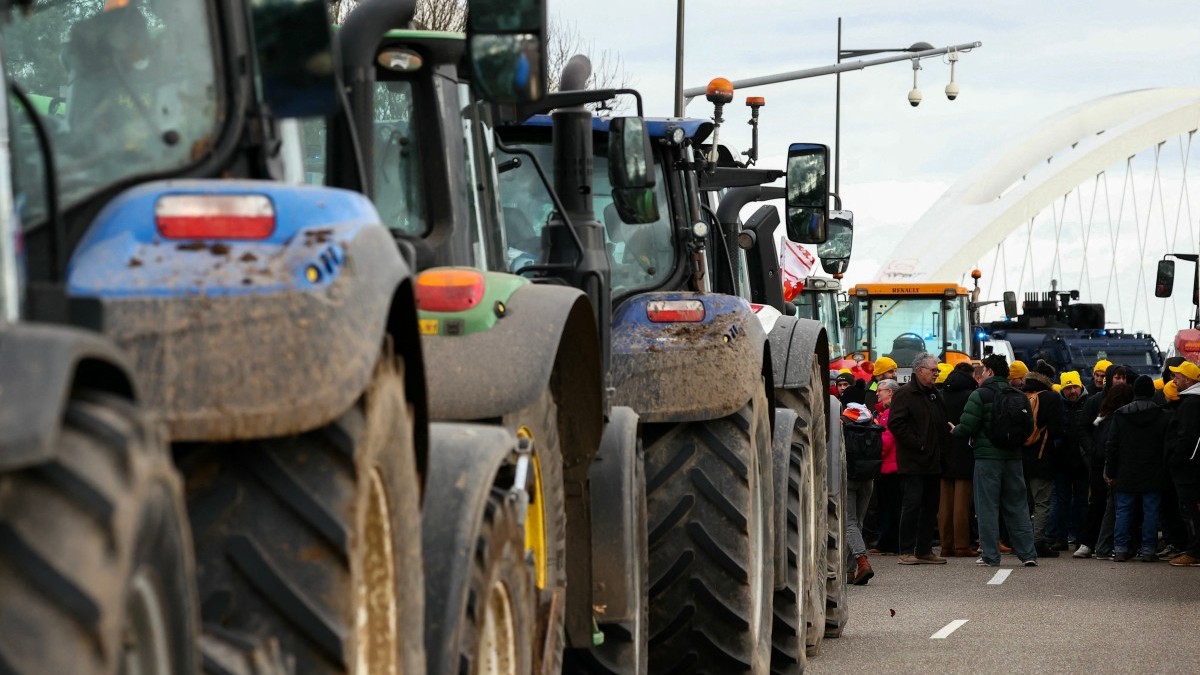
Tractors seen at the protest organized by the Coordination Rurale (CR) farmers union to push French government to block the Mercosur trade deal at the Pont de l’Europe in Strasbourg on January 9, 2026.
Frederick Florin / AFP
The European Union has approved the Mercosur free trade agreement, despite opposition from several member states and widespread concern over the deal’s impact on European agriculture. Poland, France, Ireland, Austria, and Hungary voted against the deal, warning that it would expose domestic farmers to unfair competition and threaten food sovereignty.
Patriotic European politicians have voiced strong criticism. Former Polish prime minister Mateusz Morawiecki wrote: “The EU–Mercosur deal is unfair competition for Polish farmers. Trade must be based on equal principles. The agreement threatens Polish food security. No to undermining our own agricultural production standards.”
Krzysztof Bosak, Member of Parliament and Deputy Speaker of the Sejm, added: “The EU Council has just accepted the deadly agreement with Mercosur for Polish agriculture … Donald Tusk bears full responsibility for the agreement with Mercosur coming into force and all the damage that will be inflicted on Polish farmers and Polish consumers as a result.” In another post, he warned: “The signing of the EU–Mercosur agreement carries serious consequences … Agriculture cannot be rebuilt overnight. If family farms collapse, Poland’s dependence on imports will become permanent.”
Robert Telus, former Polish Minister of Agriculture and Rural Development (PiS) stated: “WE SUPPORT THE FARMERS’ PROTEST…The EU–Mercosur agreement threatens the future of Polish farms. We want fair competition and protection for Polish food…Stop Mercosur!”
The announcement of the approval of the agreement came as over a thousand Polish farmers marched through Warsaw on Friday to protest against the trade agreement.
Hungarian politicians also expressed frustration over the deal. Minister of Agriculture István Nagy said: “We reject any agreement that threatens the competitiveness of Hungarian farmers,” adding that people’s daily bread cannot become part of political games. Kinga Gál, First Vice-President of the Patriots for Europe Group in the European Parliament criticized the Commission’s handling of the deal: “With the EU–Mercosur agreement, the von der Leyen Commission has once again abandoned European farmers. That is why Patriots [for Europe] will submit another motion of censure against the EU_Commission.”
Austria’s Freedom Party (FPÖ) leader Herbert Kickl commented: “Instead of forging an alliance against this madness, the farmers were betrayed and sold,” calling the decision a “poverty certificate” for the centre-right ruling party ÖVP.
In France, Rassemblement National (RN) MP Emmanuel Blairy warned: “Let’s not mention it to the farmers: Once we are entangled in a free trade agreement, it is difficult to get out of it! Emmanuel Macron must imperatively announce, if necessary, the suspension of our contribution to the EU budget!”
Irish MEP Ciaran Mullooly (Independent Ireland/Renew Europe) said the Mercosur agreement remains disastrous for farming, undermining food standards, environmental protections and the viability of family farms across Europe. He welcomed his government’s opposition to the deal and added: “This announcement proves one thing beyond doubt—people power works and pressure works. But let me be very clear: this deal is not dead. It has not been voted on. Nothing is done until MEPs vote in Strasbourg … Mercosur is a bad deal and it must be stopped.”