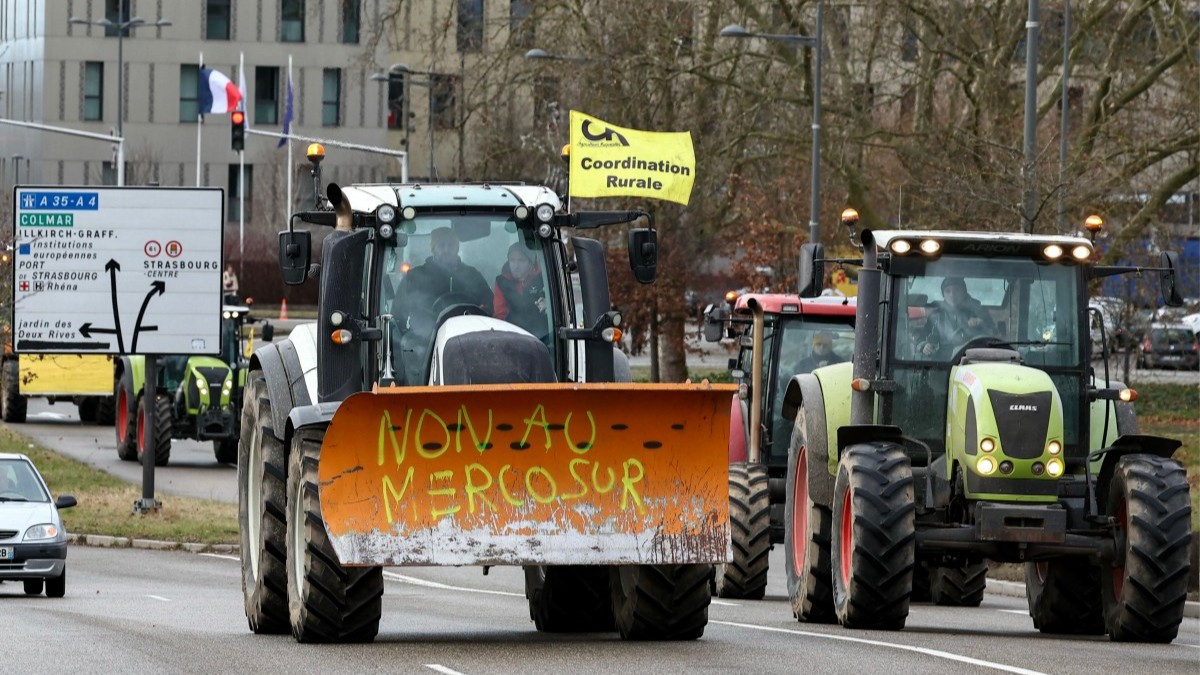
Farmers of the Coordination Rurale (CR) farmers union take part in a demonstration with their tractor to push French government to block the Mercosur trade deal and at the Pont de l’Europe in Strasbourg, eastern France on January 9, 2026.
Frederick Florin / AFP
This Friday, January 9th, a vote took place that allows the European Commission to sign the free trade agreement with Mercosur. In an official statement, French President Emmanuel Macron had announced his intention to vote against it. The symbolic gesture was destined to have no concrete effect, prompting the Rassemblement National (RN) on the Right and La France Insoumise (LFI) on the Left to put forward a motion of no confidence against the government in Paris. The RN has also announced its intention to push one against the Commission in Brussels.
Since Italy announced its support for the agreement at the last minute, France found itself isolated in its opposition, alongside Ireland, Poland and Hungary. The discontent of French farmers continues to be felt with the same intensity, as demonstrated by the demonstrations organised in Paris on January 8th.
In the official Élysée communiqué, the President was keen to highlight the improvements obtained by France in the negotiation process. Commission President Ursula von der Leyen has proposed to release an additional €45 billion for the Common Agricultural Policy from 2028, which will guarantee that the current level of aid is maintained until 2034. The European Commission has also committed to lowering customs duties on nitrogen fertilisers and ammonia and to suspending the carbon border tax on fertilisers. Macron welcomed these advances but acknowledged the “unanimous political rejection of the agreement” in France.
Macron’s statements have failed to convince the opposition. For the RN, Macron’s opposition to the treaty is feigned and opportunistic: the president had openly supported the opening of negotiations several years ago. He was unable to build a blocking minority around him to oppose the deal, so his last-minute vote was therefore nothing more than a “stunt” with no consequences.
The RN, through Jordan Bardella, has therefore announced its intention, as a sign of protest, to put forward a motion of no confidence against Sébastien Lecornu’s government in Paris. This move will be accompanied by another, in Brussels, against Ursula von der Leyen’s Commission. The RN president denounced the hypocrisy of the head of state on X on Thursday:
“By claiming to oppose it today, after years of negotiations without ever defending French interests, he is attempting a communication manoeuvre that is as belated as it is hypocritical.”
Emmanuel Macron sait que l’accord du Mercosur sera adopté, quoi qu’il arrive et quel que soit le vote de la France.
— Jordan Bardella (@J_Bardella) January 8, 2026
En prétendant aujourd’hui s’y opposer, après des années de négociations sans jamais défendre les intérêts français, il tente une manœuvre de communication aussi…
The RN is joined in its approach by LFI on the Left, which considers Macron’s objection to be nothing more than “artifice.” A motion of no confidence was proposed on Friday, January, 9th by Jean-Luc Mélenchon’s party, with two grounds for protest: the now inevitable ratification of the Mercosur deal and Venezuela. “France humiliated in Brussels but also in Washington, that is the disastrous record” of President Emmanuel Macron, according to the signatories of this motion.
By announcing his vote against the text, in line with the majority opinion in France, Macron hoped to prove his good faith and save the government, at a time when the country has still not managed to adopt a budget. This was clearly not enough.
The Mercosur affair has turned into a cruel indictment of all his actions. He has failed to convince France of the potential benefits of the deal or to block it in Europe, further weakening his already highly contested position—including among his European centrist allies, who criticise his inability to find compromises. On the French side, the lesson learned is that Brussels is definitively acting against Paris’s interests.