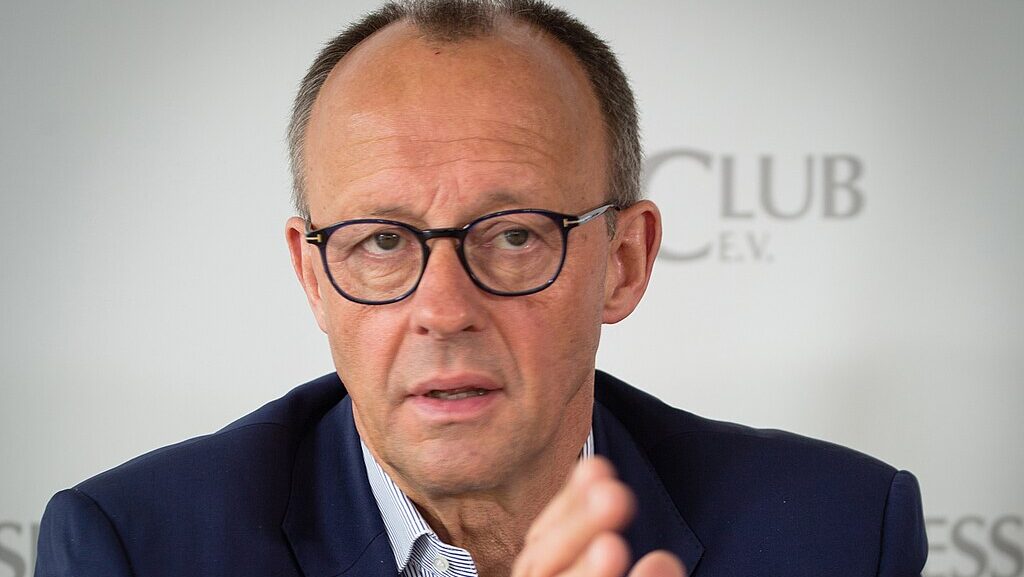
Friedrich Merz
Michael Lucan, CC BY-SA 3.0 DE via Wikimedia Commons
Chancellor Friedrich Merz has called for the establishment of a single European stock exchange, signaling German support for plans to unify the bloc’s capital markets.
“We need a kind of European stock exchange so that successful companies such as biotech firms from Germany do not have to go to the New York Stock Exchange,” said Merz in a speech to the Bundestag on Thursday, October 16th. “Our companies need a sufficiently broad and deep capital market so that they can finance themselves better and, above all, faster.” His remarks were part of a broader vision for deeper EU integration, framed as a way to enhance Europe’s global competitiveness but revealing Germany’s growing commitment to centralizing financial and regulatory authority at the European level.
Merz’s comments come as his government recently agreed to intensify collaboration with France to advance the EU’s capital markets union, including by handing over power to a single European supervisor—a sharp turn from Berlin’s previous reluctance to transfer such authority to EU bodies. EU plans for capital markets integration have long stalled, in large part due to Germany’s opposition to shifting supervision from the Bonn-based BaFin to the European Securities and Markets Authority in Paris. Other countries, including Luxembourg and Cyprus, also resist such centralization, fearing the erosion of national regulatory sovereignty. Yet Merz’s new stance suggests that Germany is now prepared to trade that sovereignty for a unified European structure, effectively accelerating the loss of economic independence among member states.
Stéphane Boujnah, CEO of Euronext—the pan-European stock exchange and market infrastructure group operating regulated markets across several European countries—quickly expressed support for Merz’s proposal, aligning with the German Chancellor’s call for a single European stock exchange.
“Euronext has always been driven by the strong conviction that in Europe it’s always possible to succeed together rather than fail separately,” Boujnah said in an emailed statement. He added that Euronext is prepared to “contribute to the next level of consolidation of markets in Europe to create a deeper liquidity pool to finance the growth of European companies.” Like Merz, Boujnah framed the initiative as a path toward growth and resilience but also called for “a decisive move towards single supervision within the European Securities and Markets Authority,” arguing that diverging national regulations and oversight remain key obstacles to a real savings and investment union.
At first glance, Merz’s argument for cutting red tape and fostering competitiveness appears sensible. He echoed Draghi’s call for “an end to the regulatory frenzy, faster procedures, open markets, more innovation, more action instead of hesitation.” However, the contradiction at the heart of his position is impossible to ignore. Even as he condemns overregulation, he continues to endorse the very ideological framework that fuels it—the EU’s climate agenda, green industrial policies, and interventionist economic governance. Merz’s pursuit of a centralized and politically directed economy under the banner of competitiveness reveals the limits of his reformism.
The rhetoric of efficiency and productivity conceals the deeper cost of Germany’s shift toward integration: a Europe where financial and regulatory power is increasingly concentrated in supranational hands, leaving less room for national economic diversity and self-determination. By binding Europe’s financial future to a single market overseen by a central authority, Berlin and Paris risk building an economic system that may be more uniform, but not necessarily more dynamic.
Merz warns that Europe must act “with renewed vigor” or risk becoming “a plaything of major economic centers in Asia and America.” Yet if his vision is realized, Europe may instead become a plaything of its own bureaucratic machinery—centralized, overregulated, and ideologically constrained. The Chancellor’s ambition to make Europe more competitive through integration and deregulation cannot succeed so long as it remains rooted in the same centralizing logic and ideological commitments that have long stifled Europe’s economic vitality.