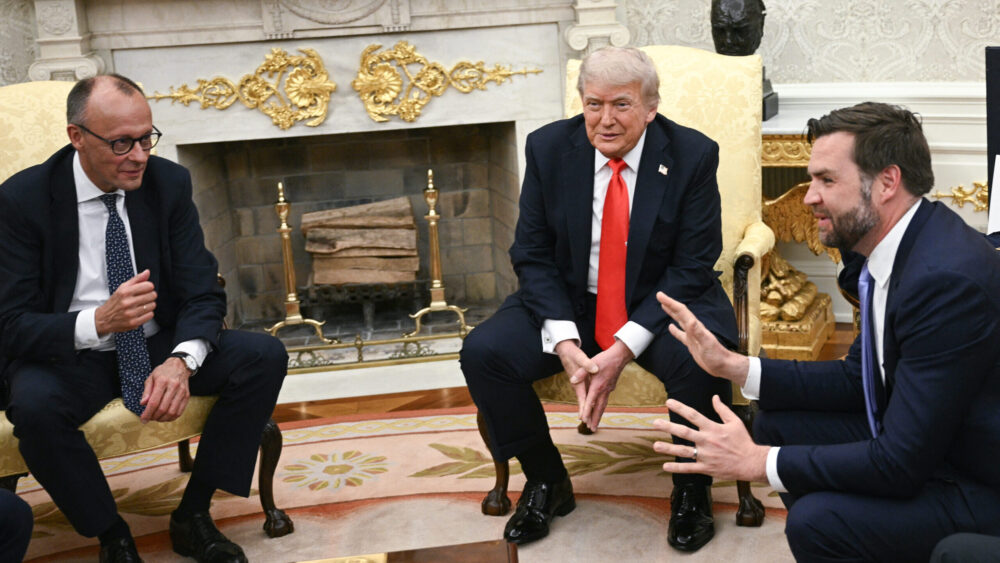
US Vice President JD Vance (R) speaks as President Donald Trump (C) and German Chancellor Friedrich Merz (L) look on during a bilateral meeting in the Oval Office of the White House in Washington, DC, on June 5, 2025.
Brendan SMIALOWSKI / AFP
In his first visit to Washington as chancellor, Germany’s Friedrich Merz sidestepped the fireworks many expected—delivering instead a gift for Donald Trump and a diplomatic show of unity. In an international context marked by rising tensions and multiple ongoing crises—particularly regarding trade tariffs and the war in Ukraine—the meeting between the two leaders unfolded in a friendly tone, with symbolic gestures and a pragmatic approach.
Merz arrived at the Oval Office bearing an unusual gift: the birth certificate of Trump’s paternal grandfather, Friedrich Trump, born in Bavaria in 1869. The American president welcomed the gesture, thanked him, and described it as “beautiful.”
The German chancellor recalled that his previous visit to the White House had been in his youth, when Ronald Reagan was president, and used the occasion to commemorate the anniversary of D-Day. Trump did not hesitate to drop a smaller bomb on Merz, asking “That was not a pleasant day for you?” The German chancellor was forced to correct the record by thanking U.S. troops for their role in the liberation of Europe.
Despite these few moments of drama, the conversation proceeded peacefully, although many expected a heated exchange due to Trump’s well-known style and Merz’s previously critical tone when referring to the U.S. leader. The chancellor quickly forgot about his previous comments about Vice President JD Vance’s “almost invasive” ‘interference’ in the German elections or how vocal he was about his support for former U.S. VP Kamala Harris.
Merz’s double talk should be outed while in the U.S. this week.
— Richard Grenell (@RichardGrenell) June 4, 2025
Be clear, Friedrich.
Germans and Americans want authentic leaders – transparency is crucial in a world filled with chaos. https://t.co/U6GbVCkXJq
During the meeting, Trump stated that the relationship with Germany would remain strong and expressed his willingness to reach a new trade agreement between the U.S. and the European Union. “We’ll have a good trade deal. I guess the EU will mostly determine that, but you’re an essential part of it,” said the president. Although he reiterated that he’s still open to imposing tariffs if a deal isn’t reached before July 9.
On security and defense, Trump praised Germany’s increased military spending and described Merz as a “tough” leader. The chancellor addressed European support for Ukraine, reiterating the need to back Kyiv against Russian aggression. He stated that “the Ukrainians only attack military targets” and, unlike the invader, “do not target civilians or energy infrastructure.” Trump did not go into detail but insisted on his desire “to stop the killing.” Here, the intentions of the two leaders diverge. While Europe continues its escalation against Russia—a path initiated by the previous U.S. administration—Trump wants to pull back from what he sees as a dead-end and focus on more strategic regions like the rest of the American continent and Asia, where China is his true rival.
Although Merz has previously been critical of Trump’s foreign policy and has called for greater European strategic autonomy, the tone of this visit remained moderate. Merz, who took office just a month ago—barely managing to get past the parliamentary vote—, stated before the meeting that he expected to discuss topics such as tariffs, NATO, and Ukraine. However, he acknowledged that breakthroughs were unlikely during this first encounter.
Regarding European influence in the United States, Giorgia Meloni remains one of the most visible figures. Based on ideological and political alignment, the Italian prime minister has cultivated a close relationship with Trump. However, Merz’s visit suggests that Germany can maintain an effective and respectful dialogue with the U.S. administration, even during strategic adjustment and change.