George Simion
Daniel MIHAILESCU / AFP
The first round of Romania’s repeat presidential election ended with results very similar to November: a nationalist victory, and a pro-EU anti-establishment candidate in second place moving to the runoff. Meanwhile, the ruling establishment parties failed to advance by a tiny margin—which many believe was the real reason behind the original election being annulled.
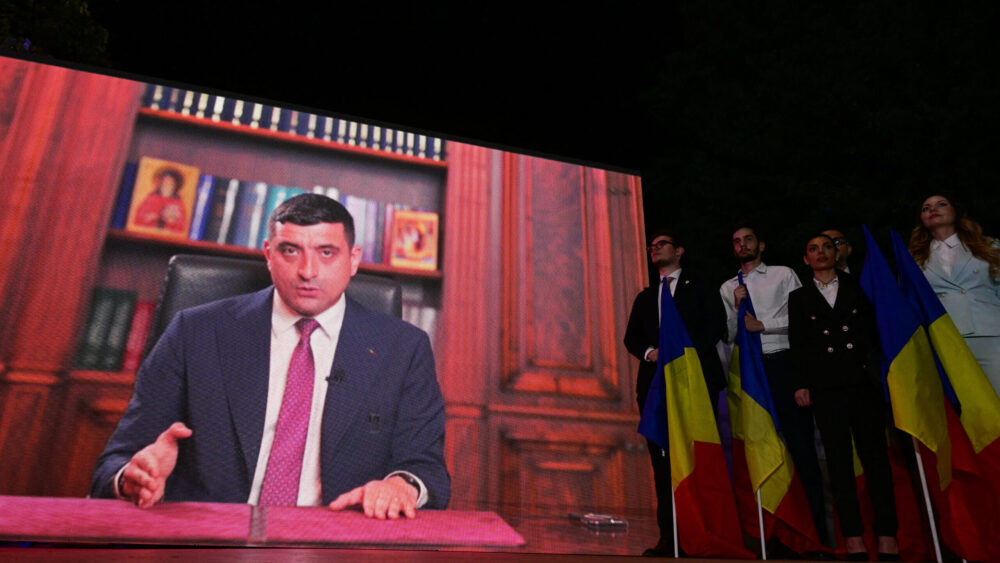
George Simion, the leader of the nationalist AUR (ECR)—who took up the mantle of the previous frontrunner, Călin Georgescu, after he was banned from running—took home the win in a landslide, with nearly 41% of the votes. That’s nearly double the results of Georgescu’s from last year, who won the annulled first round with 23%, showing how counter-productive canceling elections and “far-right” candidates is.
Simion was congratulated by national conservative and sovereigntist leaders from across Europe, including by the European Conservative and Reformist (ECR) group, who stand to gain their third member in the European Council (besides Italian PM Giorgia Meloni and Czech PM Petr Fiala) if the AUR president can emerge victorious from the second round in two weeks.
ECR Group Co-Chairmen @NProcaccini and @PatrykJaki congratulate @georgesimion on leading the first round of Romania‘s presidential race. pic.twitter.com/XbvXHkPAWE
— ECR Group (@ecrgroup) May 4, 2025
Simion’s victory did not come as a surprise, as it was predicted by virtually every poll leading up to the election, although not by such a large margin. So the real question was about who he would have to face off in the runoff on May 18th.
Most of the polls predicted that it would be Crin Antonescu, the joint candidate for the ruling establishment parties, the socialist PSD (S&D) and the center-right PNL (EPP). Antonescu was comfortably leading the race for second place all throughout the evening, only to fall to third place with 20% around midnight, after 97% of the votes had been counted.
So, the big surprise winner of the day became Bucharest’s independent reformist mayor, Nicușor Dan, who was pushed to 21% with the late addition of the diaspora votes. Dan is a co-founder of the liberal, anti-establishment USR (Renew), and even though he quit years ago, the party leadership endorsed his candidacy in the final leg of the race. In turn, USR leader Elena Lasconi—who won second place back in November but now has found herself abandoned by her own party—finished in 5th place with less than 3% and has since resigned as party president.
The fourth place went to former socialist PM Victor Ponta, one of the most divisive characters in Romania’s political history. Ponta was recently kicked out of PSD and reinvented himself as a “sovereigntist,” hoping to capitalize on the Georgescu scandal and snatch voters from Simion. In the end, his scheming did not achieve the desired results, but his message still resonated with a surprising number of voters, giving him 13%.
Romania, Preliminary final results:
— Europe Elects (@EuropeElects) May 5, 2025
Presidential election, first round today
Simion (AUR-ECR): 40.9% (+0.6)
Dan (*-RE): 20.9% (+0.1)
Antonescu (PSD/PNL/UDMR-S&D|EPP): 20% (-0.4)
Ponta (*-S&D): 13% (-0.3)
Lasconi (USR-RE): 2.6%
Şandru (PUSL~S&D): 0.6%
Funeriu (*-EPP): 0.5%… pic.twitter.com/4tbFFFPxh3
Now, the million lei question is who will win the second round—and nobody seems to have a definitive answer.
On the one hand, all ‘pro-EU’ parties are expected to rally behind Dan against the nationalist side to prevent a Simion presidency, pushing the liberal mayor close to 50%. On the other hand, if Ponta decides to endorse Simion, the joint sovereigntist side could easily snatch victory—something that would have hardly been possible without the annulled election.
But Ponta remains unpredictable. Throughout the campaign, he positioned himself against all three other camps, simultaneously courting both AUR’s nationalists and long-time socialist voters, and even seeking support from his former comrades in PSD. He would likely stay neutral by delaying endorsement, which could cause his voters to split, with the majority going with Simion.
This scenario is certainly what bookmakers expect, with the leading Polymarket putting Simion’s chances for victory at 69%, and Dan’s only at 31%. Polls predict a different outcome, though, with the last major survey published just before the Sunday election showing Dan defeating Simion by 40% against 37%.
In either case, it’s clear that Romanians had had enough of the political stagnation of the last three decades, and being ruled by an effective two-party system that is only interested in upholding the status quo.