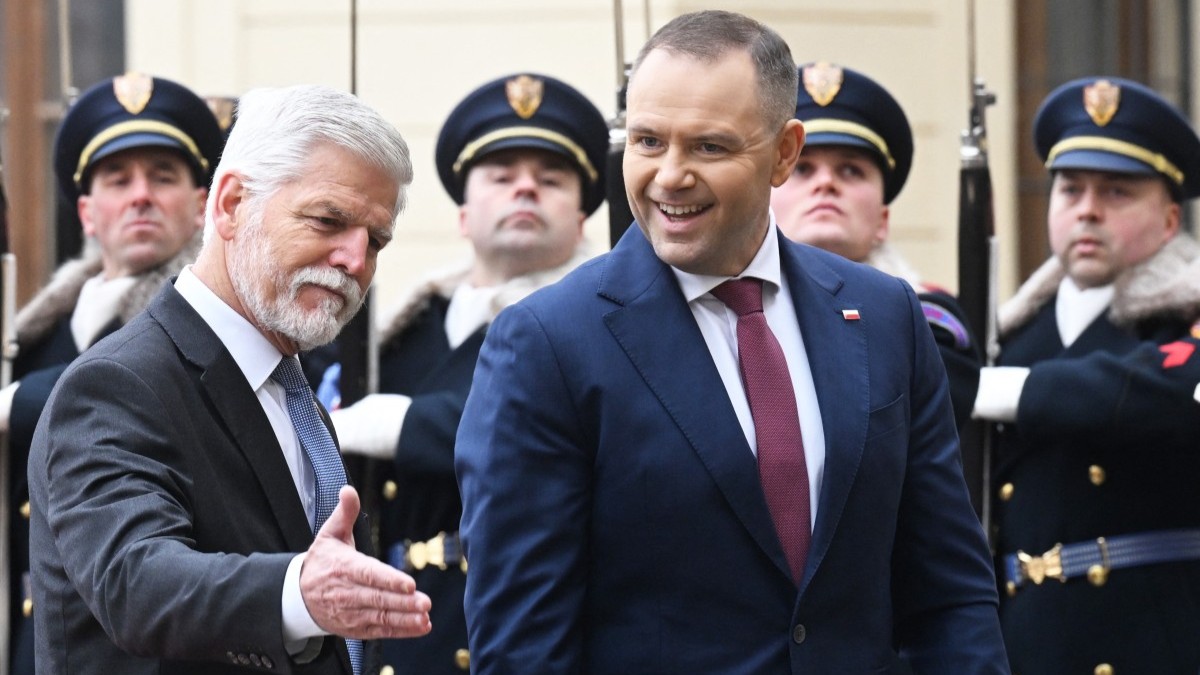
Czech President Petr Pavel (L) and Polish President Karol Nawrocki (R) review a military honor guard in front of the Prague Castle in Prague, Czech Republic, on November 24, 2025.
Michal Cizek / AFP
Polish President Karol Nawrocki’s state visit to Prague on Monday, November 24th has injected new momentum into efforts to rebuild Central Europe’s once-influential Visegrád Group (V4), as political shifts in the region open a potential path to renewed cooperation.
Received at Prague Castle by Czech President Petr Pavel, Nawrocki used the occasion to underline his commitment to strengthening regional formats such as the V4 and the Three Seas Initiative.
“Our conversation was an opportunity to address the most important matters—Europe’s security, the V4 format, the Three Seas Initiative, economic cooperation, and infrastructure development,” Nawrocki wrote on social media after meeting Pavel.
Prezydent RP @NawrockiKn w #Praga: Bardzo dziękuję @prezidentpavel za zaproszenie. Cieszę się, że mogę odwiedzić Pragę wskazując na rzeczy, które nas łączą. Nasza rozmowa była okazją do odniesienia się do spraw najważniejszych – bezpieczeństwa Europy, formatów V4 i Inicjatywy… pic.twitter.com/eY4EQIN2Gg
— Kancelaria Prezydenta RP (@prezydentpl) November 24, 2025
The visit to Czechia formed the second leg of an intensive diplomatic tour across the V4 countries. Nawrocki had travelled to Slovakia in early November, and will conclude the circuit in Hungary on December 3rd where he will meet the other V4 heads of state.
The political landscape in Central Europe has shifted markedly since October’s Czech parliamentary elections, which saw Andrej Babiš’s ANO win decisively and sign a coalition agreement with parties critical of the EU’s centralised approach.
Both Babiš and Slovak Prime Minister Robert Fico have voiced hopes that the V4 can be restored after years of stagnation under the outgoing Europhile Czech government and the current pro-EU Tusk government in Poland.
As Fico recently said: “The V4 should return to where it once was. I think it’s no secret that the V4 was one of the most important forms of regional cooperation—a format that was capable of influencing European Council decisions.”
Hungary’s Viktor Orbán has similarly argued that a sovereignty-focused Central European bloc is essential to resisting EU overreach on issues such as migration quotas.
While Donald Tusk remains aligned with Brussels, Nawrocki—a conservative and an ally of Orbán—appears determined to keep Warsaw engaged.
He acknowledges significant disagreements with Budapest, Bratislava and soon-to-be-Babiš-led Prague over Ukraine, insisting, however, that cooperation should not collapse over this dispute.
As Marcin Przydacz, the head of the Polish president’s International Policy Bureau recently noted, “international politics is not only about what connects or divides,” adding that the V4 countries still maintain close cooperation in economic, cross-border, and energy-security matters, and they all have a shared interest in stopping the EU’s centralisation efforts—for example, they are preparing to build a joint alliance against the migration pact.
In a recent interview, Nawrocki argued that many of the crises that have engulfed Europe in recent years could have been avoided if Western European leaders had heeded warnings from Central and Eastern European states and allowed open debate.
I understand my role as president of Poland not as someone who questions our presence in the European Union, but as a leader who, based on the countries of our region, our sensitivity and emotions, will build a stronger Poland in the European Union, also listening to those countries which warned about the Union’s biggest crises.
The upcoming V4 summit of the V4 heads of state to be held in Esztergom, Hungary could therefore mark the first step toward a revitalised alliance. Whether this emerging alignment becomes a genuine counterweight to Brussels will depend on how far the region’s leaders can balance unity with divergent strategic priorities—particularly over Russia’s war in Ukraine.