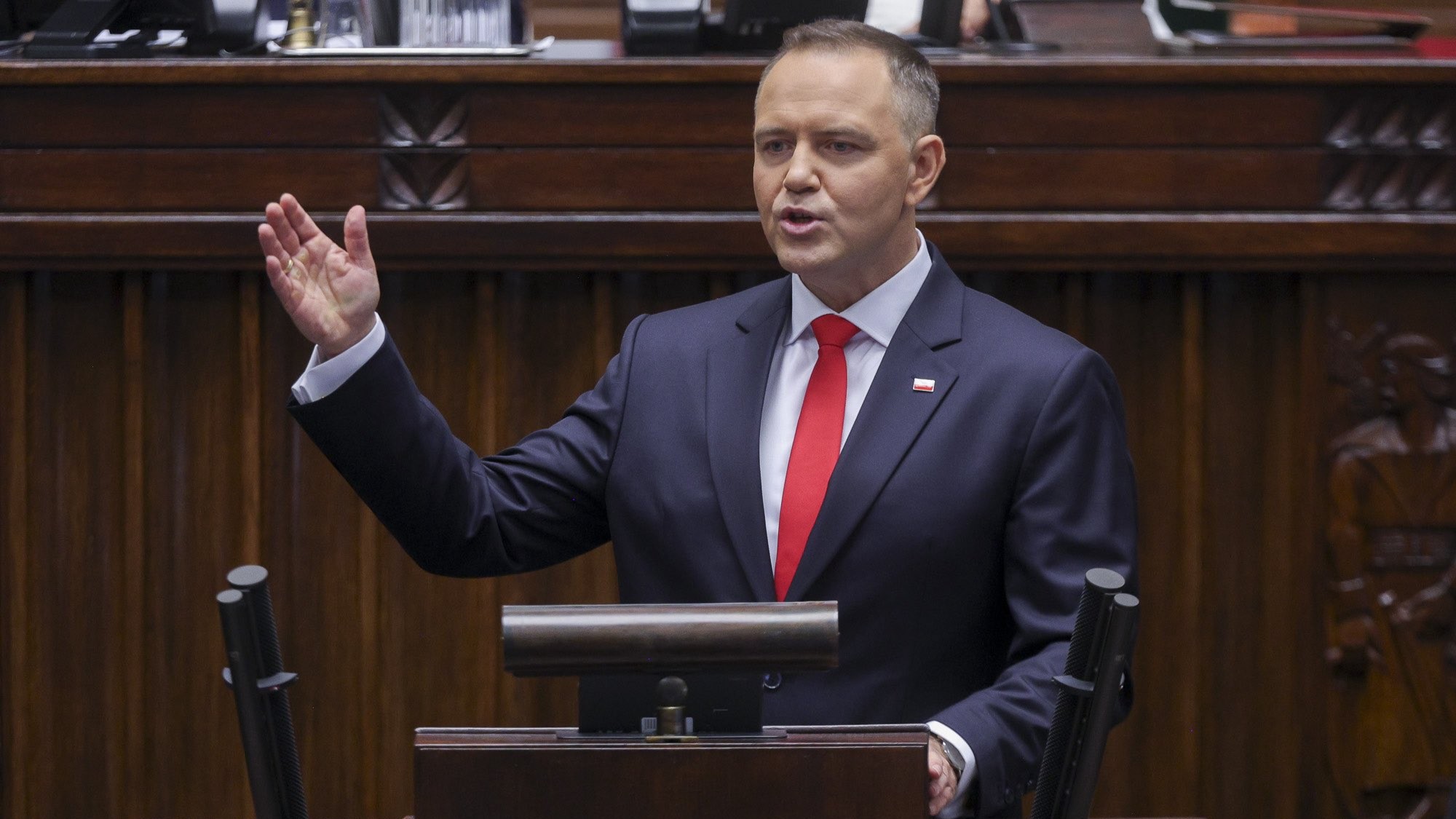
Polish President Karol Nawrocki gives his first speech to the Sejm after his inauguration.
@pisorgpl on X, 6 August 2026
On Wednesday, August 6th, Karol Nawrocki was officially sworn in as the 7th President of Poland since the fall of communism, marking both a major political shift and the first step toward returning to the national conservative governance that characterised Poland for much of the past decade.
Nawrocki—not officially a member of any party but supported by the conservative PiS (ECR)—secured 50.9% of the vote in a tightly contested runoff in early June against liberal Warsaw mayor Rafał Trzaskowski, the vice-chairman of PM Tusk’s ruling Civic Platform (EPP) and a staunch advocate of closer EU integration.
The victory of the 42-year-old historian came as a shocking blow to the ruling coalition, whose candidate was favored by most polls throughout the campaign. In the end, however, millions of Poles decided to rally around the simple yet powerful message of Nawrocki: return to a Poland that is free, strong, and faithful to its roots.
On Wednesday, he posted a single image from the inauguration ceremony, accompanied by the words: “So help me God.”
Tak mi dopomóż Bóg 🇵🇱 pic.twitter.com/QwqXr38CFr
— Karol Nawrocki (@NawrockiKn) August 6, 2025
In his first speech as president, Nawrocki was careful enough not to go into party politics, talking about values that unite the nation instead, and the people—instead of elites—who are the true source of democratic power.
“Despite the lies and propaganda, the free choice of a free nation has placed me before you today,” he said. “The President of the Republic of Poland must be the voice of the citizens of the Republic of Poland. I will be that voice!”
The fight for national sovereignty at a time of the EU’s increasingly hostile takeover of member state competences—enabled by mainstream leaders such as Tusk—was also a major issue during the campaign. When talking about foreign policy in his speech, Nawrocki was crystal clear. Cooperation? Yes. Submission? Never.
“Poland is not the European Union,” the president declared. “Poland is Poland, and it will stay that way.”
The message was hardly lost on the Tusk government, which is often accused by the conservative opposition of not willing to defend the country’s interests from Brussels’ overreach, but instead submitting to the will of old allies, EU Commission chief Ursula von der Leyen and the rest of the Brussels elite.
Besides, the government has been struggling to find footing ever since Nawrocki’s victory. The defeat deepened existing fault lines between the members of the diverse rainbow coalition—counting parties from center-right to far-left—and not even Tusk’s recent cabinet reshuffle seems to be able to quell these internal conflicts.
If rumors circulating in Polish media are true, Tusk could be on the brink of calling early parliamentary elections as soon as next year, which could provide an opportunity for the conservative PiS to retake the government.
But even if Tusk somehow survives the remaining two and a half years of his term, his job is only going to be harder from now on. Nawrocki—just like his predecessor, President Duda—is expected to block many of the most radical progressive reforms that Tusk plans to implement, whether it’s about same sex marriage or abortion liberalization.
This will only further the dissatisfaction with the prime minister within his camp, which may predict that the road for the PiS comeback will likely be open by November 2027 at the latest.