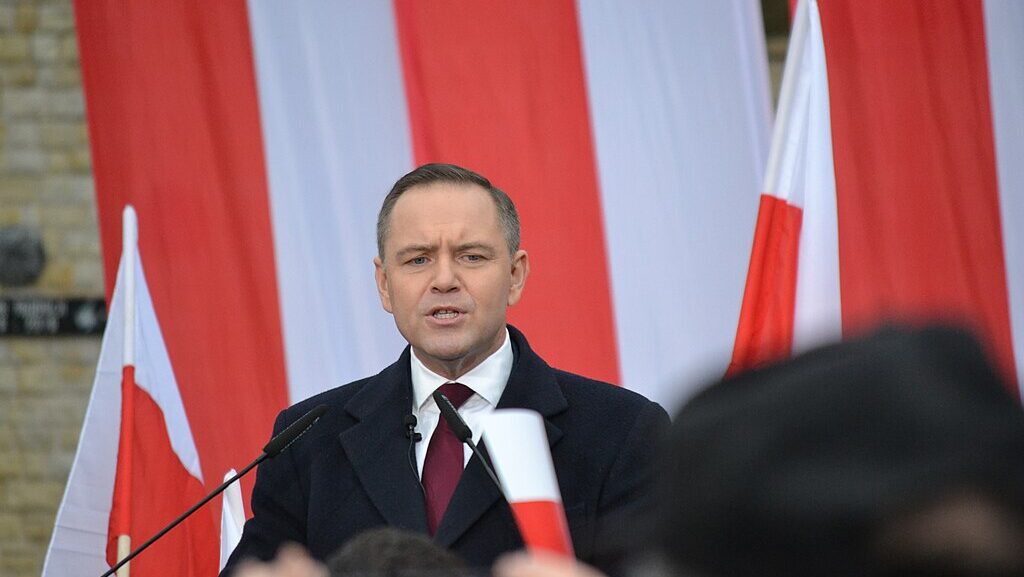
President Karol Nawrocki
Marsilar, CC BY-SA 4.0, via Wikimedia Commons
On September 29th, the Polish Constitutional Tribunal struck down the so-called hate speech act, ruling it unconstitutional. The Tribunal concluded that the legislation represented “improper interference with the constitutionally protected freedom of expression.”
Following the court ruling, President Karol Nawrocki announced he will not accept the hate speech legislation passed by parliament. His decision makes it certain the measure will not advance, as the government lacks the three-fifths parliamentary majority needed to overturn a presidential veto. Opposition parties Law and Justice (PiS) and Confederation have also opposed the law.
The current government, a coalition led by liberal pro-EU prime minister Donald Tusk, does not recognize the Constitutional Tribunal’s legitimacy, as it claims that some of the judges were unlawfully appointed by the former PiS administration. The government will therefore not publish the ruling—which enters into force upon its publication—but that does not prevent the president from relying on it for his decisions.
The hate speech act, passed by parliament in March, sought to broaden the catalogue of hate crimes by adding four new grounds: age, gender, disability, and sexual orientation. Its purpose was to ensure that hate crimes based on these characteristics would be prosecuted ex officio by public authorities, rather than requiring a private indictment.
The proposal followed lobbying from LGBT activists and was viewed as a compromise after the ruling coalition failed to reach agreement on civil partnership legislation for same-sex couples.
However, the Constitutional Tribunal deemed the amendments “inextricably linked to the entire act” and therefore unconstitutional. In its justification, the court warned that the discriminatory grounds were “imprecisely defined” and susceptible to “overly broad” criminalization of speech. It added that the vague wording made “the line between legal criticism, jokes, polemics, and crimes elusive.”
The Tribunal further stressed that while offensive statements cannot be tolerated, restricting expression with vague prohibitions undermines fundamental rights: “Restricting the freedom of expression by establishing types of prohibited acts with insufficiently defined characteristics violates the constitutional freedom of speech,” the ruling states.
The court also warned that criminal law risked being distorted. Instead of being “the last resort used solely to combat the most serious forms of hatred or violence,” it could become “a tool for censoring speech that was not intended to be discriminatory.”
“The constitutional court … sided with freedom of speech,” said Zbigniew Bogucki, head of the Chancellery of the opposition Conservatives. Bogucki had earlier argued that the vagueness of the definitions would ultimately stifle debate and may lead to a shallow “political correctness that we will not be able to express our views, even if they are not negatively marked.”