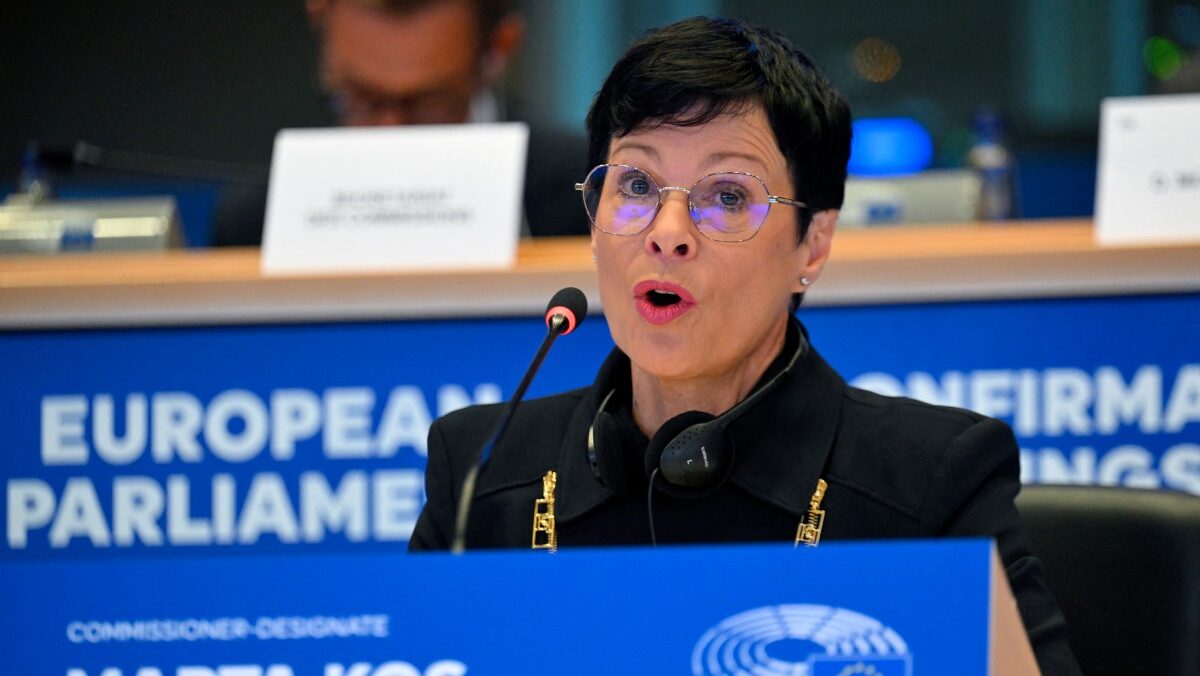
EU Enlargement Commissioner Marta Kos
Nicolas Tucat / AFP
In an April 28th interview with Radio Free Europe (RFE)/Radio Liberty, EU Enlargement Commissioner Marta Kos doubled down on the Brussels rhetoric that Hungary is somehow wrong when asking Kyiv to restore the full rights of the Hungarian ethnic community in Transcarpathia.
Speaking on the broader issues of Ukraine’s and Moldova’s accession, she remarked on Hungary blocking Ukraine’s integration into the Union, suggesting that “Ukraine has done enough” in terms of the situation of Transcarpathian Hungarians. She even claimed she was speaking out of “personal experience” because she was “facilitating the dialogue between Hungary and Ukraine. And there were many points, and Ukraine is willing to fulfil all of them. But this is not enough for Hungary.”
Well, Kos is not wrong in the sense that Kyiv has been claiming for at least two years now that it is willing to restore the rights of the Transcarpathian Hungarian community (which RFE keeps describing as “the Hungarian-speaking community”).
But no action has followed so far, and therefore Budapest is demanding that the Ukrainians act on their promises before the Hungarian government consents to their accession.
This is not the first time Kos has declared that Ukraine “has done enough.” Recently, Viktória Ferenc, an MEP from Hungary’s ruling Fidesz party (Patriots) said in a statement that representatives of the European Parliament’s foreign affairs and budget committees had an exchange of views with Kos on the so-called Ukraine Instrument, which supports Ukraine’s recovery, reconstruction and modernization efforts. Ferenc, who is herself from Transcarpathia, Ukraine, found it “surprising” that the EU Commissioner had earlier praised Ukraine for merely being willing to consider Hungary’s requests concerning the rights of the approximately 150,000 Hungarian community in Transcarpathia. As she pointed out, minority rights have in fact not been restored.
In January 2024, Hungary shared an 11-point list with Ukraine that contains the measures Budapest expects Kyiv to take in exchange for the Hungarian support of Ukraine’s EU membership.
The requested measures include ensuring the use of the Hungarian language in the entire educational process, the possibility of obtaining a Hungarian translation of the External Independent Evaluation and the National Multisubject Test for students, and the introduction of the status of a “national community general secondary education institution.” These points did not come out of the blue: Kyiv has been systematically undermining Hungarian language education, including in private (mostly church-run) institutions, with actions ranging from imposing the teaching of a growing number of subjects in Ukrainian to banning the display of Hungarian symbols to removing ethnic Hungarian school directors.
Budapest has also requested that the representation of Hungarians be guaranteed in the Ukrainian parliament. (Currently, there is an ethnic German and an ethnic Ukrainian spokesman in the Hungarian parliament.)
Consultations on the document have been ongoing, but with little effect.
Most recently, Hungarian Foreign Ministry state secretary Levente Magyar held talks with Olha Stefanishyna, Deputy Prime Minister for European Integration, in Budapest. At a joint press conference following the meeting, Magyar said there was “new dynamism and spirit” regarding bilateral issues, which he said would result in “an acceptable solution” regarding the rights of the Hungarian minority in Transcarpathia.
Olha Stefanishyna, who also heads the Ukrainian Ministry of Justice, emphasized that Ukraine takes all obligations that lead the country toward Euro-Atlantic integration seriously. “This includes protecting the rights of minorities and maintaining good neighbourly relations,” she added, praising Budapest for offering temporary protection for those fleeing the war. She admitted that a number of educational and minority issues remain to be resolved but said “a point has been reached where a plan has been drawn up to address all 11 points outlined by the Hungarian side.”
In the RFE interview, Kos also said it was “regretful” that Budapest “is playing politics” with Ukraine’s membership. She cited as an example the consultative referendum on Ukrainian EU membership launched in Hungary. State Secretary Magyar reflected on the issue at the joint press conference with his Ukrainian colleague. Magyar said “the government will determine its mandate and measures based on whether the Hungarian population supports Ukraine’s accession to the European Union in the ongoing consultation. Hungary’s foreign policy approach towards Ukraine is multifaceted and cannot be simplified to a yes or no,” he stressed. He added:
Any favorable changes in the status of the Hungarian minority in Transcarpathia will not change the fact that the EU and Hungary would take on an economic burden with the accession process outlined for 2030 that is currently unacceptable because it would fundamentally rewrite the internal relations of the Union.
Other member states are likely well aware of this, but it remains convenient—for them and for Brussels—to scapegoat Hungary as the reason behind what increasingly appears to be the indefinite delay of Ukraine’s accession.