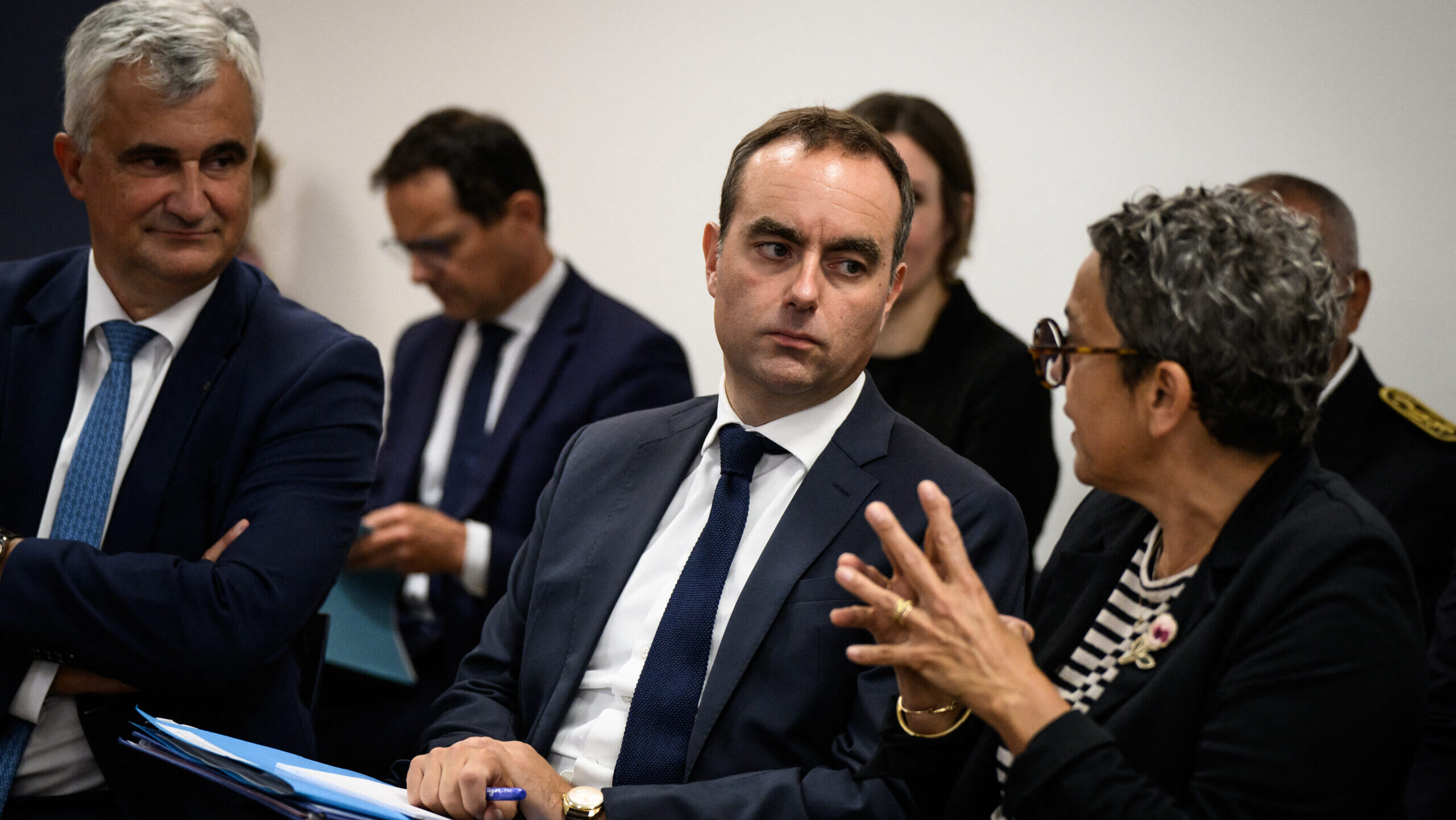
Sébastien Lecornu
JEFF PACHOUD / AFP
While the composition of his government remains unknown, Prime Minister Sébastien Lecornu has already met with allied parties to secure support in parliament. For his next budget, he has ruled out the creation of new taxes and has even said he was in favour of reducing certain taxes “in favour of work.” The Left feels betrayed, while the right-wing RN is reconsidering its threat of a no-confidence vote.
On Monday, September 29th, the prime minister brought together representatives of the parties that support President Emmanuel Macron: the president’s own party, Renaissance, the centrists of the Modem and Horizons parties, and the centre-right allies, Les Républicains.
The prime minister explained that his government would make proposals to reduce taxes “in favour of work” and asked his supporters to be “open to debate on tax justice” and a “fair sharing of the effort to restore public finances” but “within the limits of not damaging growth and employment.”
While these announcements remain vague, the political message is quite clear: the prime minister has no intention of yielding to pressure from the Left, which believes that ‘tax justice’ means the creation of new taxes. In an interview with Le Parisien on Friday, September 26th, Lecornu dashed the hopes of the Socialists by explaining that he would not introduce the ‘Zucman tax’ nor would he reinstate the wealth tax. He also said he was opposed to any renegotiation of the pension reform. However, he pointed out that this was a “starting point for negotiation” and that he remained open to discussion.
With another day of strikes and demonstrations planned by the trade unions across the country on Thursday, October 2nd, the Left has expressed its indignation at the prime minister’s clear decision to send signals to the Right. For Marine Tondelier, president of the Green Party, by taking such a stance, the prime minister is “actively preparing his own downfall.” Olivier Faure, first secretary of the Socialist Party, considers Lecornu’s refusal to compromise with the Left “unreasonable.”
Meanwhile, Rassemblement National (RN) is blowing hot and cold. The prime minister’s interview in Le Parisien was met with scepticism by Marine Le Pen: “A number of intentions have been expressed, but if these intentions result in anecdotal or trivial measures that fall short of what is needed to restore the country’s fiscal stability, then it will not work,” she explained. But her political party cannot ignore the signals sent by the prime minister to the Right, in favour of tax cuts on the one hand, but also on “the urgency of addressing everyday security” and the need to tackle “social fraud.”
On Tuesday, MP Jean-Philippe Tanguy said that the RN would not vote to bring down the government if the budget did indeed include tax cuts and public spending cuts. “We don’t bring a motion of no confidence just for the sake of it,” he said. Nevertheless, he remains very cautious about the budget that will be proposed to MPs and believes that the chances of it being satisfactory are slim: “If there are tax cuts for the middle and working classes, tax cuts for those who work, and spending cuts on the side, it will be miraculous.” The party also fears that the government, in the absence of a viable compromise, will impose the budget by means of ordinances.
For now, the prime minister will not keep one of his first promises, which was to give France a government by October 1st—the date when parliamentary debates resume in the National Assembly. According to the latest rumours, we will have to wait until the end of the week, perhaps Saturday.