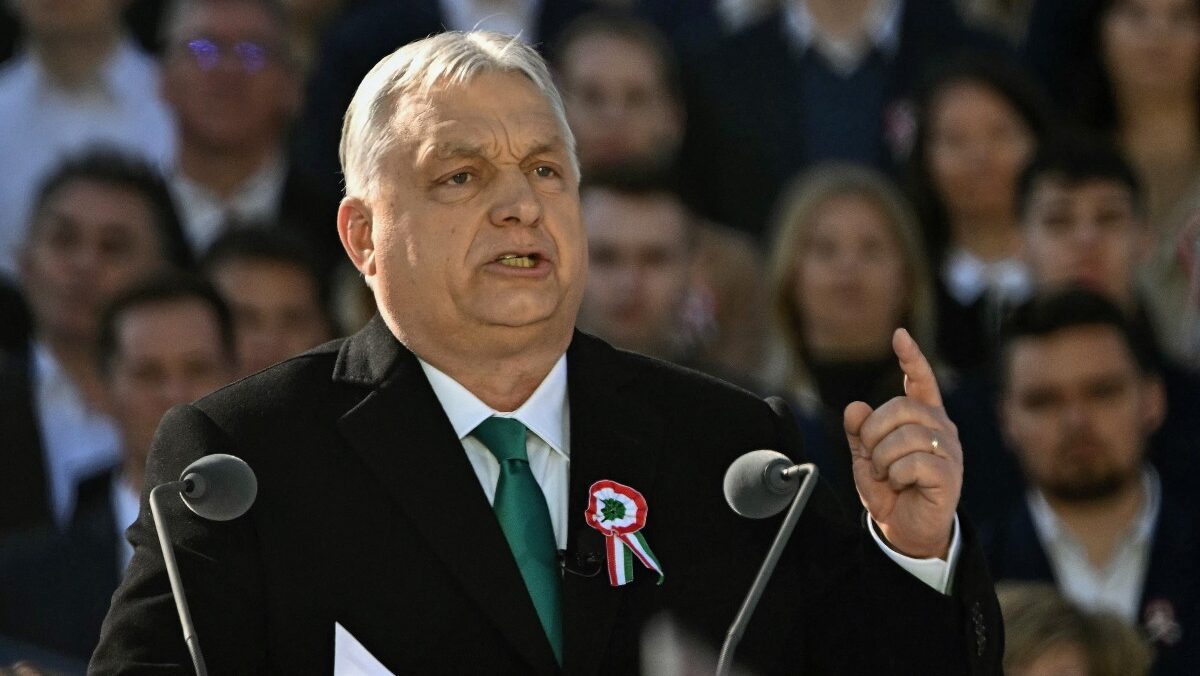
Hungarian Prime Minister Viktor Orbán makes a speech in front of the Parliament building in Budapest, Hungary, on March 15, 2026
ATTILA KISBENEDEK / AFP
European Commission president Ursula von der Leyen and European Council president António Costa announced on Tuesday that the European Union will provide technical and financial assistance to Ukraine to restore the Druzhba oil pipeline.
In a joint statement, they said:
Our priority is to ensure energy security for all European citizens. In this sense, the President of the European Commission and the President of the European Council will continue to work with the concerned parties on alternative routes for the transit of non-Russian crude oil to the countries of Central and Eastern Europe.
Ukrainian president Volodymyr Zelensky, in a letter of response dated March 17, again denied a deliberate blockade of oil transport to Europe and blamed a Russian attack for the pipeline disruption. He claimed Ukraine has been “working on an alternative technical solution since the first days after the attack” and that he expects the pipeline to be operational within approximately one and a half months, “of course in the absence of any further attacks by Russia.”
Zelensky opened his letter by thanking the European Union “for the allocation of a EUR 90 billion support loan for Ukraine for the next two years”—an EU plan blocked by Hungary over the end of oil transport through the Druzhba pipeline—and emphasized the importance of “allowing the first tranche to be disbursed already at the beginning of April.”
Hungary has reacted firmly. Prime Minister Viktor Orbán stated on X: “No oil deliveries? No money. It’s that simple.” Orbán stressed that the oil blockade goes beyond energy concerns and carries political implications for domestic elections, potentially benefiting the opposition Tisza Party. He reiterated that EU funds for Ukraine must be linked to the reopening of the Druzhba pipeline.
Foreign Minister Péter Szijjártó sharply criticized von der Leyen’s statement on X: “Good morning, Ursula von der Leyen! After nearly 50 days, the EU Commission has noticed that two member states are under an oil blockade by Ukraine, now promising to resolve the situation. Don’t be fooled. This is a political game. Every step was coordinated between Kyiv and Brussels.”
Good morning, Ursula von der Leyen! After nearly 50 days, the @EU_Commission has noticed that two member states are under an oil blockade by Ukraine, now promising to resolve the situation.
— Péter Szijjártó (@FM_Szijjarto) March 17, 2026
Don’t be fooled. This is a political game. Every step was coordinated between Kyiv and… https://t.co/lLtMGKozEc
Szijjártó emphasized that Hungary is fully prepared for the situation, having developed alternative transport routes, increased reserves, and strengthened regional cooperation. He called on Volodymyr Zelensky and Ursula von der Leyen to immediately lift the blockade, noting that the pipeline is technically capable of transporting oil.
Slovak prime minister Robert Fico also warned EU leaders that Ukraine’s actions should not supersede the interests of member states.
IN A CONVERSATION WITH THE PRESIDENT OF THE EUROPEAN COUNCIL, A. COSTA, I EMPHASIZED THAT THE EU CANNOT PRIORITIZE THE INTERESTS OF UKRAINE OVER THE INTERESTS OF EU MEMBER STATES SUCH AS SLOVAKIA OR HUNGARY
— Robert Fico 🇸🇰 (@RobertFicoSVK) March 16, 2026
As part of preparations for Thursday’s European Council summit, I held a… pic.twitter.com/BCn3SYbaFK
The Druzhba pipeline disruption has already strained relations, prompting Hungary and Slovakia to halt diesel shipments to Ukraine. Hungary also continues to block the €90 billion EU loan for Kyiv, citing the energy blockade.