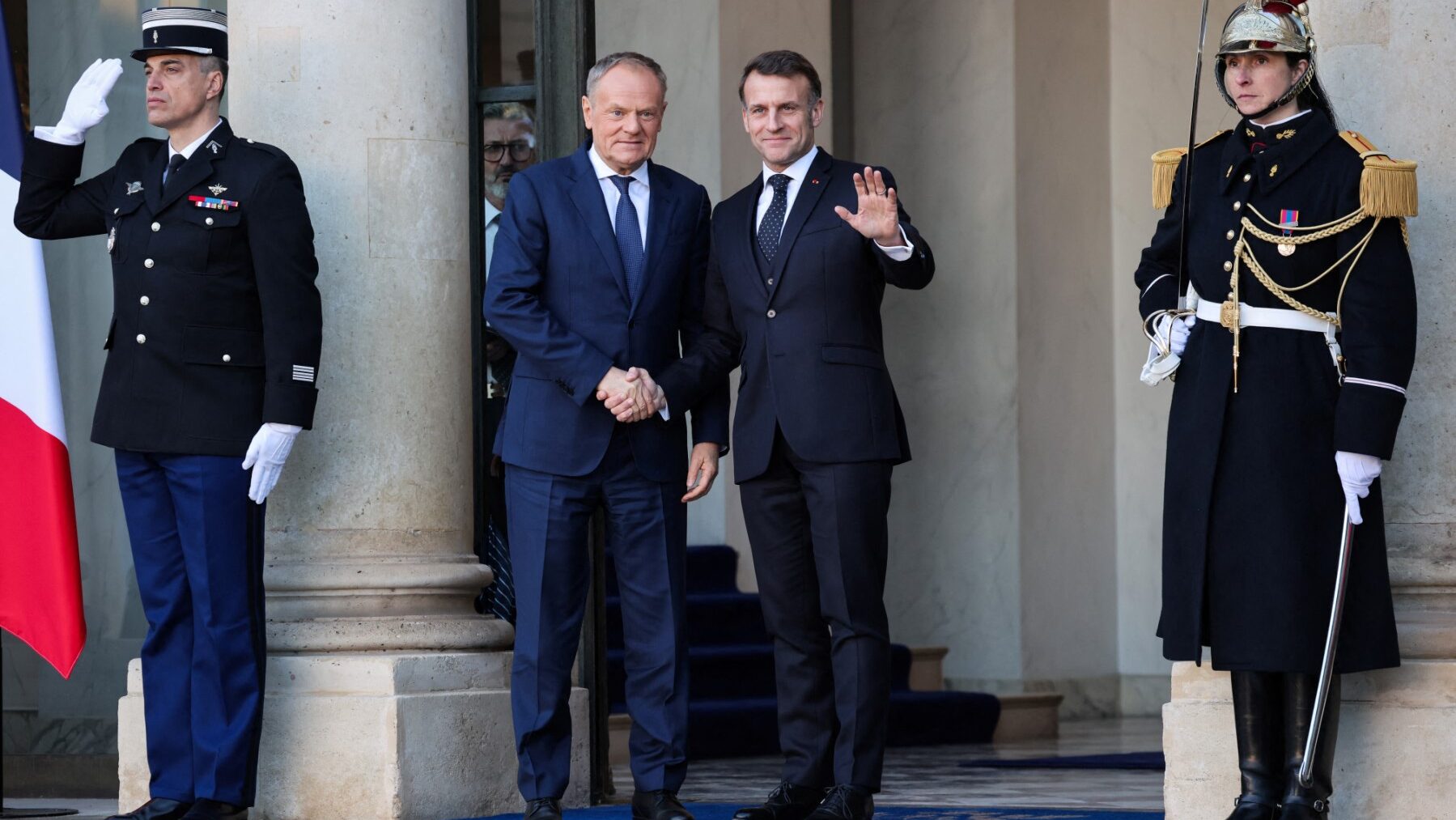
France’s President Emmanuel Macron (R) welcomes Poland’s Prime Minister Donald Tusk (L) at the Elysee Palace in Paris, on January 6, 2026
LUDOVIC MARIN / AFP
Emmanuel Macron’s announcement on Monday, March 2nd, of the implementation of advanced nuclear deterrence to be shared with France’s European partners was met with mixed reactions in Europe, revealing the French head of state’s difficulties in establishing himself as a leading international figure, as he would like.
From the naval base of L’Île-Longue in Brittany, Macron announced an increase in the number of nuclear warheads, the integration of a new concept of ‘advanced nuclear deterrence’ involving closer collaboration with several European states, and the possibility of temporarily deploying French nuclear assets on the continent in certain circumstances. Paris would nevertheless retain exclusive control over nuclear decisions.
For Macron, this was a major response to the uncertainties surrounding the U.S. nuclear commitment to Europe since Donald Trump came to power, given his security doctrine of pushing Europeans to take charge of their own defence.
According to the French president, eight countries are now in line to join this shared nuclear deterrence.
The most notable enthusiasm came from Poland, both at the political and media levels: Poland’s inclusion among the eight European countries mentioned by Macron as potential partners is seen by the Polish press as a landmark moment for European security, with some going so far as to call it a “revolution.” Polish Prime Minister Donald Tusk emphasised his intention to achieve maximum autonomy in nuclear deterrence while cooperating closely with France and other European allies, seeing the initiative as a means of strengthening the continent’s security.
Denmark has made it clear that it is ready to cooperate with Paris—within certain limits. Prime Minister Mette Frederiksen described the strategic cooperation agreement with France as a necessary response to growing threats, particularly from Russia, while specifying that this does not mean the installation of nuclear warheads on Danish soil. The Danish government also stressed that this cooperation would complement NATO’s nuclear deterrence but was not intended to replace it. This commitment to the overall NATO framework also remains the watchword on the German side, although discussions are already well advanced for a privileged bilateral strategic partnership, with the aim of German conventional forces participating in nuclear exercises under French leadership.
In Belgium and the Netherlands, the strategic dialogue with Paris is seen as needing to be conducted in a constructive but cautious spirit. There is an awareness that nuclear deterrence—which is seen as European rather than French—must complement American deterrence, which remains paramount. Defence Minister Dilan Yesilgöz-Zegerius and Foreign Minister Tom Berendsen said the Netherlands was in strategic talks with France on nuclear deterrence as “a supplement to, and not a replacement for, NATO’s collective defence and nuclear deterrence capabilities.” Increased cooperation with France is seen only as an additional benefit and in no way as a definitive alternative.
Unlike the pro-deterrence positions of several countries, Spain is perhaps the country that takes the most critical line. The Spanish government has firmly rejected the logic of nuclear rearmament, rejecting the idea of further militarisation and even indirect sharing of the French nuclear umbrella, which it considers incompatible with its defence policy and international commitments on disarmament.
In Italy, Atlanticism is still the norm, and the desire to place itself under a French nuclear umbrella remains very limited. The recent extreme deterioration in relations between France and Italy has not helped matters. The Italian government has rejected the French offer, and Italy is therefore not one of the eight countries willing to join the shared nuclear deterrence programme. Giorgia Meloni’s ally, Matteo Salvini, has been unequivocal on the subject: “What Macron says counts for zero with me.”
For Macron, this is therefore a mixed success. Through his initiative, he has undeniably succeeded in taking centre stage and placing himself in a position of strength, while promoting French expertise in nuclear energy and advanced weaponry. In his speech, he was keen to remind his audience of France’s military strength, which places his country at a level of power that no one else in Europe is currently able to rival in material terms. A notable point of convergence among European states is the need to preserve French sovereignty over nuclear command, which has the advantage of suiting both the French, who are concerned about their prerogatives, and other states, which must be careful not to compromise their own national policies by committing too far to deterrence. But the insistence of many European states on recalling the NATO framework and the importance of American power proves how difficult it is for them to break away from the convenient position of strategic inferiority under American leadership in which they have been entrenched for decades and which both Trump and Vance are now calling into question.
In a televised address on the evening of March 3rd, Macron confirmed these orientations to the French people. He also confirmed the rumour, previously denied by the Ministry of Defence, that the aircraft carrier Charles de Gaulle would be sent to the Middle East with a frigate escort, following the Iranian missile strike on two French bases, in accordance with the military agreements binding France to the Gulf monarchies: the UAE, Saudi Arabia, Bahrain, and Kuwait.