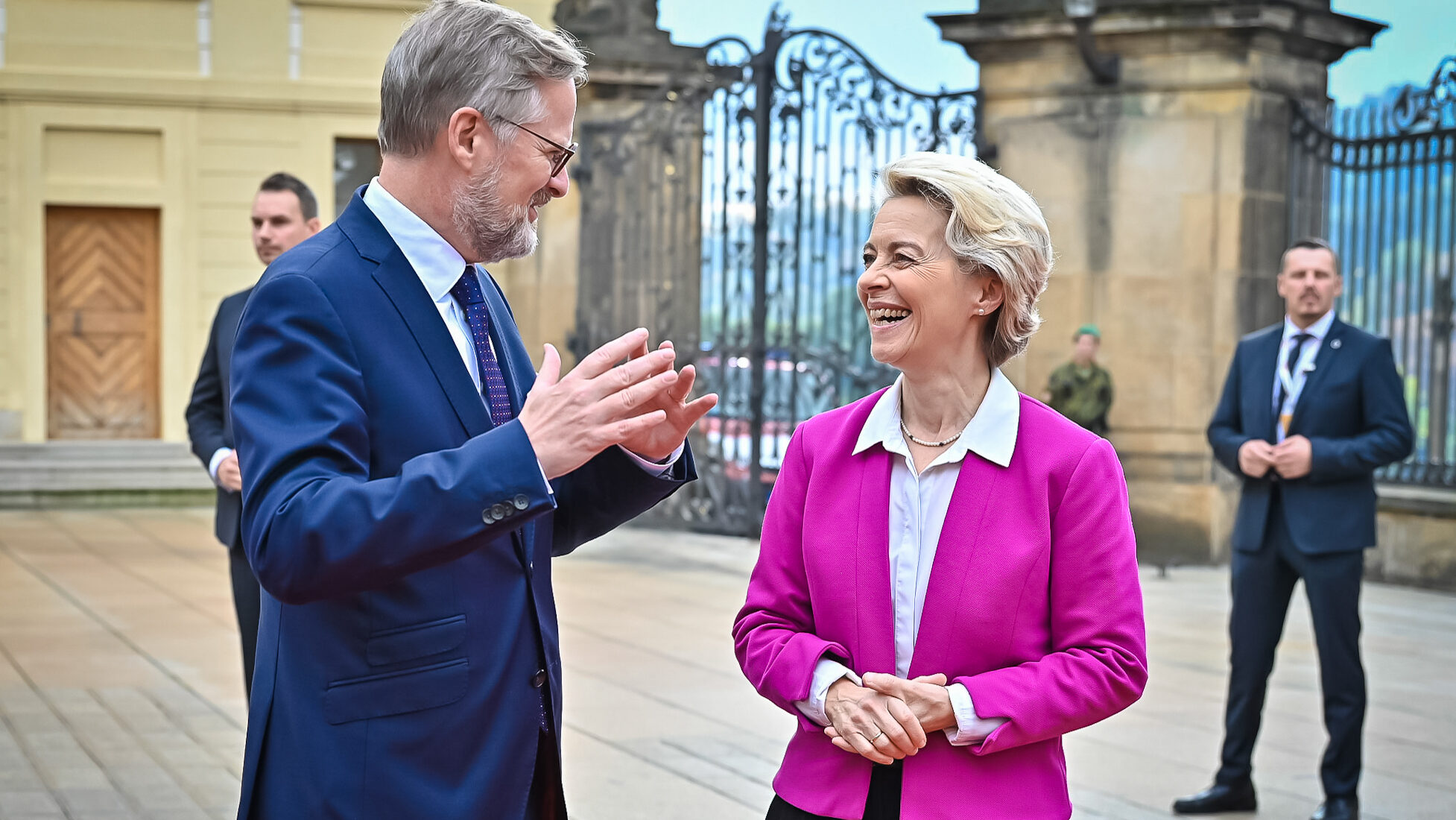
Czech PM Petr Fiala and EU Commission President Ursula von der Leyen
© European Union, 2022
Tensions are running high less than three months before the Czech parliamentary elections, as more than 40% of Czechs believe Brussels may try to interfere in the process.
After all, there’s ample reason for the von der Leyen Commission to worry about the vote, as polls predict Andrej Babiš’s populist ANO party—a founding member of the Patriots for Europe (PfE) group—to reclaim the government in a landslide, ousting Petr Fiala’s strikingly unpopular center-right, pro-EU government.
According to the recent study published by the Central European Digital Media Observatory (CEDMO), 41% of Czech voters believe Brussels will “likely” interfere in the October election, just one percent less than those who suspect Russia of the same, with some overlap as well.
Czechs are only slightly more suspicious of the EU than the Poles (39%), but less than Slovaks, 46% of whom believe the EU is likely to interfere in their elections.
The Czechs are also prone to view the EU negatively—the approval rate is only 29% (far below the EU average of 43%), while 27% view Brussels more negatively, and 44% are neutral.
According to CEDMO, the findings largely mirror voter distribution as well. Based on the most recent polling data, the support of Eurosceptic parties sitting in either PfE or ESN collectively stands at 49%—including ANO’s leading 31%—while Fiala’s five-party coalition (EPP/ECR) barely reaches 33%.
Czechia, STEM poll:
— Europe Elects (@EuropeElects) July 13, 2025
ANO-PfE: 31%
SPOLU-ECR|EPP: 20% (-1)
STAN-EPP: 13% (+1)
SPD-ESN: 12% (-2)
Piráti-G/EFA: 8%
Stačilo!-NI: 6% (+1)
Auto-PfE: 4%
SocDem-S&D: 3% (+1)
Přísaha-PfE: 2% (-1)
+/- vs. 12 June – 01 July 2025
Fieldwork: 19 June – 08 July 2025
Sample size: 1,553
➤… pic.twitter.com/9w7hVSZRUc
While covert election interference from the EU through biased media funding and social media censorship is very much a reality, the Czech government immediately began to gaslight everyone who even brought up the idea in the past weeks.
Reacting to the survey results, Czech EU Affairs Minister Martin Dvořák went on the offensive and said any claim or suspicion of EU interference is “groundless” and driven by “enemies of democracy.”
This is the same type of rhetoric that came from Commission chief Ursula von der Leyen, who accused everyone who demanded her to comply with the EU Court of Justice’s ‘Pfizergate’ ruling of being “extremists,” “conspiracy theorists,” and “puppets of Moscow.”
Similarly, Dvořák insists that the EU “has neither the interest nor the instruments to influence elections in its member states,” which is just wrong on both counts.
In truth, the Commission has virtually unlimited funding it can disburse to liberal media and NGOs to tilt any country’s playing field in one direction, while it can also ramp up political censorship on social media through the DSA. Then there’s also EU-supported lawfare, like against Marine Le Pen in France, or what’s already being prepared against Babiš in Czechia.
And if everything fails, there’s always the opportunity to cancel the results just by pointing at Russia, like in the case of Romania. Former Commissioner Thierry Breton even admitted to EU pressure behind that move and threatened that Brussels may need to do the same to Germany in case of an AfD victory, so the argument of the Czech government stands on pretty shaky ground.
At the same time, seeing the Patriots gain another seat in the Council, allowing Babiš and Orbán to defend each other against EU attacks, is the definition of a Brussels nightmare scenario. It’s quite clear that the EU has both the means and the reason to influence the Czech elections, whatever the minister says.
The problem is that this type of soft interference is hard to monitor, unlike the cyberattacks allegedly coming from Russia. And that is something that Fiala’s government is actively preparing for, recently launching a new cybersecurity task force to monitor the electoral process in the information space.
Hopefully, this task force will not magically find evidence of Russian interference only after the election is over and Babiš has won; otherwise, Czechia could be plunged into the same kind of chaos that dominated Romania for the first five months of the year.