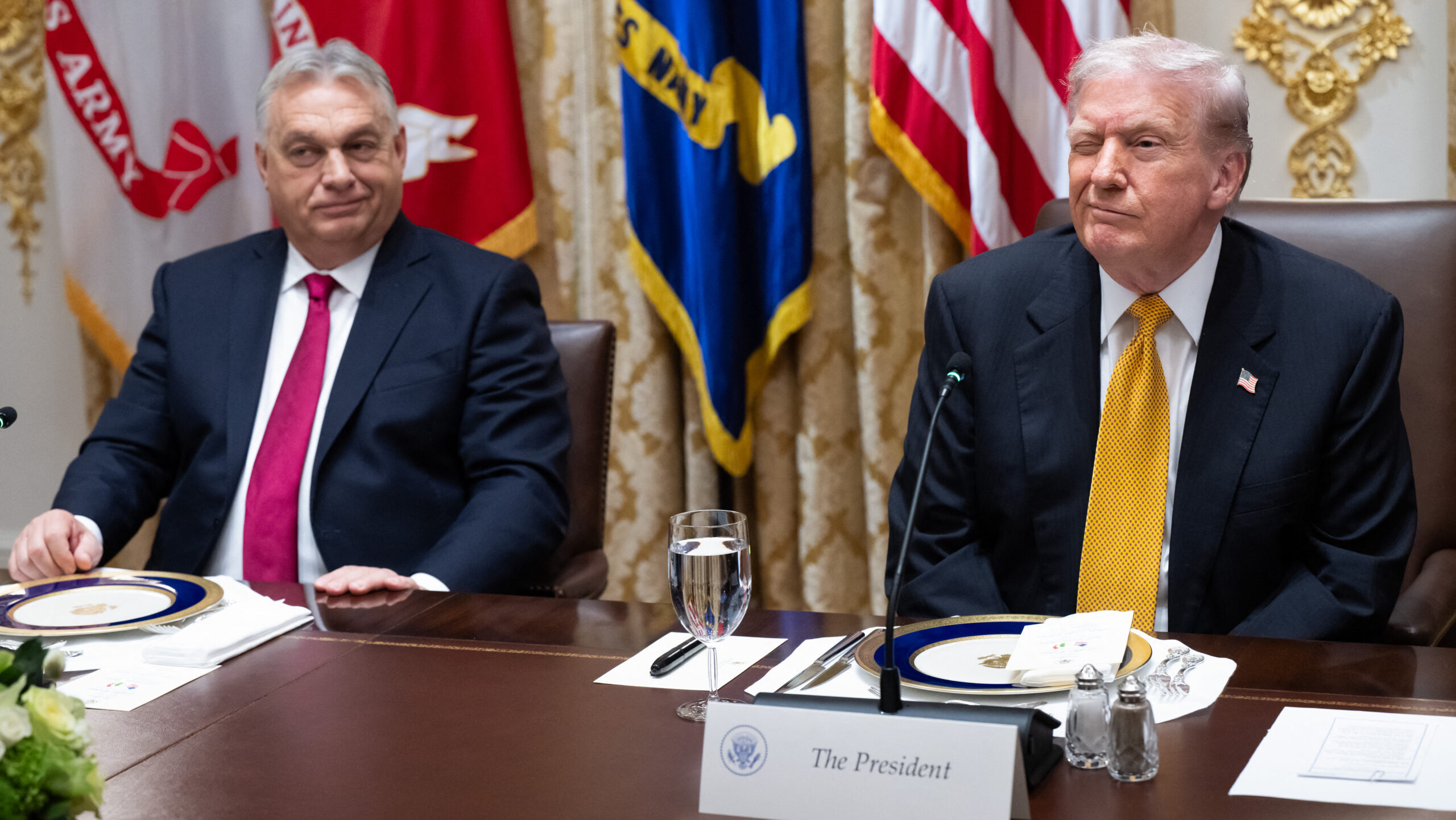
Viktor Orbán and Donald Trump
SAUL LOEB / AFP
Donald Trump left little doubt about his admiration for Viktor Orbán during October’s Gaza peace conference in Sharm El-Sheikh. Praising the Hungarian leader in front of unimpressed European counterparts, Trump said:
We love Viktor… You are fantastic. I know a lot of people don’t agree with me, but I’m the only one that matters.
‼️At the Peace Summit in Sharm el-Sheikh, 🇺🇸 @realDonaldTrump reaffirmed his full support for 🇭🇺 Hungary and @PM_ViktorOrban:
— Balázs Orbán (@BalazsOrban_HU) October 13, 2025
“We’re behind you 100%.” pic.twitter.com/Hjebdz5vQD
A few weeks later, in early November, Orbán was in Washington to talk with Trump about the path towards peace in Ukraine, among other things. By this time, it had already been agreed—following other similar discussions between the two leaders—that Budapest would be positioned as the diplomatic hub for ending the war, which really got under Brussels’ skin.
Now, Trump is pushing ahead full throttle on peace talks—importantly, with plans that appear more likely to succeed than other recent efforts.
The timeline here appears significant. Could it be that Orbán has convinced Trump to intensify attempts to bring the fighting to an end? We know that the Hungarian PM has his ear, and that the U.S. president respects what he has to say—indeed, that he wants him to remain in office in Budapest, where his voice can be heard loudest.
We also know that none of Europe’s establishment leaders could have encouraged Washington to seriously renew its push for peace. Indeed, Hungary’s advocating for an immediate ceasefire and negotiations between Russia and Ukraine has made it somewhat of an outlier within the European Union. Brussels is, instead, adamant that member states should continue sending more weapons and, of course, money—lots and lots of it—to Ukraine to be used not in the negotiation halls but on the battlefield.
That’s even despite increasing reports of high-level corruption in Kyiv, potentially involving senior officials. Searches inside the Kyiv apartments of some top officials have recently resulted in the finding of “duffel bags filled with cash” and, indeed, a “golden toilet.” Yet Ursula von der Leyen’s Commission continues to demand that European nations—or, rather, European taxpayers—plug Ukraine’s €135.7 billion funding gap for 2026-2027.
As Ralph Schoellhammer highlighted on Europeanconservative.com a fortnight ago, the Trump-Orbán meetings are not “routine encounter[s],” but actually signal “the potential emergence of a wider geopolitical change and the rise of a political philosophy long dismissed by Brussels elites and Western media.”
The European establishment’s response to some of these recent agreements has also given away Hungary’s role in (hopefully) bringing about peace in Ukraine. Some officials said late last month that they would not allow Russia’s Vladimir Putin to enter their airspace to get to Budapest for negotiations, despite even them knowing they would do no such thing. Mainstream media outlets have also tried their hardest to weaken Orbán’s influence on Trump because, again, they know that it exists.
But these criticisms hardly matter in the grand scheme of things, since, as has also broadly been the case with the war in Gaza, the EU really has no strategy of its own—beyond, as above, prolonging the conflict with more arms and cash—and, crucially, that Trump knows this to be the case. So, in fact, does Ukraine’s Volodymyr Zelensky, who said last week that “only” the U.S. and, in particular, President Trump, “have sufficient power to make this war come to an end.”
This is obviously true. Although pressure from like-minded nations is clearly helping to push the peace effort along.