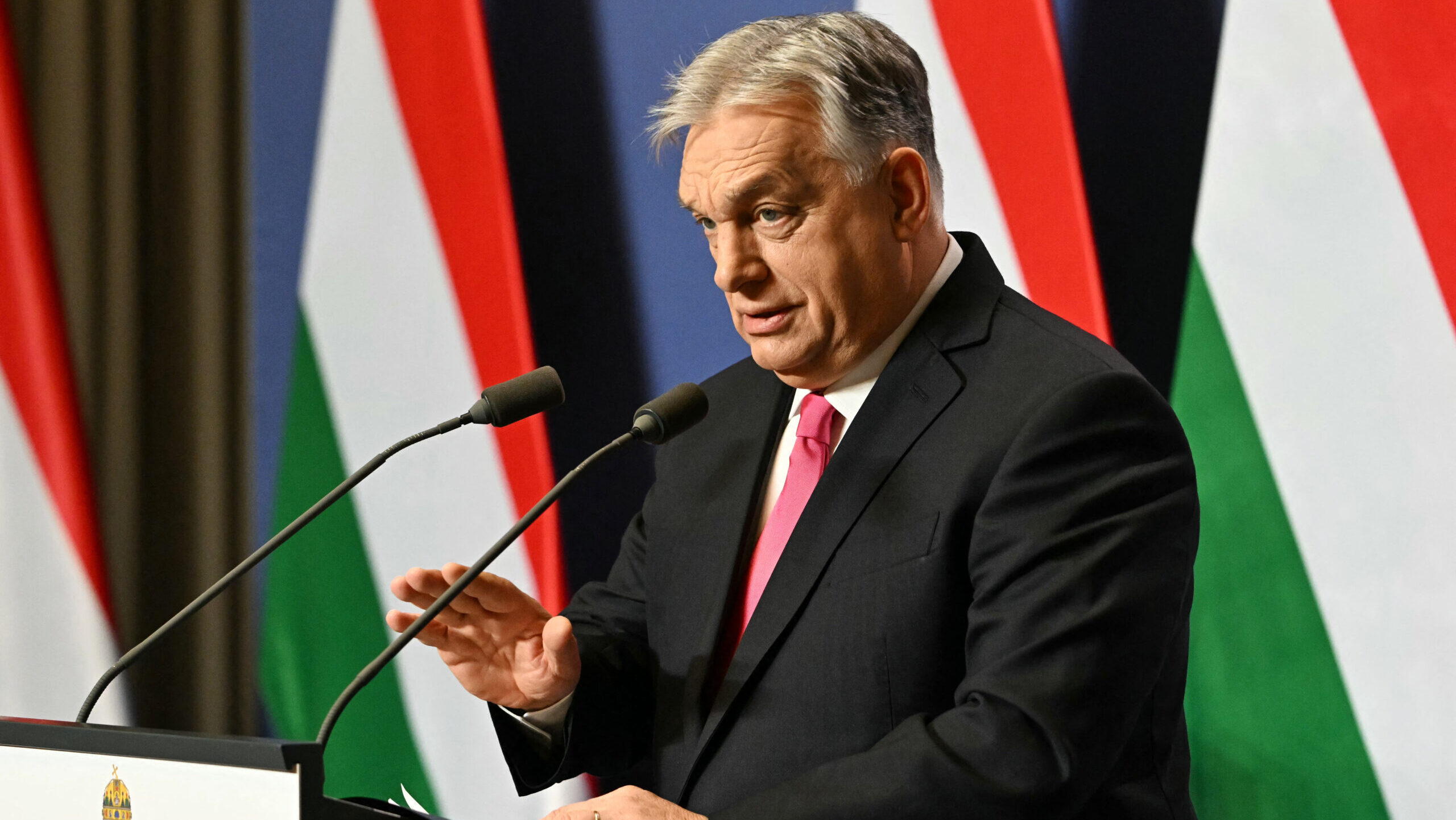
Viktor Orbán
Attila KISBENEDEK / AFP
Hungarian Prime Minister Viktor Orbán said on Monday, January 5th, that Hungary would not need to follow the United Kingdom’s path out of the European Union because the bloc is “falling apart by itself.”
Speaking at an international press conference in Budapest, the conservative leader argued that a “process of de-integration” is already under way within the EU, driven by the growing incompetence of EU leaders.
He said Brussels repeatedly adopts major policy decisions only to abandon or dilute them later, pointing to unrealistic deadlines for the green transition and the weakening of the Schengen system—the system of open internal borders within the EU—as clear signs of systemic failure.
Orbán has been a thorn in the side of the liberal establishment in the EU, regularly denouncing Brussels’ interference in member states’ sovereign domestic affairs and the loss of the EU’s global competitiveness due to strategic mistakes.
His criticism, as well as his rejection of the EU’s pro-migration, pro-Ukraine, and pro-LGBT stance, has resulted in Hungary’s EU funds being frozen.
Orbán reiterated Hungary’s outright rejection of the EU’s new migration pact, which enters into force later this year, and which forces member states to choose between taking in relocated migrants or paying financial contributions instead.
Under the pact, Hungary would be required to assess 23,000 asylum claims annually and accept 350 migrants from other member states.
“Hungary will not take in a single migrant,” he said. He recalled that Hungary already has to pay a fine of €1 million daily for refusing to admit illegal migrants. The Central European nation was punished in a ruling by the European Court of Justice in 2024 for defending its borders and for forcing migrants to hand in their asylum requests outside Hungary’s borders.
🚫 @PM_ViktorOrban: Hungary will not accept migrants, will not build migrant camps, and will not change how we protect our borders. We will not allow Brussels to decide who we must live with or turn Hungary into an immigrant country. pic.twitter.com/ctdDR63ESc
— Zoltan Kovacs (@zoltanspox) January 5, 2026
Orbán said this year’s Hungarian parliamentary elections, due in April, would be decisive. He summarised the choice as either “going down the Brussels road or staying on the Hungarian road.”
In a world dominated by great-power interests, Brussels also has political ambitions and would seek to influence the Hungarian vote, he warned.
He has repeatedly claimed that the opposition Tisza Party acts as a proxy for Brussels and the pro-EU liberal European People’s Party, and would reverse Hungary’s current policies, including its refusal to send weapons to Ukraine and its opposition to Ukraine’s EU membership.
On Ukraine, Orbán was blunt: Hungarian money would not be handed over to Kyiv. He also dismissed calls for the reintroduction of compulsory military service—slowly being reintroduced in many European countries—arguing that conscription is a wartime measure and therefore not timely for Hungary.
He also announced Hungary’s refusal to align with Brussels’ push for a “European war economy,” stating that such an approach does not serve peace or member states’ interests
Asked about the capture of Venezuelan leader Nicolás Maduro by U.S. forces, Orbán declined to take a moral stance. He said the development was good for Hungary’s interests, arguing that the fall of “narco-states” strengthens the global fight against drugs.
He linked the issue to energy, saying the United States needs cheap energy for re-industrialisation and modern technologies, which aligns with Hungary’s own need for affordable energy until the Paks II nuclear project comes online in the early 2030s.
He confirmed that Hungary vetoed a joint EU statement on Venezuela, insisting that without a sovereign foreign policy, there can be no nation state.