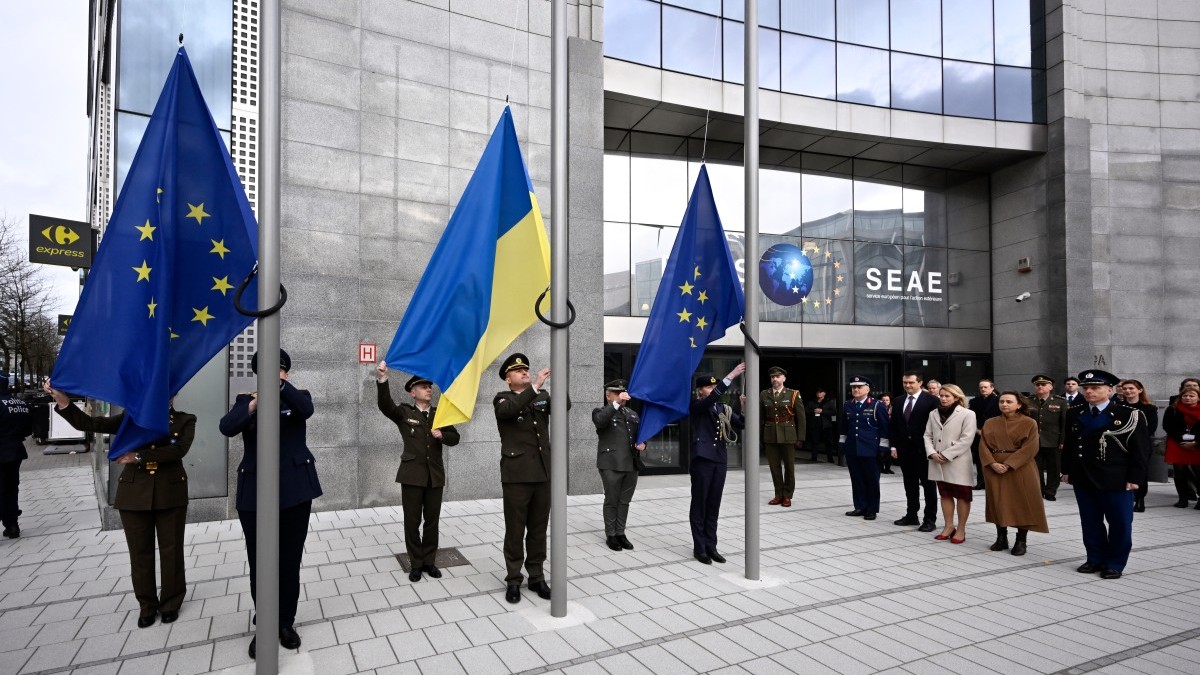
The Ukrainian flag is raised in front the European External Action Service (EEAS) building in the presence of EU officials and the head of the Ukrainian mission to the European Union during a ceremony marking the fourth anniversary of Russia’s invasion of Ukraine, in Brussels, on February 23, 2026.
JOHN THYS / AFP
Europe’s near-total focus on Ukraine might make sense if security at home was at least largely in place. But since this is far from the truth, the continent should instead concentrate on its own future.
That is according to Hungary’s Viktor Orbán, who is preparing for a major election test on April 12th. The prime minister told GB News, in his first sit-down interview with a British broadcaster in over a decade, that there is “no question” of the fact “we have to rearm ourselves.”
I think Europe should concentrate and focus on itself, not on Ukraine. Ukraine is not the solution, it is a problem. Ukraine makes us weaker, not stronger. If we would like to be stronger, we have to concentrate on ourselves, not on Ukraine.
The so-called coalition of the willing, which primarily includes Britain and France, has now spent about a year talking about contributing to a ‘peacekeeping’ force in Ukraine, even potentially with European boots on the ground. Yet it lacks the means to provide any serious amount of support, and has done little-to-nothing to change this.
Though not commenting directly on the leaders behind this rhetoric, Orbán said the “first issue is to provide a security system in Europe which is good enough and safe enough for us,” which will include forking out for “higher-quality military capacities.”
AfD co-leader Alice Weidel pushed a similar line in the German Bundestag on Wednesday, stressing there is “no time” for “hollow phrases and grandstanding world power rhetoric,” and that governments must instead pursue “an immediate change of course.”
Balázs Orbán, the Hungarian prime minister’s political director, described this—prioritising “security and stability” at home—as one of the key issues “at stake” in next month’s election, saying: “Hungary wants a government that can guarantee this and defend the country’s interests against pressure from Brussels and beyond.”
Focusing on European stability also involves ensuring the security of energy flows. Yet Brussels has clearly been disappointed by Budapest’s block on a €90 billion EU loan package for Ukraine until Kyiv restores Russian oil transit to Hungary via the Soviet-era Druzhba pipeline.
Volodymyr Zelensky claims the line was damaged in a Russian drone attack and that repairs would be too dangerous. But Orbán’s administration earlier this month said satellite images and “operational information” proved “there is no technical obstacle to restarting” oil transit.
EU officials are meeting in Brussels today, March 19th, and will reportedly try to convince the Hungarian PM to lift his veto on the loan. But Orbán insists “I will never support any kind of decision here which is in favour of Ukraine [as long as] the Hungarians are not able to get the oil which belongs to us.”