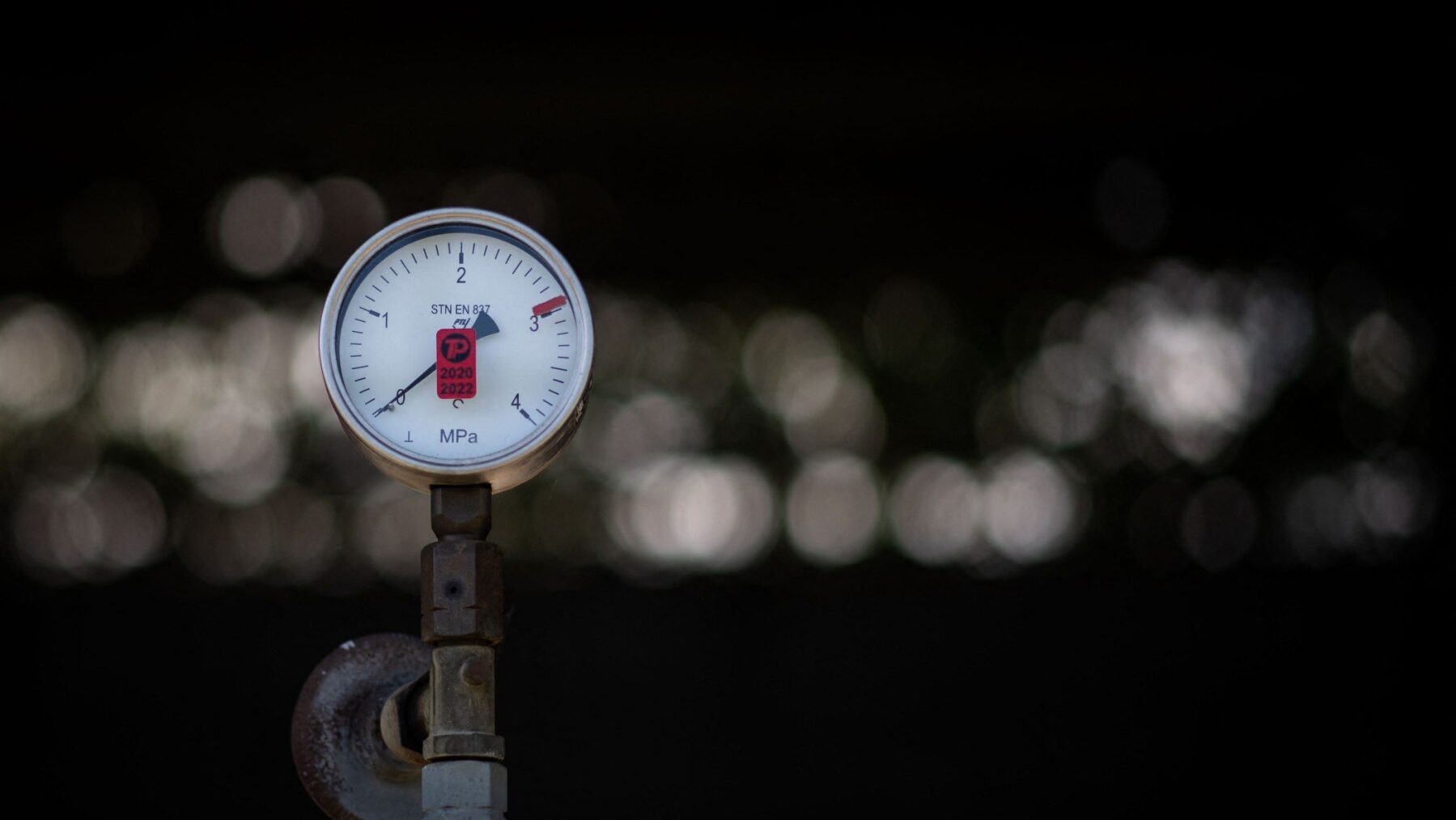
A pressure gauge on the Druzhba pipeline
VLADIMIR SIMICEK / AFP
One of the inevitable consequences of the U.S.-Israel war on Iran has already been the surging of oil prices—by nearly 10% on Monday morning alone.
The importance, then, of restoring Russian oil transit to Hungary and Slovakia via the Soviet-era Druzhba pipeline has “doubled,” Hungarian PM Viktor Orbán said on Saturday. He added that Ukrainian president Volodymyr Zelensky’s alleged refusal to repair the line, which Kyiv claims was damaged in a Russian drone attack, had become “even more sinful”—endangering “not only the companies, not only the industry but every Hungarian person.”
Hungary is blocking a €90 billion EU loan package for Ukraine until this restoration has taken place, much to the ire of Brussels officials who—lipservice aside—have predictably betrayed Budapest and backed Kyiv instead.
Following an investigation over the weekend, Orbán said on Monday that “there is no technical obstacle to restarting” the pipeline, citing satellite images, which have been made public, and “operational information.” This would suggest that the only obstacle was Kyiv’s lack of political will.
‼️ Satellite images prove that there is no technical obstacle to restarting the Friendship oil pipeline.
— Orbán Viktor (@PM_ViktorOrban) March 2, 2026
I call on President @ZelenskyyUa to immediately resume oil deliveries! pic.twitter.com/zDZfCFZSzj
The prime minister’s political director, Balázs Orbán, added that “what President Zelensky is doing amounts to plain blackmail against Hungary.”
In this, Kyiv’s accomplices are Brussels and the Hungarian opposition leader Péter Magyar, whose objective is to trigger fuel shortages and drastic price hikes in order to influence the Hungarian elections and install a Brussels- and Ukraine-friendly government—at any cost, even if this directly endangers the energy security of Hungarian families.
Hungarian foreign minister Péter Szijjártó also on Monday echoed the claim that “Ukraine is deliberately undermining Hungary’s energy security.”
Slovak prime minister Robert Fico spoke with Zelensky late last week, proposing the establishment of an inspection group, which he said would be “composed of experts nominated by the European Commission and EU Member States” and “would directly determine on site the actual state of technological damage to the pipeline or its ability to continue oil transit to the territory of the Slovak Republic.”
The Commission has backed this joint proposal, saying: “We need to take the next steps to see what shape and form this fact-finding mission will take.”