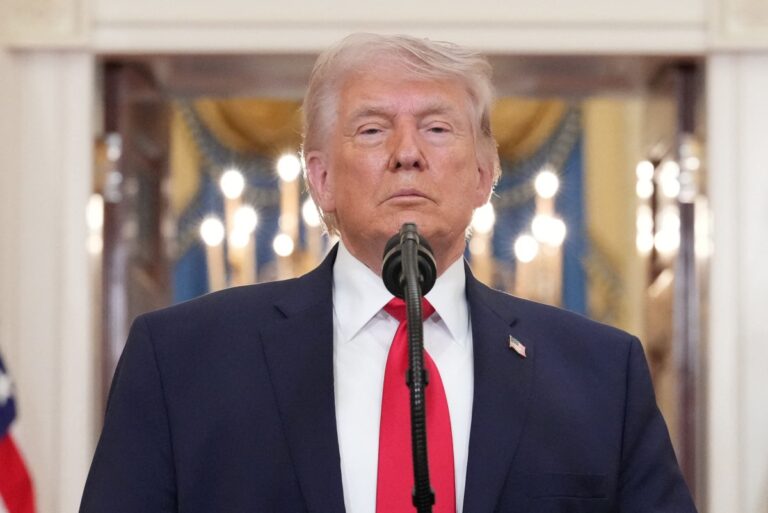
(L-R) Former Polish PM Mateusz Morawiecki, Hungarian PM Viktor Orbán, and former Czech PM Andrej Babiš
Wojtek Radwanski / AFP
The way it looks now, it’s only a matter of time until newly-elected sovereigntist governments revive the Visegrad Four (V4) alliance, and together they will be able to put up a blocking opposition to the EU Commission’s plans for the next EU budget, which favor Ukraine over the needs of Europeans, Hungarian Prime Minister Viktor Orbán said in an interview with wPolsce24.
“The next European budget must be approved unanimously by EU member states,” Orbán said. “We have elections in April next year. [PiS] President Kaczyński and PM Morawiecki will return to power [in Poland]. Andrej Babiš will win in the Czech Republic in October, and Slovak PM Robert Fico is strong enough to stay.”
Then the four of us, as the Visegrád Group, will be able to stop the crazy ideas contained in this project.
The Visegrad Group—founded in 1991 between Poland, Czechia, Slovakia, and Hungary—has long been regarded as an exceptionally effective model of regional cooperation, which ensured its members could represent the interests of Central Europe in all international fora much stronger than they individually could, as long as their governments were politically aligned.
In recent years, cooperation within the V4 was virtually non-existent, due to the political differences between the sovereigntist leaderships of Hungary and Slovakia, and the strongly pro-EU governments in Poland and the Czech Republic. But this could change very soon, Orbán predicted, and there’s a good chance that the V4 will represent a formidable, unified front in Brussels again.
That would require that both Orbán and Slovak PM Robert Fico remain in power in the upcoming elections—Hungary’s is due in April 2026, while Slovakia goes to the ballots in September 2027—and the sovereigntist opposition forces of Babiš and Morawiecki retake the government in the other two countries, which is even more likely in the next two and 18 months respectively.
In Czechia, former PM Andrej Babiš’s ANO party—a co-founder of the Patriots for Europe (PfE) group together with Hungary’s Fidesz and Austria’s FPÖ—is looking forward to a comfortable victory in just a few months in early October, as polls predict a crushing defeat of PM Petr Fiala’s centrist coalition.
Meanwhile, in Poland, PM Donald Tusk’s left-liberal coalition has been in decline for months due to growing dissatisfaction and internal conflicts, and more and more voices predict an early election before the end of 2026 to ease the tensions. That would open the door for a comeback for former PM Mateusz Morawiecki and his national conservative PiS party, which has been leading the polls for weeks now.
Budget talks in Brussels are notoriously difficult, and they usually get approved at the last minute, meaning there would likely be no final deal on the 2028-2034 MFF before December 2027. That is why it’s so important that all four elections have a favorable outcome for the sovereigntist bloc, so the V4 countries can stand together for a more reasonable and Europe-focused budget.
The current proposal, besides slashing agricultural subsidies by 23%, is a “Ukraine-centered, wartime budget” that is not in the service of European prosperity and competitiveness, Orbán and many of his allies argue.
According to the prime minister, over a quarter of the entire €2 trillion MFF would either go to Ukraine directly in the form of various aid mechanisms or be used to service EU debt accumulated to support Kyiv under the current plans. This is “not a European budget, but a Ukraine budget,” Orbán said.
The PM also reiterated that Hungary will block any form of the MFF unless the EU Commission releases all of its remaining frozen funds, worth over €12 billion.
But that’s just one small part of the battle ahead, as Hungary alone doesn’t have enough weight to push for radical change in the proposed structure of the next seven-year budget. With the V4 together, however, it’s a completely different question.