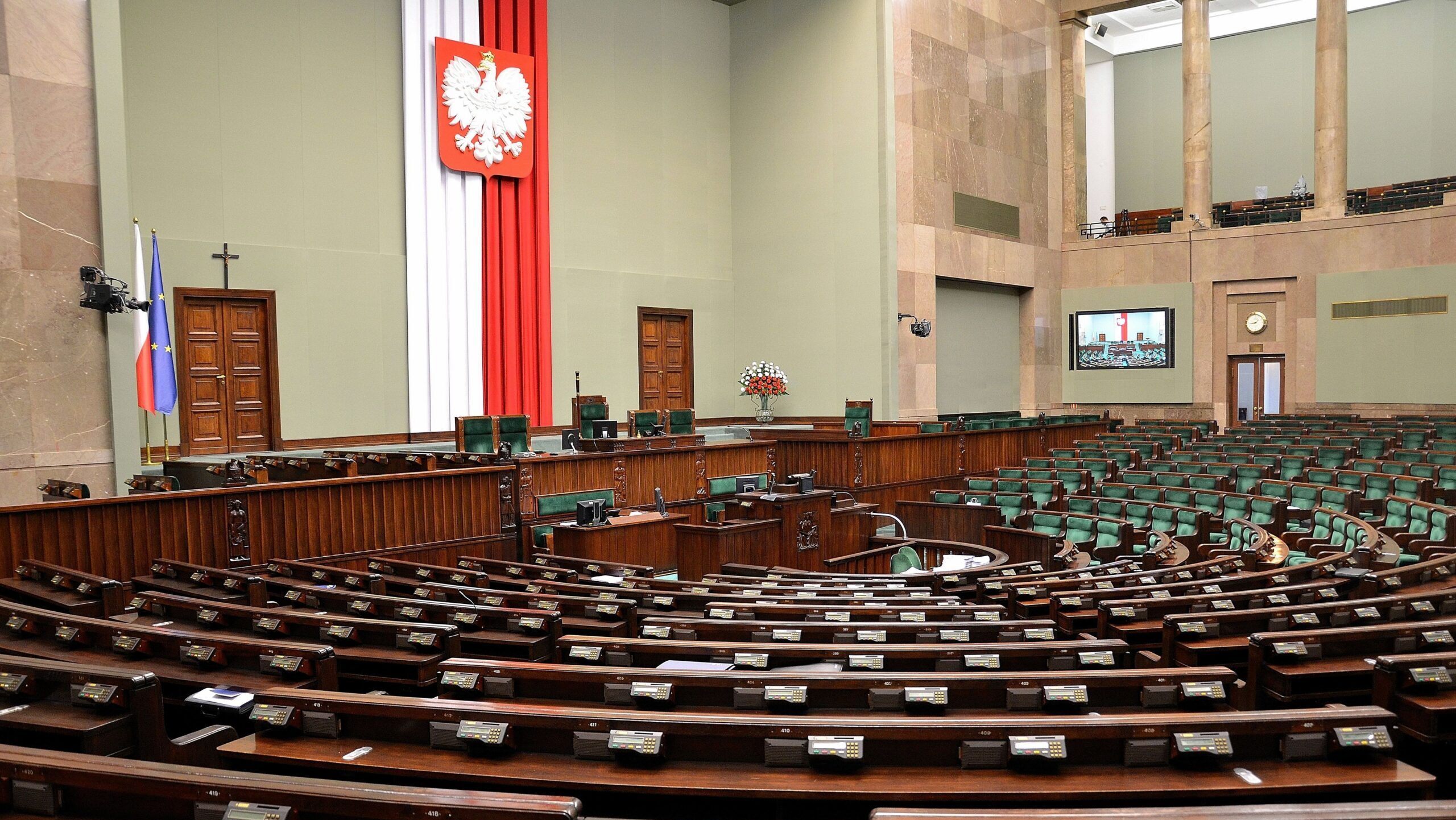
Sejm chamber
Adrian Grycuk, CC BY-SA 3.0 PL, via Wikimedia Commons
Poland’s opposition Law and Justice party (PiS) has demanded a secret sitting of parliament to examine alleged links between individuals close to parliament speaker Włodzimierz Czarzasty and figures connected to Russia, as a diplomatic row with the United States shows no sign of abating.
Speaking at a press conference in Warsaw, former prime minister Mateusz Morawiecki said PiS was calling for the Sejm to convene behind closed doors to discuss recent media reports linking individuals close to Czarzasty to figures from Russian President Vladimir Putin’s circle. Morawiecki said Czarzasty’s background raised fundamental questions about Poland’s security.
Czarzasty built his career in the communist party. Anyone with elementary knowledge of history knows that, without the consent of the KGB and Moscow, it was impossible to build a career in the 1980s Polish People’s Republic. Can such a person be Marshal of the Sejm, the number two figure in the Polish political system?
Former defence ministers Mariusz Błaszczak and Antoni Macierewicz echoed the accusations. They cited a Gazeta Polska report alleging “dangerous connections” involving Czarzasty and his wife, as well as concerns over his access to classified information while serving on a parliamentary committee overseeing the security services.
The PiS intervention followed an unprecedented escalation in U.S.–Polish relations. On Thursday, the U.S. ambassador in Warsaw, Tom Rose, announced that Washington would have “no further dealings, contacts, or communications” with Czarzasty.
In a post on X, Rose said Czarzasty’s “outrageous and unprovoked insults directed against President Trump” had made him “a serious impediment” to bilateral relations.
We will not permit anyone to harm U.S.–Polish relations, nor disrespect Donald Trump, who has done so much for Poland and the Polish people.
The dispute began after Czarzasty said he would not support an initiative by U.S. House Speaker Mike Johnson and Israeli Knesset Speaker Amir Ohana to nominate Donald Trump for the 2026 Nobel Peace Prize. He criticised Trump’s foreign policy as destabilising and driven by transactional power politics.
Prime Minister Donald Tusk reacted sharply, telling Rose that “allies should respect, not lecture, each other.” The ambassador later praised Tusk personally while reiterating his condemnation of the speaker, saying that insulting the U.S. president was unacceptable for any Polish leader.
The episode has highlighted deep divisions within Poland’s ruling coalition and reinforced perceptions that the Trump administration does not trust Tusk’s left-liberal government. Instead, it appears to prefer dealing directly with President Karol Nawrocki, a conservative nationalist who has cultivated close ties with Washington. That preference was evident last summer, when Trump sidelined Tusk in favour of Nawrocki during high-level talks on Ukraine.
PiS and Nawrocki have accused the government of undermining Poland’s traditionally strong ties with the United States, including by aligning with European leaders against Washington on issues such as Greenland.
Despite efforts by the government to de-escalate the dispute, Czarzasty said he regretted the ambassador’s reaction but would not change his position.
By elevating a former communist party activist to the second-highest office in the state and tolerating his open hostility toward the U.S. president, Tusk’s government has further weakened Poland’s standing with its most important ally at a time of growing regional insecurity.