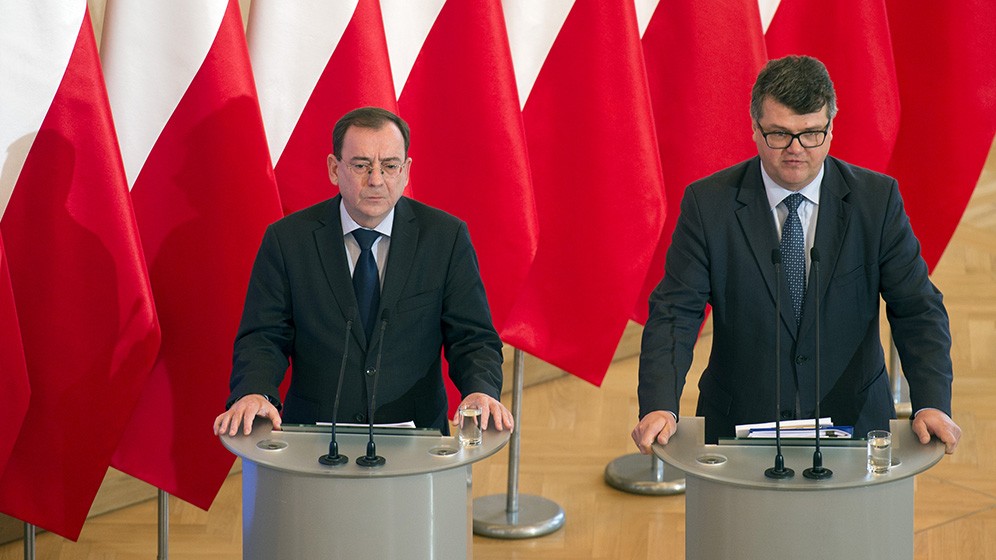
Mariusz Kamiński and Maciej Wąsik holding a joint press conference in 2017
By Kancelaria Premiera from Poland – Konferencja ministra Mariusza Kamińskiego i Macieja Wąsika w KPRM, PDM-owner, https://commons.wikimedia.org/w/index.php?curid=107435445
Two leading opposition figures from Poland’s former conservative government, Mariusz Kamiński and Maciej Wąsik, are to stand trial after prosecutors in Warsaw filed indictments accusing them of violating a court-imposed ban on holding public office.
The Warsaw District Prosecutor’s Office confirmed on Thursday, October 16th, that the pair, now Members of the European Parliament, are charged with continuing to exercise their parliamentary mandates despite a December 2023 judgment prohibiting them from doing so.
The indictment alleges that they took part in parliamentary votes in the Polish Sejm in December 2023 and attended a committee meeting a week later. If convicted, they face up to five years in prison.
Both men served as ministers under the former Law and Justice (PiS) government and have long argued that the charges are politically motivated.
“It is hard to imagine more political accusations than charging MPs for carrying out their duties towards voters,” Kamiński wrote on X. Wąsik accused prosecutors of waging a witch hunt against opposition MPs, noting that the same prosecutors had discontinued cases against allies of the current government.
Trudno o bardziej polityczne zarzuty niż oskarżanie posłów za wykonywanie swoich obowiązków wobec wyborców. https://t.co/KAv9zekQaT
— Mariusz Kamiński (@Kaminski_M_) October 16, 2025
Their case stems from a long-running legal and constitutional dispute that has gripped Poland since the return to power of liberal Prime Minister Donald Tusk in December 2023.
Kamiński and Wąsik were convicted in 2023 of abuse of power while leading the Central Anti-Corruption Bureau (2006-09), receiving two-year prison sentences and five-year bans from public office.
However, they had earlier been pardoned by then-President Andrzej Duda after an initial verdict but before their appeals were heard—a move later deemed invalid by the Supreme Court, though upheld by the PiS-aligned Constitutional Tribunal.
The legal confusion led to their dramatic arrest at the presidential palace in January 2024 and subsequent two-week imprisonment, before President Duda again intervened with a fresh pardon. In February, the Speaker of the Sejm barred them from entering parliament, prompting clashes between PiS deputies and police.
Despite later being elected to the European Parliament, their immunity was lifted in April this year at the request of Poland’s prosecutors—a move critics see as part of a wider campaign by the Tusk government to eliminate its conservative rivals.
The European Parliament’s decision to strip the pair of their protection contrasted sharply with its refusal to lift the immunity of Italian left-wing MEP Ilaria Salis, who is facing trial in Hungary for violently attacking bystanders in Budapest—a discrepancy which serves as evidence of the institution’s ideological bias.
The indictment of Mariusz Kamiński and Maciej Wąsik comes only weeks after another high-profile case involving former Justice Minister Zbigniew Ziobro, who was detained by police at Warsaw’s airport, in what PiS members called “another act of political revenge.”
Since taking office, Tusk’s government has launched a sweeping drive to prosecute former PiS officials, seize control of public media, and restructure the judiciary.
PiS leader Jarosław Kaczyński said that he “completely disagreed” with claims that the courts were objective and called for a “very radical reform of the judiciary, including personnel changes.”
The European Commission, once outspoken about rule-of-law violations under PiS, has remained largely silent about the Tusk government’s actions—a silence that reveals Brussels’ double standards when dealing with governments it views favourably.