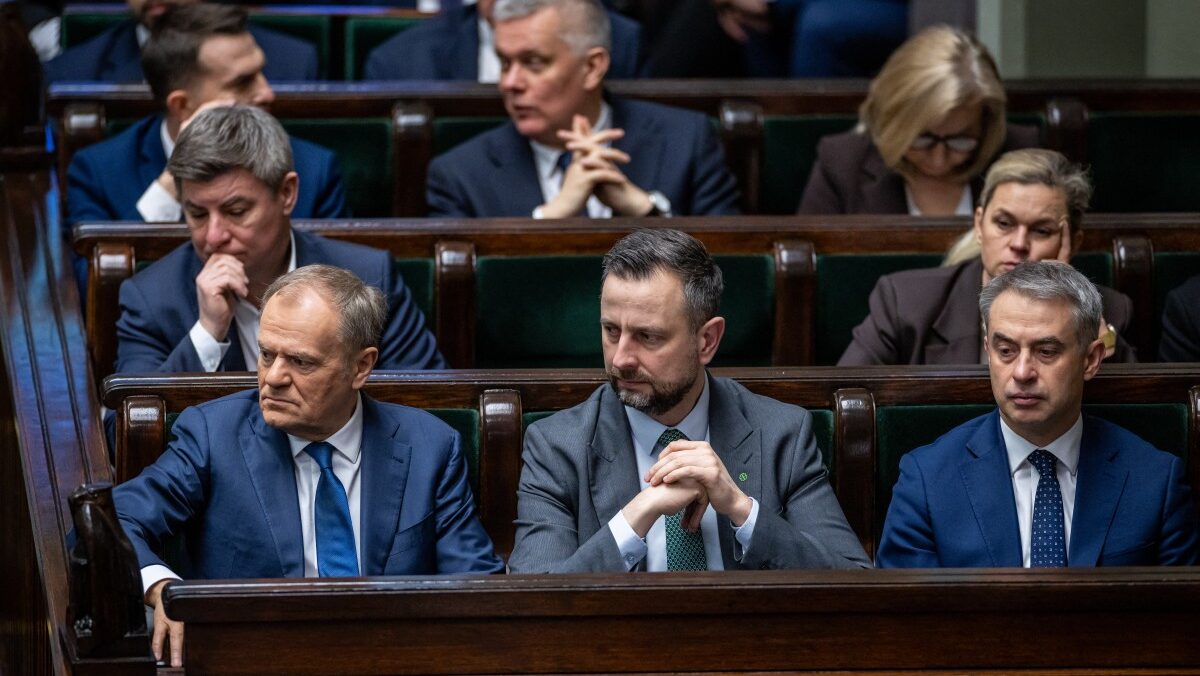
Polish Prime Minister Donald Tusk, Defence Minister Władysław Kosiniak-Kamysz and Digital Affairs Minister Krzysztof Gawkowski
Wojtek RADWANSKI / AFP
Poland’s government has moved forward with plans for a new “digital tax” on major online platforms, opening a potential clash with the opposition, the presidential palace, and the United States after the proposal was added to the legislative agenda.
The draft, led by Deputy Prime Minister and digital affairs minister Krzysztof Gawkowski, would impose a tax of up to 3% on revenue from selected digital services provided in Poland, including targeted online advertising, platforms connecting users, and the sale of user data. It would apply to companies with global revenues above €1 billion and more than 25 million zloty in taxable revenue in Poland, regardless of where they are headquartered, and would be reduced by corporate income tax already paid in Poland.
Announcing the move, Gawkowski said global platforms often pay less tax than local firms and argued the measure would create fairer competition while raising billions of zloty for the state.
The proposal, however, faces political resistance. President Karol Nawrocki is seen as a possible obstacle, and Finance Minister Andrzej Domański has previously said there is a “very, very low chance” the tax will ultimately be introduced.
Critics have also questioned who would really bear the burden. Earlier reporting on the ministry’s 2025 plans cited warnings from Janusz Cieszyński, a former digital affairs minister from the Law and Justice (PiS) camp, that the measure could fall heavily on Allegro and end up functioning less as a tax on foreign tech giants than on Polish e-commerce.
The plan also risks friction with Washington. The United States has consistently opposed digital taxes aimed at its technology firms, and Tom Rose, named as incoming U.S. ambassador to Poland, previously warned that such a move could trigger retaliation from President Donald Trump.
Within the governing coalition, support is uneven. Poland 2050 has backed the proposal, with leader Katarzyna Pełczyńska-Nałęcz calling it “a very good solution,” while Prime Minister Donald Tusk has not publicly embraced it.
Even if the bill clears parliament, it could still be stopped by a presidential veto.