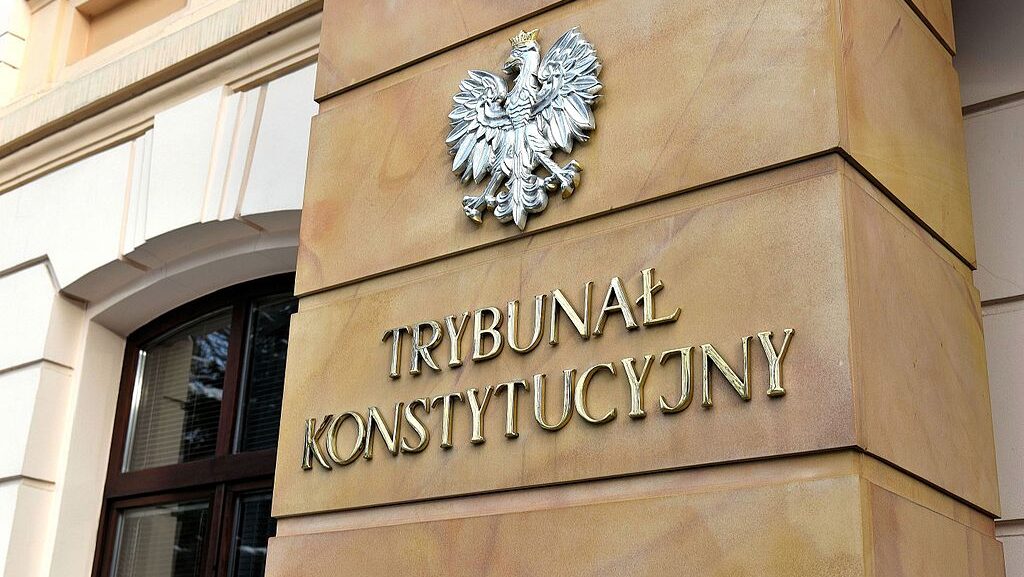
Entrance to the building of the Polish Constitutional Tribunal
Photo: Adrian Grycuk, CC BY-SA 3.0 PL, via Wikimedia Commons
Poland’s Trybunał Konstytucyjny (Constitutional Tribunal, or TK) court has found that parts of the 2025 state budget that cut funding to itself and the National Council of the Judiciary (KRS) are unconstitutional.
Conservative Polish President Andrzej Duda signed the budget in January but asked the TK to check the legality of some of its provisions, his aide insisting at the time that the bill “cannot result in any blocking of the payment of remuneration of legally appointed judges of the Constitutional Tribunal or the National Council of the Judiciary.”
But Donald Tusk’s Brussels-friendly government will likely ignore the ruling, given that it does not recognise the TK’s legitimacy. The court remains filled with judges appointed by the former Law and Justice (PiS) administration and has previously been referred to the European Court of Justice by the European Commission for “challenging the primacy of EU law.”
The budget would see funds to the KRS reduced by 23% compared to what it had requested, and funds to the TK cut by 17%.
Przepisy budżetu państwa na 2025 rok na mocy których zmniejszone zostały środki dla Trybunału Konstytucyjnego i Krajowej Rady Sądownictwa są niekonstytucyjne – orzekł dzisiaj Trybunał Konstytucyjny. #RozprawaTK K 2/25https://t.co/JRbBusS1E5
— Trybunał Konstytucyjny (@TK_GOV_PL) May 6, 2025
An official document from the court said that
Such a fundamental change, unprecedented in the history of the functioning of both of these institutions, effectively hindered their full and efficient implementation of their unchanged, constitutional and statutory obligations, and the regulation of liabilities.
The body will now be watching closely for how the government responds to its demand for the budget to be updated immediately, but should not hold its breath. Supreme Court judge Kamil Zaradkiewicz said he would be “surprised if the government complied with the ruling, except that failing to take the initiative will have specific legal consequences in the future.”
Teraz ruch należy od Rady Ministrów, która ma w zakresie ustawy budżetowej wyłączną inicjatywę ustawodawczą. Oczywiście zdziwiłbym się, gdyby rząd zastosował się do wyroku, tyle że niepodjęcie inicjatywy będzie miało w przyszłości określone skutki prawne (niewykluczone, że… https://t.co/w6lG5xAHKr
— Kamil Zaradkiewicz (@Zaradkiewicz_K) May 6, 2025