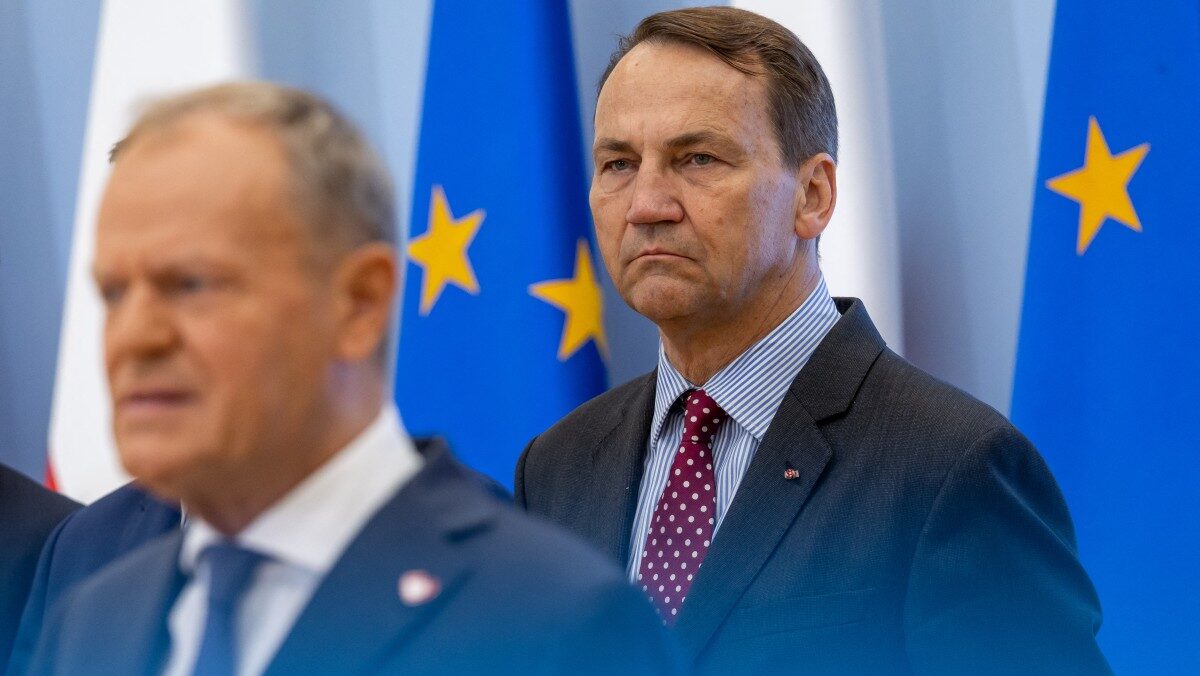
Polish PM Donald Tusk (left) and Foreign Minister Radosław Sikorski.
Photo: Wojtek Radwanski / AFP
Polish PM Donald Tusk has presented a cabinet reshuffle proposal to steady his fragile left-leaning coalition, shaken by the conservative Law and Justice (PiS) party’s electoral win two months ago.
Ever since the victory of President-elect Karol Nawrocki, Tusk’s Civic Coalition (KO) has been dropping in the polls, which emboldened junior coalition partners to push for more power in the government.
The center-right Poland 2050 wanted a new deputy prime minister post for itself, while the Polish People’s Party (PSL) even suggested replacing Tusk with its leader, Defense Minister Władysław Kosiniak-Kamysz. Both of these demands were ultimately dismissed.
Instead, Tusk opted to promote Foreign Minister Radosław Sikorski to deputy prime minister, replace several other ministers, and slash the number of ministries from 26 to 21, arguing that he wanted “not the biggest government, but the best one.”
Perhaps the biggest surprise is the replacement of Justice Minister Adam Bodnar, the architect of Poland’s so-called “transitional justice” system, which allowed the government to disregard virtually any law introduced by the previous conservative administration while persecuting and imprisoning several top figures of the PiS.
All this led to the public prosecutors, on behalf of the Constitutional Court, launching an official probe against Bodnar and his colleagues on a suspicion of “coup d’état” and undermining the country’s legal order, which the Tusk government similarly disregarded.
Bodnar also came under fire from within his own camp over the slow pace of judicial reforms, which allegedly led to Tusk now replacing him with Krakow District Judge Waldemar Żurek, a vocal critic of the former PiS government.
Tusk also announced two new ‘super ministries’—an energy ministry that will be led by Miłosz Motyka (PSL) and an economy ministry added to the portfolio of Finance Minister Andrzej Domański (KO).
While the dissatisfaction of PSL is addressed, the threat of rebellion from Poland 2050 has only been exacerbated by the changes. Not only did the party not get the deputy premiership it asked for, but its climate and environment portfolio has also been weakened by taking energy out of it and giving it KO in the new ‘super ministry.’
Rumors about Poland 2050’s possible defection to the conservative side—which could collapse the entire government—began circulating when its party leader met the head of PiS in secret a few weeks ago, reportedly to discuss ways to “save Poland” amid Tusk’s apparent impotency to address the migrant crisis on the German border.
Both PiS and Poland 2050 deny planning an alliance, but the episode has left a lasting stain on the public image of the prime minister. More recent reports suggest Tusk may even be planning to step down early if he doesn’t manage to consolidate his grip on power soon.