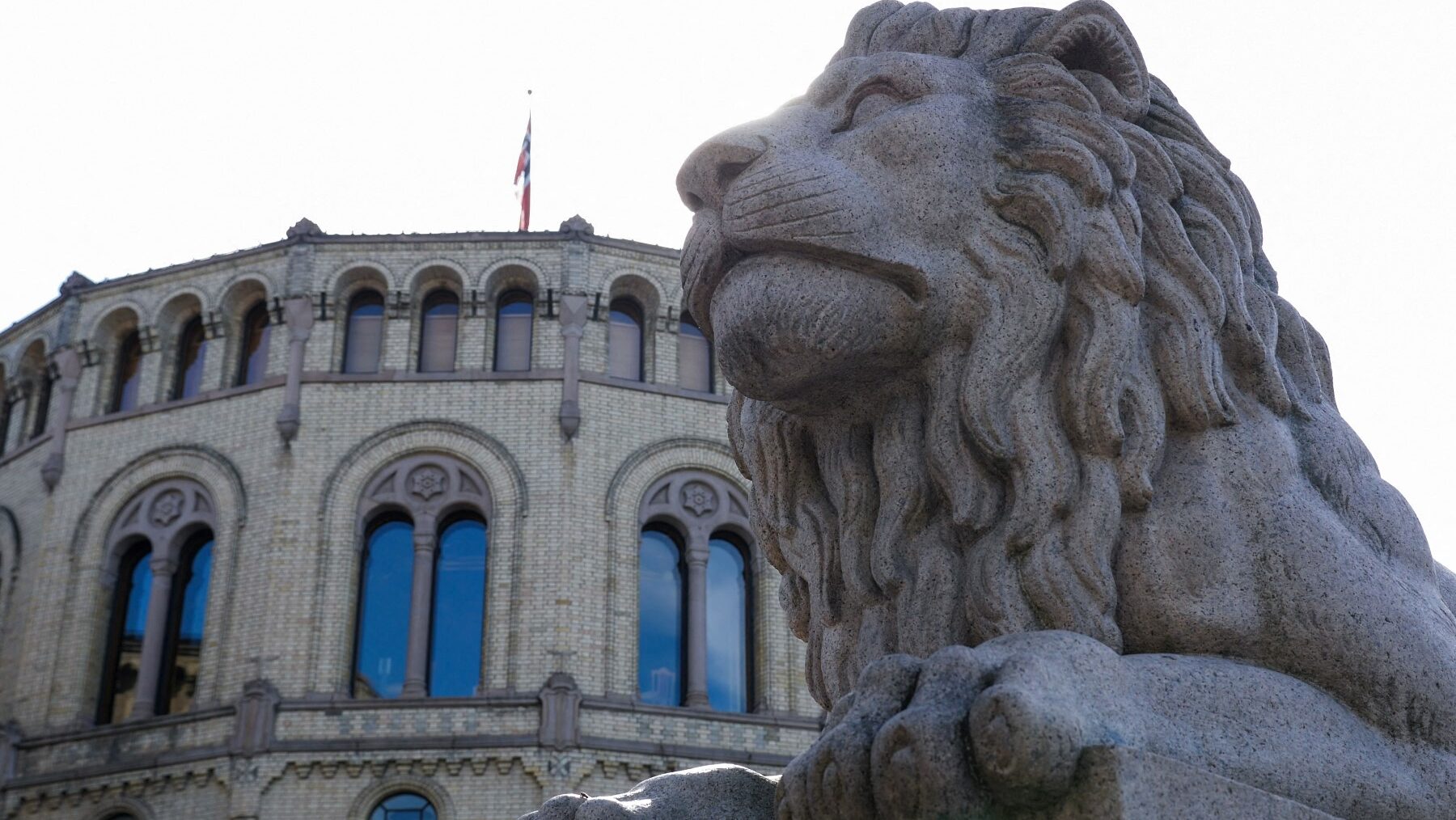
A lion statue in front of the Norwegian Parliament in Oslo, ahead of the parliamentary elections. Norwegians go to the polls on September 8, 2025 for the legislative elections.
Petter Berntse / AFP
As Norwegians head to the voting booth on Monday, defense, the economy, and immigration are high on voters’ minds. Energy policy is also central, with tensions over Norway’s oil-dependent economy versus the push for renewable energy transitions and EU directives on electricity markets.
PM Jonas Gahr Støre’s social democratic Labor Party (Ap) government, formed in 2021 with the Euroskeptic Center Party (Sp), cracked in January 2025 over disagreements on implementation of the next EU energy package, leaving Ap to govern alone. The party hit an all-time low in the polls in late 2024, dropping to 16.8% in December.
Enter former NATO chief Jens Stoltenberg. With the well-respected statesman’s return to domestic politics—as finance minister—in February, the governing party’s ratings got a boost. The ‘Stoltenberg effect’ has brought voter support up to around 27–30% by August 2025.
Political scientist Johannes Bergh told AFP that U.S. President Trump’s trade policies and questions over U.S. willingness to defend Europe militarily have also shifted Norwegians towards the well-known leaders of Ap, who have been campaigning under the slogan “Security for the Future.” Finding consensus with the four other leftist parties they would need for support might be a challenge, however.
On the Right, the Progress Party (FrP), Norway’s right-wing populist party, has surged in polls and is currently the country’s second biggest party. Founded in 1973 to fight high taxes and government overreach, the FrP is known for its advocacy of economic liberalism, tax cuts, and stricter immigration policies.
The party has doubled its support since the 2021 elections (11.6%) under leader Sylvi Listhaug and has overtaken the center-right Conservatives (Højre) as the major right-wing force, polling in the 20-22% range (with a high of 26.9% in February) against the Conservative Party’s numbers in the mid-to-low teens.
Norway, InFact poll:
— Europe Elects (@EuropeElects) September 3, 2025
Ap-S&D: 27%
FrP~ECR: 22% (-2)
H-EPP: 14% (+1)
R~LEFT: 7% (+1)
Sp~RE: 6%
SV~LEFT: 5% (-1)
KrF-EPP: 5% (-1)
V-RE: 5%
MDG-G/EFA: 5% (+1)
+/- vs. 12 August 2025
Fieldwork: 02 September 2025
Sample size: 1,109
➤ https://t.co/Df7Nsbqbrl pic.twitter.com/gkBYi9xcDj
Party leader Listhaug caused quite the ruckus back in 2016 when she, as integration minister, warned immigrants that, “Here we eat pork, drink alcohol, and show our faces. You must abide by the values, laws, and regulations that are in Norway when you come here.” But in the years since, FrP’s focus on immigration has shifted the national conversation, influencing even Ap to consider stricter asylum policies.
FrP has called for zero net immigration from “high-risk countries” (e.g., parts of the Middle East, Africa, and Asia), citing integration challenges, crime, and costs to the welfare state. It prioritizes Christian refugees and stricter rules for citizenship, permanent residence, and family reunification. The party’s spokesman on immigration issues, Erlend Wiborg, told Aftenposten, “Over time, Norway has taken in far too many immigrants from these countries. It’s not sustainable and places a heavy burden on taxpayers,” pointing to Sweden as a cautionary example. Currently, about one-fifth of residents are immigrants or children of immigrants.
A key element of FrP’s latest policy proposal is a plan to hold municipalities accountable for integration outcomes. Wiborg suggested introducing publicly available local statistics on crime, employment, welfare dependency, education levels, and social participation. The goal, he said, is to halt immigration to municipalities that are clearly struggling with integration.
“This way, municipalities can also learn from each other, while at the same time stopping all immigration to municipalities that clearly have major integration challenges,” Wiborg said.
The party is also pushing for the establishment of offshore asylum reception centers in third countries—an idea also backed by the Conservative Party, which the FrP hopes to join in a potential future governing coalition. Its projected 39–46 seats in the 169-seat parliament could make it the largest party in a center-right coalition, potentially positioning Listhaug as a prime ministerial candidate, though Høyre’s party leader Erna Solberg is also a contender.