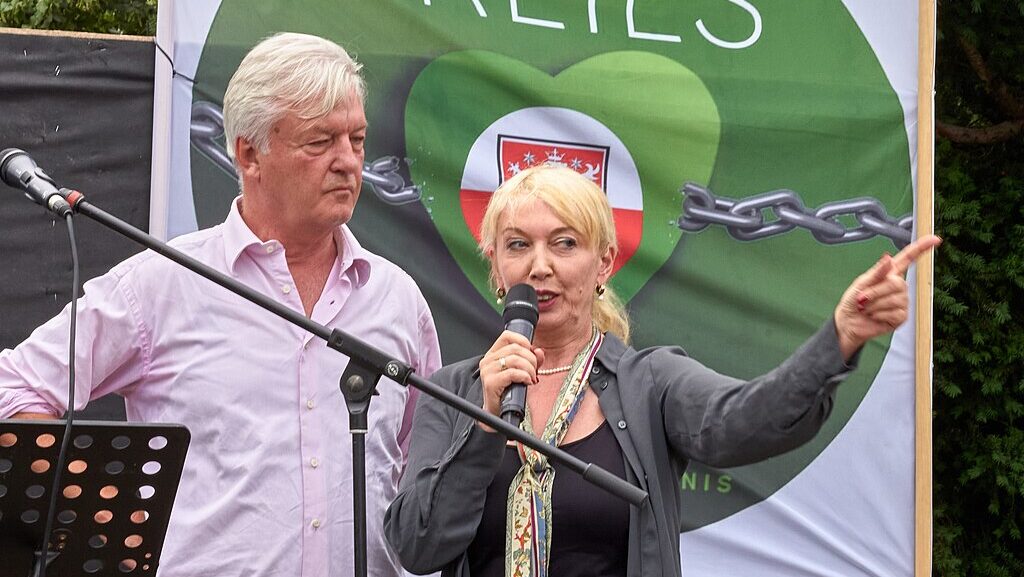
Jürgen and Stephanie Elsässer at the Compact Summer Festival event “WE for Peace and Freedom” in Gera, Germany
Photo: Dirk Bindmann, CC BY-SA 4.0, via Wikimedia Commons
The federal administrative court in Leipzig has started to hear the case regarding the ban of German right-wing magazine Compact.
In what was seen by right-wing commentators as an attempt to curb press freedom and silence conservative voices, the interior ministry last year banned Compact for “inciting hatred” and “aggressively propagating the toppling of the political order.”
The move was unsurprising given the fact that the ruling elites in Germany have for years been persecuting parties, organisations, and even ordinary citizens who dare to criticise the establishment parties and their failed policies.
The court, however, suspended the ban only a month later, claiming that though it had found evidence of Compact “violating human dignity,” upholding a free press takes precedence.
The interior ministry appealed the decisions, and a final ruling on whether the ban was justified is set to be announced as early as this week.
According to editor-in-chief Jürgen Elsässer, the first day of the hearing on Tuesday, June 10th, focused on whether the interior ministry had unlawfully used a law governing associations to ban a press publication. Banning an association is less difficult because it is not protected by the freedom of the press.
Mir gingen heute gleich mehrere Lichter auf, wie man sieht. Tag 1 nähert sich dem Ende! pic.twitter.com/IV5x53VCua
— Jürgen Elsässer (@JurgenElsasser) June 10, 2025
The wider issue being discussed, however, is whether the activities and statements of Compact go beyond the expression of opinion and pose a concrete threat.
Compact is an anti-establishment, anti-immigration publication founded in 2010. It has a circulation of 40,000, an X account that counts 78,000 followers, and a YouTube channel with 512,000 subscribers. Its number of followers has rapidly increased since last year’s ban.
The magazine has been in the crosshairs of the establishment for many years for holding up a mirror to the government on its failed policies, including the decision to allow millions of migrants to enter Germany illegally.
The ban was heavily criticised by conservative media, which called the move an attack on democracy and free speech by a government that has been using every political and legal means possible to undermine its political rival, the second strongest party in Germany, the right-wing Alternative für Deutschland (AfD).
The rhetoric surrounding Compact—saying it had “combatively and aggressively” acted against the constitutional order—is similar to the one being used to stigmatize the AfD which many mainstream politicians also want to ban.
Not surprisingly, mainstream politicians, including then-chancellor Olaf Scholz defended the ban, with Scholz stating that “freedom of the press includes being able to say a lot of nonsense, but there are limits that you can’t overlook.”