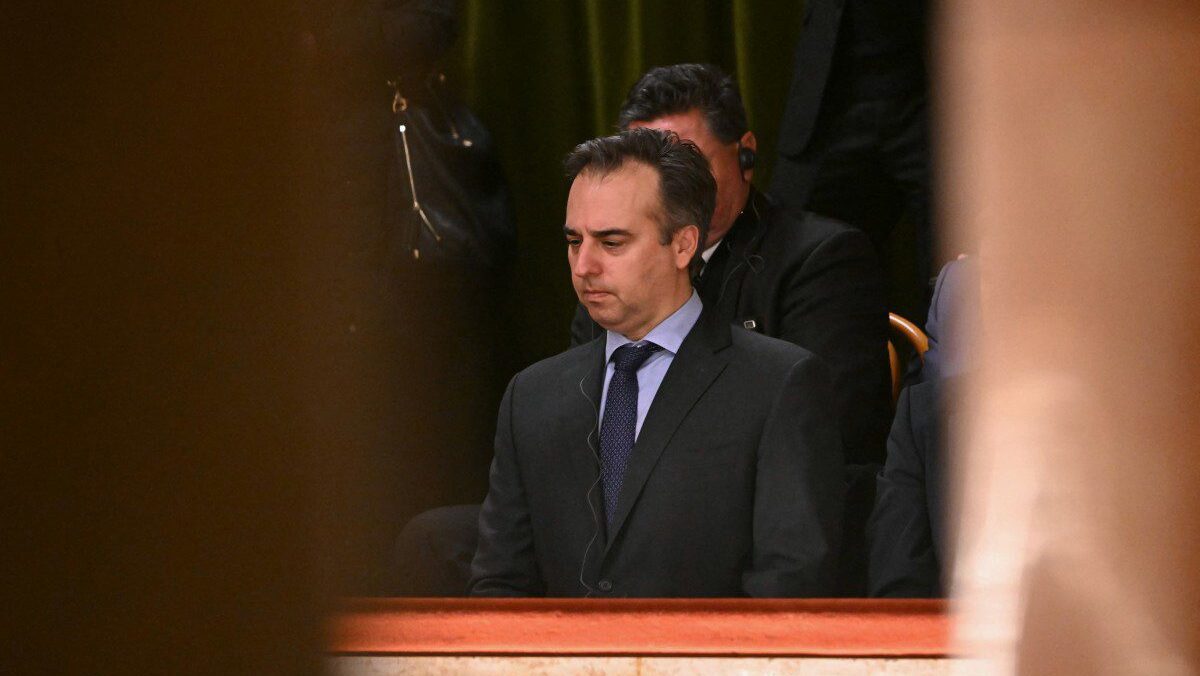
U.S. Ambassador to Hungary David Pressman and other diplomatic representatives of NATO members states follow an extraordinary sitting at the Hungarian opposition’s request to debate Sweden’s NATO bid at the Hungarian Parliament in Budapest on February 5, 2024.
Photo: ATTILA KISBENEDEK / AFP
The Hungarian Parliament will not ratify Sweden’s accession to NATO until Swedish Prime Minister Ulf Kristersson visits Hungary—this was the clear message issued by politicians from the ruling conservative Hungarian Fidesz party on Monday.
“If joining [NATO] is important to the Swedes, they will come here, just like they went to Turkey,” Máté Kocsis, leader of the Fidesz parliamentary group said.
“The Swedish Prime Minister has been invited to visit Hungary to clear the remaining hurdles around their ratification. We hope he accepts and shows that their membership in NATO is an important issue for Sweden,” Hungarian Foreign Minister Péter Szijjártó stressed.
❗️FM Péter Szijjártó: The @SwedishPM has been invited to visit Hungary to clear the remaining hurdles around their ratification. We hope he accepts and shows that their membership in NATO is an important issue for Sweden. pic.twitter.com/E8zMLmmPzh
— Zoltan Kovacs (@zoltanspox) February 5, 2024
The statements came as Fidesz boycotted an extraordinary meeting of parliament on Monday, initiated by left-wing and liberal opposition parties, whose aim was to force a vote on accepting Sweden into NATO. However, parliament lacked the minimum number of MPs for the vote to be valid.
As we previously reported, Hungary is now the only member of the 31-member military alliance that has yet to ratify the accession of Sweden, after Turkey did so two weeks ago. Sweden, along with Finland, reversed its strategy of military non-alignment after Russia’s invasion of Ukraine, and applied to join NATO two years ago. Finland’s accession went relatively smoothly but both Turkey and Hungary delayed a vote on Sweden—the former demanded, amongst other things, anti-terrorist legislation from Stockholm, while the latter has been angered by being lambasted by Swedish high-ranking politicians for its conservative policies.
Prime Minister Viktor Orbán recently tweeted that he backs Sweden’s accession, and invited his Swedish counterpart, Ulf Kristersson to Budapest to discuss bilateral matters, writing in his letter that “the basis of any political or security agreement between Sweden and Hungary must be mutual strong trust.”
Just finished a phone call with @NATO Secretary General @jensstoltenberg. I reaffirmed that the Hungarian government supports the NATO-membership of #Sweden. I also stressed that we will continue to urge the Hungarian National Assembly to vote in favor of Sweden’s accession and…
— Orbán Viktor (@PM_ViktorOrban) January 24, 2024
However, the Stockholm government has made it clear that the Swedish prime minister would only travel to Hungary once the Budapest parliament has ratified the entry of Sweden.
There is increasing pressure on Hungary by Western nations, especially the United States to act. More than a dozen ambassadors from NATO countries attended the extraordinary session of parliament on Monday, including U.S. Ambassador David Pressman who has publicly criticised Hungary’s government on a number of occasions, leading to conservative politicians and media outlets accusing him of overstepping the boundaries of diplomacy.
David Pressman wasn’t shy about sharing his opinion on Monday either, stating:
The Prime Minister pledged to convene parliament, to urge parliament to act at its earliest opportunity, today was an opportunity to do that. We look forward to watching this closely, and to Hungary acting expeditiously.
Meanwhile, the U.S. State Department’s deputy spokesman Vedant Patel told reporters the United States is disappointed that Fidesz blocked an opportunity for a vote on Sweden’s NATO bid. A group of U.S. lawmakers last week called on Orbán to immediately ratify Sweden’s bid, saying patience with Hungary is “wearing thin” as it continues to delay its approval.
The ruling party does intend to vote on the matter, and may give its approval when parliament reconvenes for a normal session at the end of February, “but we are expecting the Swedish prime minister to visit Hungary first,” Fidesz said in a statement on Monday.