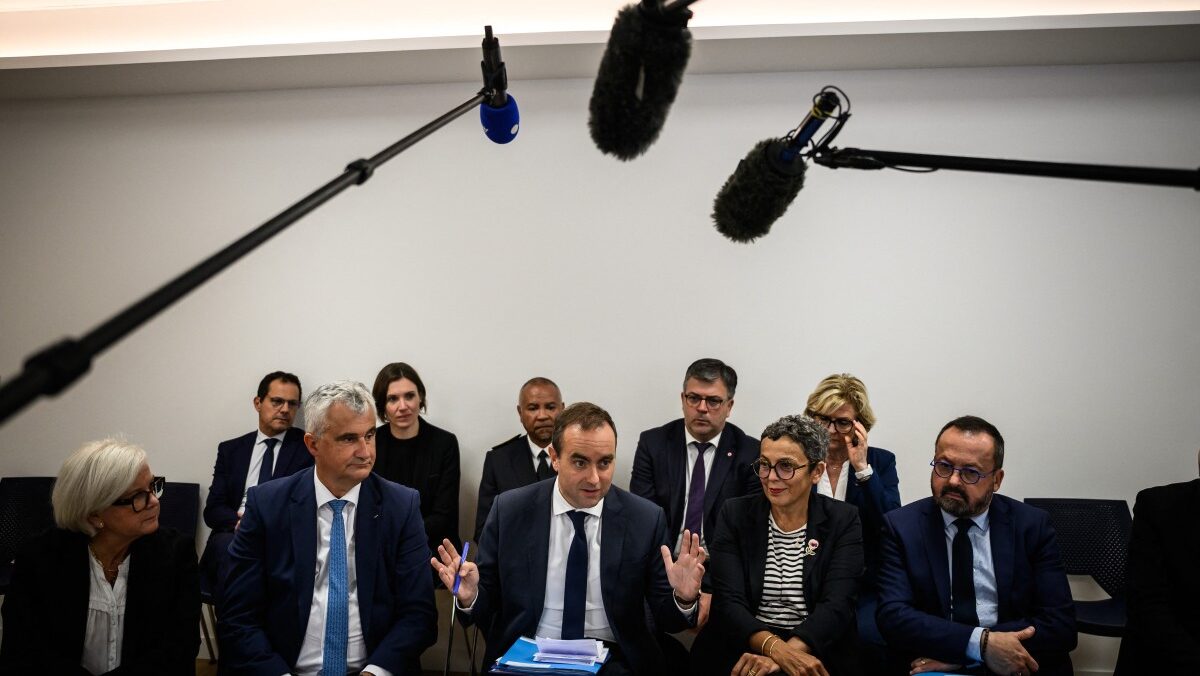
Newly appointed France’s Prime Minister Sebastien Lecornu speaks during a meeting as he visits the departmental health center in Macon, central eastern France, on September 13, 2025.
Jeff Pachoud / AFP
It has been two weeks since Emmanuel Macron appointed a new prime minister, and there is still no government in sight. France seems to be in a state of lethargy, while dark clouds gather on the horizon. The country is suffering, but no one seems to care.
According to Jérémie Iordanoff, Green Party MP and vice-president of the National Assembly, the current situation of stagnation has reached its peak, with “no change whatsoever in the political equation” since the French went back to business in September.
On Friday, September 26th, Sébastien Lecornu will have broken Michel Barnier’s ‘record,’ whose government was appointed sixteen days after he took office at Matignon—something unheard of since the beginning of the Fifth Republic. The appointment of a government normally takes place within three to five days, at most.
For the moment, nothing is happening, even though there is no shortage of urgent issues. The prime minister, without a team, gives the impression of filling time as best he can, with announcements that come to nothing—on the efficiency of state agencies or on reducing the communication resources of ministries. The budget for 2026 has still not been drafted, even though it must be presented to MPs before the end of October. As for new reform projects that could revive a country that is bleeding dry and sinking into chaos, there is no question of them for the moment.
Macron’s entourage had warned that no government would be appointed as long as international affairs, namely the recognition of the Palestinian state and the United Nations General Assembly in New York, were taking centre stage. This delaying tactic is very convenient for the prime minister, who is currently unable to put together a working team. In any case, the project must take precedence over the individuals, Matignon insists. The fact remains that, for the time being, the individuals are conspicuous by their absence.
On Wednesday, September 24th, the prime minister met with the trade unions. Nothing came of the meeting, and a new day of strikes is already scheduled for October 2nd. Lecornu has promised another meeting in the coming days to ‘clarify’ his line. Buying time and doing nothing seems to be the government’s only agenda. No interviews, no public statements, no trips. The whole country seems to be plunged into a strange lethargy. The new speciality of ministerial cabinets is to produce memos and organise meetings that will most certainly serve no purpose.
This organised vagueness at the highest level of government fuels the justified criticism from the opposition, on both the Right and the Left. How can we imagine that the policy of ‘rupture’ announced by the prime minister can be carried out when he has been Macron’s loyal second-in-command from the outset and knows nothing else but to walk in his shadow?
Everyone already knows what is in store: a government that will be nothing more than a repeat of previous teams, with only marginal changes. Many ministers already on François Bayrou’s team are expected to be reappointed, so all the ingredients are in place to fuel public discontent. Why wait, when we know the game is already over?
The presidential camp wants to turn its weakness into a strength: “It means that negotiations are taking place, and that’s how it works in all democracies,” explains centrist MP Erwan Balanant to France Info, no doubt parroting talking points dictated from above. Except that Lecornu isn’t meeting with many people and isn’t negotiating much. Nothing democratic in all that.
On the National Assembly side, the parliamentary session is set to open on Wednesday, October 1st. On that date, elections will be held to renew administrative positions in parliament. The prime minister could wait to see what the new office at the Palais Bourbon will look like before announcing his government, according to several ministerial sources. This is a sign of a man who does not know where he is going or what he should do.
These internal power struggles have one main effect: they wear down public opinion and convince the public, more than ever, of the government’s inability to reform the country. There is no longer even any expectation of renewal, just a huge sense of resignation—not to say despair. There are still twenty months to go before the presidential election. By then, the French people’s disgust for their political class will certainly have reached new heights.