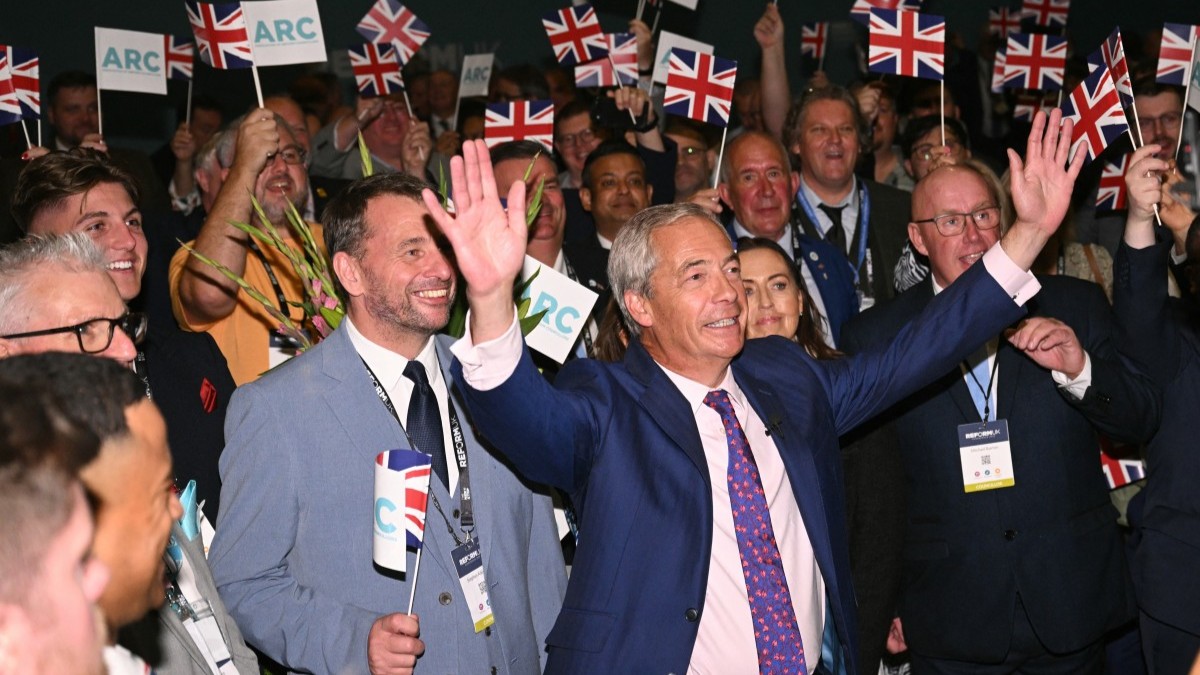
Reform UK Leader Nigel Farage with supporters on the second and final day of the Reform UK party conference at the NEC Birmingham, central England, on September 6, 2025.
Oli Scarff / AFP
Reform UK’s annual conference in Birmingham this weekend marked a decisive moment for Nigel Farage’s party. Commentators called last year’s gathering a fringe event; this year, they had to acknowledge it was the main show in town, drawing thousands of activists, corporate sponsors, and widespread media attention.
On the main stage, Farage said the resignation of Labour Deputy PM Angela Rayner was proof that Keir Starmer’s government was “imploding” after barely a year in office. Meanwhile, the Conservatives were “in a trance,” while the Liberal Democrats had become “irrelevant.” That left Reform as the only party with real momentum—and potentially on the path to power.
The mood among attendees reflected this sense of political opportunity. They were not the usual lobbyists or party insiders, although the likely next party of government naturally attracted a few. These were real, committed activists, many wearing turquoise Make Britain Great Again caps and Reform-branded football shirts with Farage’s name on the back. Others came simply to learn more about the party’s ideas. Mixed with the optimism was a sense of urgency: “This is Britain’s last chance!” was a refrain heard repeatedly.
If journalists from the legacy media were paying attention to ordinary members, they would have quickly realised how inaccurate several common myths about Reform really are.
First, the claim it is just a one-man band. Farage undoubtedly dominates headlines, and the party would not be where it is today without him. Yet members spoke far more about policies than personalities. Many said they would remain with Reform even if Farage stepped aside.
Second, the idea that Reform is simply the Conservative Party in exile, waiting to return once the Tories recover. Most members were not ex-Tories at all. Many had never been involved in politics before. They described feeling let down by successive governments and said no Conservative leader would win back their trust.
Third, the notion that Reform has no serious plan for government and will collapse through lack of preparation. Judging by the quality of the fringe events, the party now has heavyweight advisers and policy thinkers. Speakers discussed measures such as leaving the ECHR, repealing Tony Blair’s Human Rights Act, abolishing the Supreme Court, and restoring the role of the Lord Chancellor.
The main hall was packed, sponsorship deals were on display, and the overall atmosphere was one of optimism and growth. Heathrow Airport backed the event, the Institute for Government hosted seminars, and corporate packages costing up to £60,000 offered opportunities ranging from branding Reform buses to champagne breakfasts with Farage himself.
The combination of set-piece speeches and full side events showed how far the party has come in building intellectual and cultural depth beyond its leader. Reform UK now boasts its own academics, media figures, and activists—evidence of a movement turning itself into a full-fledged political force.
Attendees skewed younger and more working-class than at Labour or Conservative gatherings, many dressed in ordinary clothes rather than suits. Lobbyists and journalists stood out in contrast.
The Birmingham conference confirmed that Reform UK has captured political energy missing from Britain’s traditional parties. With Labour distracted by resignations and reshuffles, and the Conservatives struggling to define themselves in opposition, Farage’s “turquoise tide” is rising fast. What was once dismissed as a fringe movement now looks increasingly like a national contender—one that could redefine Britain’s political landscape in the years ahead.