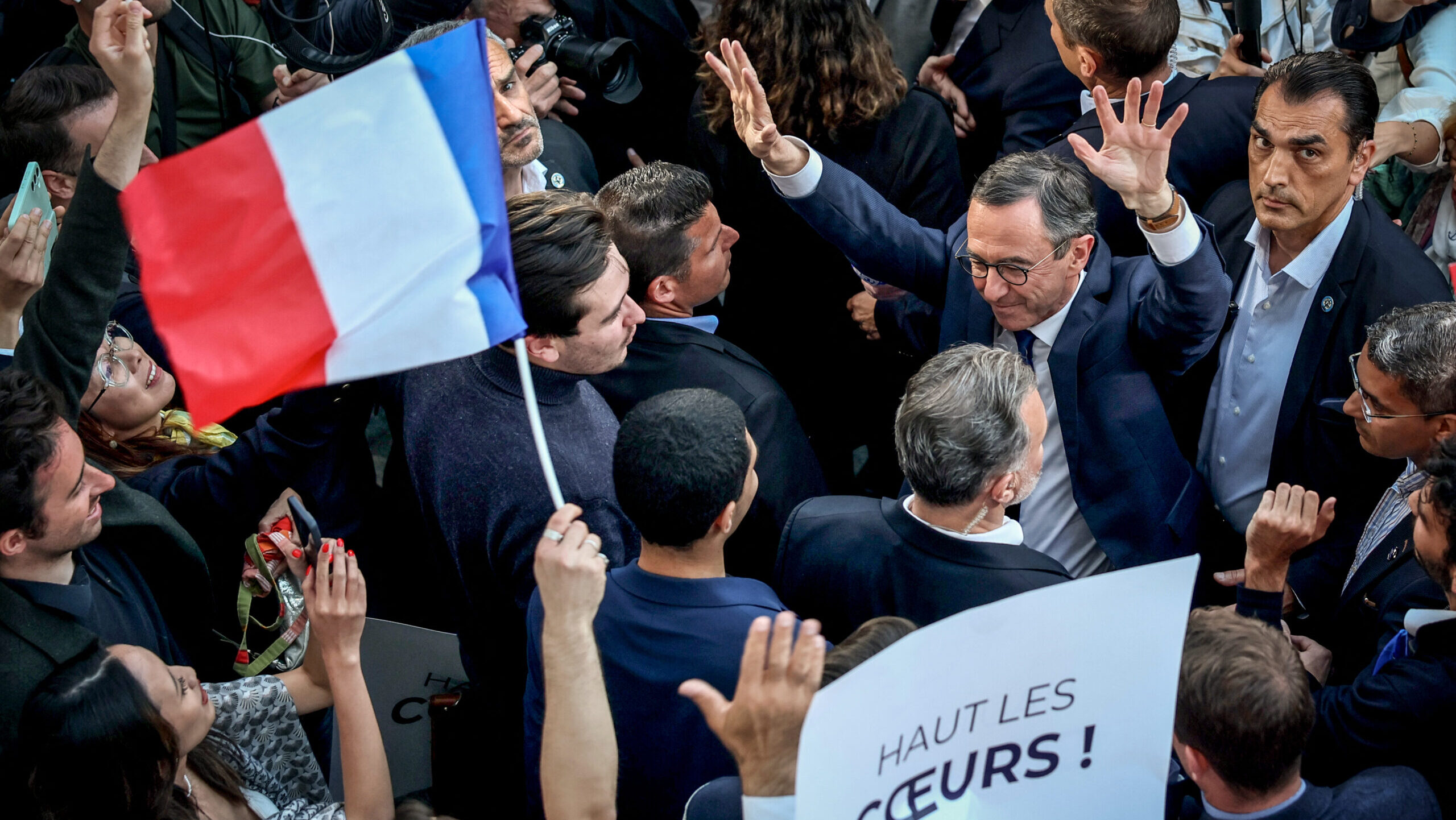
France’s Interior Minister Bruno Retailleau celebrates with supporters, surrounded by reporters, as he leaves French party Les Républicains (LR) headquarters following his election as LR’s president in Paris on May 18, 2025.
Photo: Kiran Ridley / AFP
The French right-wing party Les Républicains (LR) elected a new president on Sunday, May 18th, in the form of Bruno Retailleau, the current minister of the interior, who defeated his rival Laurent Wauquiez, former president of France’s second-largest region. Retailleau won with 75% of the vote. Although the majority of party members placed their trust in him, his political roadmap remains unclear.
Polls had shown Bruno Retailleau as the clear winner for several weeks. Laurent Wauquiez, leader of the Republican Right in the National Assembly, had hoped to spring a surprise, but was unable to defeat an opponent who has been well-established in the media since his arrival in government and who enjoys strong support both among the general public and among LR party activists.
For many years, the Les Républicains party has been undergoing a profound crisis of legitimacy. Once at the heart of French political life and heir to Gaullism, it has failed to reach the second round of the presidential elections for several elections, losing out to Marine Le Pen’s Rassemblement National. In the last elections, it failed to pass the 5% threshold that would have entitled it to reimbursement of its campaign expenses by the state. It is paying the price for its politically unclear discourse, its shift towards the centre, its repeated compromises with Emmanuel Macron, and its inability to work effectively towards a union of the Right that would allow crucial policies on immigration, crime, and public spending control to be implemented.
In this context, Retailleau’s victory is an ambiguous result. Retailleau is seen as the new hope of the Right and has gained support thanks to his firm stance since joining the government on issues such as resistance to Algeria. But his presence in government also proves that he remains tempted by an alliance with the centre, and his tough talk has so far had little effect. His rival, Laurent Wauquiez, based his campaign precisely on his desire to see the party play a full opposition role, rather than acting as a sidekick to Macronism. He strongly denounced the “common ground” (socle commun), i.e., the alliance between the Right and the centre that supports the current government. He called for “rupture” to avoid being “diluted” by macronism, but few were willing to follow. As a result, Retailleau’s credibility as the embodiment of the renewal of the French right-wing government may be only superficial. If he is simply there to provide the votes that Macron’s successor needs to win, what is the point?
Proof of the ambiguity of this victory: the day after the election, the central bloc said it was “relieved,” according to the newspaper Le Monde. Retailleau announced that he was staying in the government, and the prime minister offered him “warm congratulations” on his “magnificent victory.” Former Prime Minister Gabriel Attal, Macron’s protégé, also expressed his joy, as did Xavier Bertrand, the unsuccessful candidate in the 2022 LR primary, a centrist violently hostile to the right-wing ‘excesses’ of his former party.
Their enthusiasm is understandable: with this “magnificent victory,” the question of the LR’s participation in the government has been settled for many months to come.
Some observers want to rejoice at this new chapter opening for the historic right-wing party. Laurent Wauquiez and Bruno Retailleau are both convinced of the need to work, sooner or later, for the unity of the Right, and have made the fight against immigration the core of their commitment. But the terms of this imaginary unity of the Right remain unknown. A certain Nicolas Sarkozy, a few years ago, had the skill to stake everything on an ‘authentic’ right-wing discourse—only to end up, once in power, handing the keys to power to left-wing ministers in his government. In politics, scenarios have an unfortunate tendency to repeat themselves, so once again, caution is advised.
Éric Ciotti, former president of LR, who was dismissed for wanting to form an alliance with the RN during the last legislative elections, remained very cautious when the results were announced:
“I hope he will also follow me in the union of the Right, the only way to lift France up, and that he will not remain a prisoner of the dying macronism that has ruined the country,” he wrote on X.
At the same time as the election of Retailleau is announced, Ciotti is publishing a book in which he recounts his dismissal from LR and the decision to ally with the national Right. The title? Je ne regrette rien (I regret nothing).