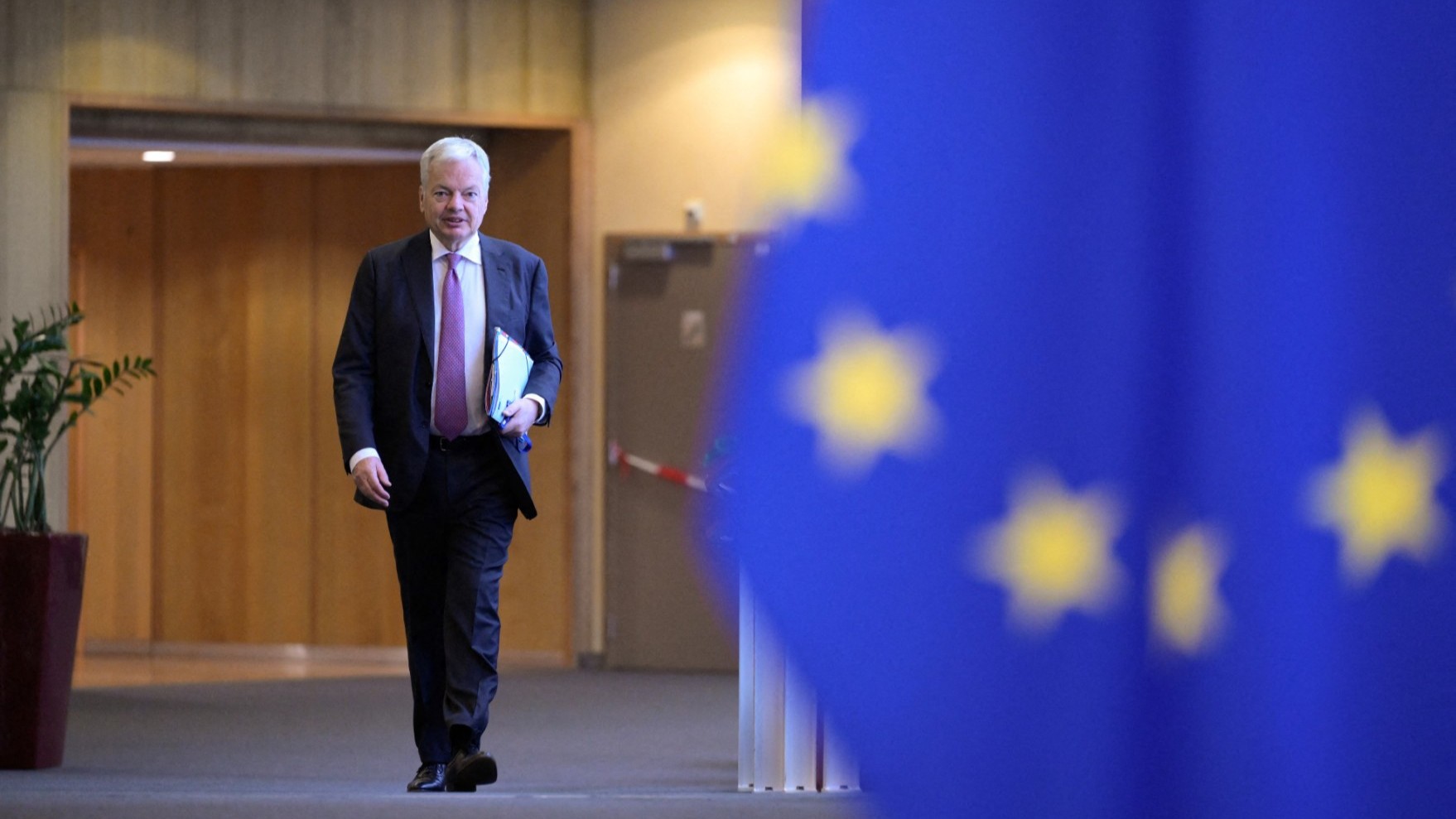
EU Commissioner for Justice Didier Reynders arrives for a College meeting at the EU headquarters in Brussels on October 30, 2024.
John Thys / AFP
Former Belgian deputy prime minister and ex-European commissioner Didier Reynders has been formally charged with money laundering by Belgian authorities. The move follows a long-running investigation into suspicious financial transactions involving close to one million euros, revealed by Le Soir, De Standaard, and Follow the Money.
Reynders was questioned on October 16th by investigating judge Olivier Leroux, who later filed charges that include one or more potential additional crimes, the exact legal classification of which remains unclear. This designation means that Reynders and his legal team now have greater rights to defend themselves: they can access the case files and request further investigative steps. The former politician is not in custody and remains free while awaiting further developments.
Reynders’ wife, Bernadette Prignon–an honorary judge at the Court of Appeal in Liège–was also questioned shortly after her husband, but no charges were brought against her.
In December 2024, just a few days after Reynders’ mandate as (ironically) Commissioner for Justice expired, Belgian authorities raided his home on suspicion of money laundering. The investigation has focused on the origins of close to 1 million euros. Reynders is suspected of having laundered about 700,000 euros through his personal bank account for a decade, between 2008 and 2018. He then allegedly started laundering some 200,000 euros by buying large amounts of lottery tickets and transferring any winnings to that personal account.
Brussels prosecutors are also investigating Reynders’ bank, ING Belgium, in connection with the corruption case. ING previously said it could not provide details “due to data protection and legal obligations,” but stated that it is “strongly committed to fighting financial crime” and “invests significantly in detecting money laundering practices.”
It remains unclear how Reynders obtained the money but he will have to prove that he acquired it legally. However, sources close to the case say that Reynders told Belgian investigators and ING Bank in 2018 that the funds came from the sale of art and antiques.
The news of the raids may not come as much of a surprise to Belgians, as Reynders has been accused of high-level corruption several times before. Yet the politician has so far managed to evade prosecution, earning him the nickname ‘Teflon Didier’ in Belgium.
High-level corruption scandals are nothing new in the heart of the European Union, but the fact that police have opened a criminal probe into the very person who, until recently, was responsible for overseeing the rule of law across the EU adds a level of irony rarely seen in European politics. The former liberal politician (MR/Renew Europe) was previously tasked with “upholding the rule of law” and played a central role in launching politically charged infringement procedures against the conservative governments of Poland and Hungary.
Reynders has not commented publicly on the charges, and his legal team has maintained that he will only respond officially within the framework of the judicial process. As the investigation moves forward, the case could become one of the most significant political and legal scandals in Belgium’s recent history.
Lukács Fux is currently a law student at Pázmány Péter Catholic University in Budapest. He served as an intern during the Hungarian Council Presidency and completed a separate internship in the European Parliament.