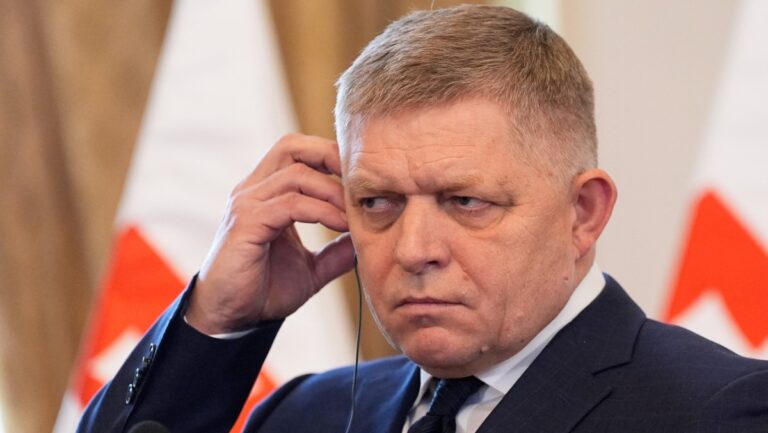
D66 leader Rob Jetten cuts a cake as he as he delivers remarks to journalists at the Lower House, the day after the Dutch parliamentary election, in The Hague, on October 30, 2025.
Simon Wohlfahrt / AFP
The Netherlands has held its first election after more than two years of government crisis. The big winner in the vote was the liberal D66 party led by Rob Jetten, a former climate and energy minister, while Geert Wilders’ anti-immigration PVV and the left-wing PvdA coalition, which had been considered strong contenders, performed worse than expected. The country is now expected to be led by a centrist-to-center-left coalition.
After the votes were tallied, D66, led by 38-year-old up-and-coming Jetten, was projected to win 26 seats in the 150-seat Dutch parliament, 11 more than in the previous general election in 2023. The right-wing PVV led by Geert Wilders is also expected to win 26 seats, well below its 2023 results. Center-right VVD will likely have 22 seats, left-wing GL-PvdA 20, and centrist CDA 18 seats.
Jetten said the result showed that “it is possible to defeat populist movements,” adding
Millions of Dutch people have chosen today positive forces and a politics where we can look forward together again.
Jetten has emulated former U.S. President Barack Obama in a ‘yes we can’-style campaign focused on political stability, economic renewal, and European cooperation.
Rob Jetten emphasized that he expects to have to cooperate with many parties in order to form a government, but at the same time said that he wants to create “a stable and ambitious cabinet,” made up of a “broad political center.”
His statements hint at a possible collaboration with the pro-migration green-socialist GL-PvdA, centrist CDA, and center-right VVD. This formula would have a comfortable majority of 86 out of 150 seats in the House of Representatives.
However, VVD campaigned forcefully against GL-PvdA and its leader Frans Timmermans, favoring instead an alliance with right-wing forces, including JA21. The departure of Timmermans, who announced his resignation as leader of the leftist alliance after a disappointing election result on Wednesday night, could pave the way for the VVD to change its stance, but there are no guarantees those talks will succeed.
In any case, it seems certain that Geert Wilders’ party will not be a member of the new government, as Jetten’s D66—along with other major parties holding about two-thirds of parliamentary seats—has ruled out long-term political cooperation with it.
The new government must quickly find solutions to the country’s complex housing and nitrogen pollution crises, as well as simmering anti-immigrant sentiment. This will be no easy task, as the parties have radically different ideas about how to deal with both the energy crisis and the country’s migration problems.
Jetten, for example, ran a strong campaign advocating a return to hardline progressive green politics. The party aims for the Netherlands to run entirely on green energy by 2035, pledging to close all remaining coal-fired power plants by 2030 and to end sales of new gas-fired boilers from 2026. Millions of households will need to switch to electric systems or heat pumps, a change that could be financially unfeasible for many and put huge pressure on the energy grid.
Meanwhile, the party’s migration policy has been shifting to the right, with Jetten calling for taking back control over migration. D66 argues that the current international asylum regulations no longer reflect the realities of the 21st century and therefore need to be revised. However, the party’s program also includes support for the binding implementation of the European Migration Pact, which is strongly opposed by member states that want to retain national sovereignty over the issue, primarily Hungary, Poland, and Slovakia..
Left-wing and Green politicians argue D66 has shifted to the right to appeal to more conservative voters. Jetten rejects this assumption, saying
It’s not about tightening, but about rationalization. The goal is to make migration predictable, fair and humane—not a political hostage.
Lukács Fux is currently a law student at Pázmány Péter Catholic University in Budapest. He served as an intern during the Hungarian Council Presidency and completed a separate internship in the European Parliament.