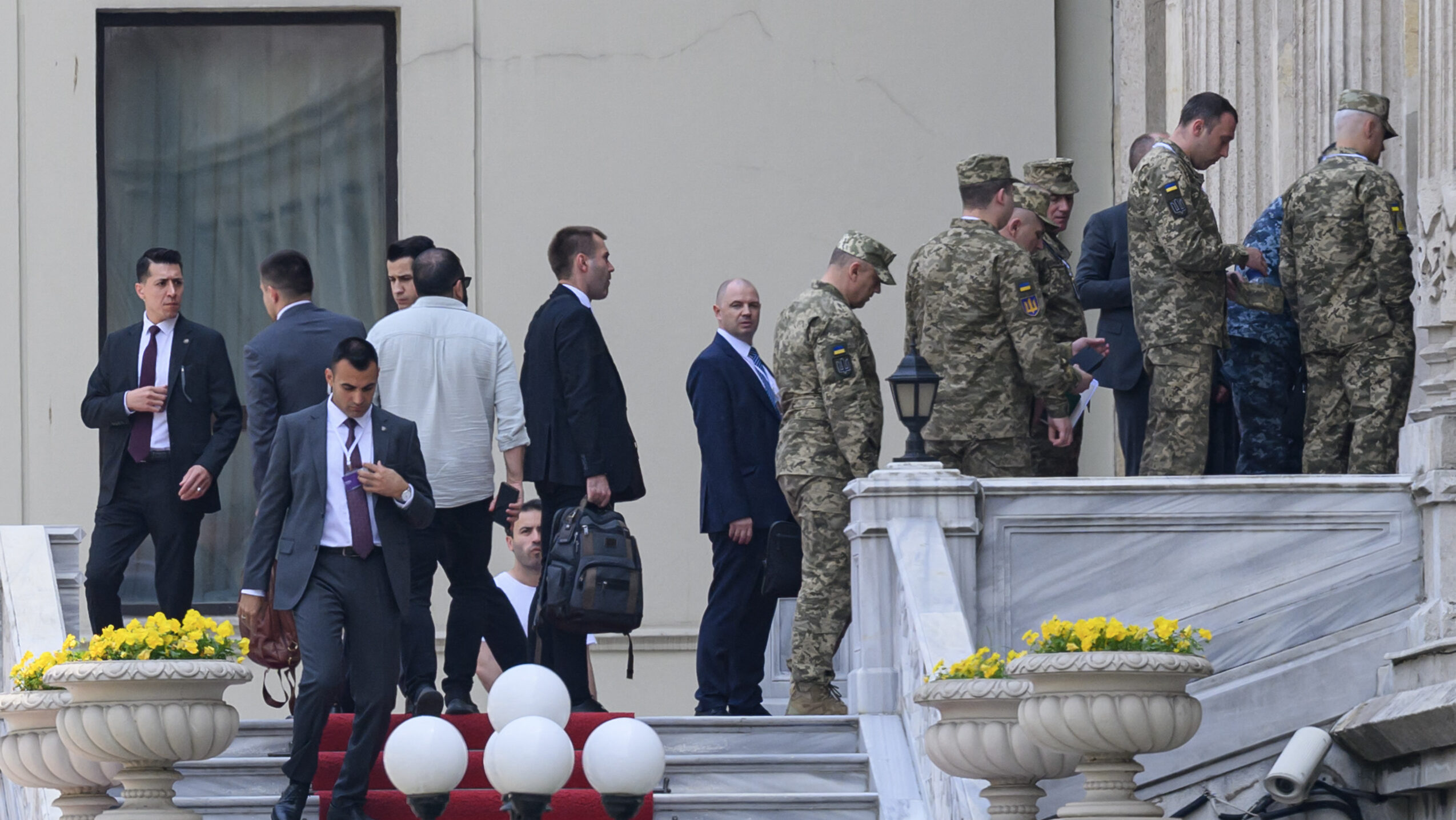
Members of the Ukrainian delegation in Istanbul.
Photo: Yasin Akgul / AFP
The second round of direct Russian-Ukrainian peace talks in Istanbul ended abruptly after barely an hour on Monday, June 2nd, just a day after Kyiv surprised friends and foes alike by conducting a highly sophisticated covert attack against multiple airbases on Russian soil with unprecedented scale and precision.
The aim was to demonstrate Russia’s vulnerabilities, hoping it would be more ready to accept Ukraine’s peace conditions, but Russia’s ‘Pearl Harbor’ might have ended up pushing it in the opposite direction and causing negotiators to walk away from the table.
The talks began two hours later than scheduled, with no explanation given for the delay. No immediate information is available on why exactly the discussion ended and which side broke it first—but it’s likely that the Russian team would not have wanted to seem overly open to negotiations at home after suffering such a major humiliation.
The current meeting marks the second time Russian and Ukrainian officials have conducted direct talks since the early stages of the war. The initial peace talks in Turkey broke down in May 2022 when the Ukrainian delegation (acting under Western pressure) left the table, to resume the process only last month at the initiative of U.S. President Donald Trump.
The first round of talks, on May 16th, ended without any major breakthrough—no peace or ceasefire conditions agreed upon—except for a large-scale prisoner swap that saw 1,000 troops set free on both sides.
This time, Ukraine came prepared, suggesting a comprehensive roadmap for further talks. According to the blueprint, which was sent to the other side the day before, Kyiv upholds its demand for an unconditional 30-day ceasefire as a prerequisite for everything else, followed by the return of all POWs from both sides as well as the Ukrainian children allegedly abducted by Russia.
All further details of an eventual, lasting peace should be discussed with both the U.S. and the EU involved, the document states. However, Kyiv already rejects any deal that would involve withdrawing beyond the current frontline (as suggested by Russia’s ‘buffer zone’ plans) or the international recognition of any occupied territories, including Crimea; adding that any peace requires robust and ‘credible’ security guarantees from the West.
This last bit will be tricky to arrange, as Russia’s key demand is a written pledge from Western allies that NATO won’t expand further to the east, guaranteeing Ukraine’s neutrality. Moscow’s list also includes lifting all Western sanctions, releasing its frozen assets held in European banks, as well as the protection of minority and language rights of the ethnic Russian community remaining in Ukraine.
Monday’s talks, however, began at a particularly tense time, following a series of major escalations from both sides. It began with multiple sabotage attacks against Russia’s railway infrastructure, one of which derailed a passenger train in Bryansk, killing seven civilians and injuring another seventy, on May 31st. Shortly after, Ukraine managed to blow up a military freight train in occupied Zaporizhzhia, destroying Russia’s ‘key logistical artery’ toward Crimea in the process.
Then, on Sunday, June 1st, Ukraine conducted its largest and most elaborate operation inside Russia to date, striking 41 aircraft—including nuclear-capable strategic bombers—with over a hundred drones across five air bases, two of which are located in Siberia, four thousand kilometers from Ukraine. The hardest part involved smuggling the drones across Russia before activating them simultaneously, and the attack reportedly took 18 months to set up.
According to Ukraine, ‘Operation Spider Web’ caused approximately $7 billion in damages to Moscow and disabled a third of Russia’s cruise missile-carrying aircraft. President Zelensky called it “brilliant,” and something that will enter the history books.
Russia immediately retaliated by launching over 470 drones against Ukraine on Sunday, the largest number in a single day since the start of the war, in an attempt to overwhelm Ukrainian air defenses. Ukraine managed to down three-quarters of them, while the rest killed 12 people and wounded another sixty.
The timing of Ukraine’s operation was not incidental: Kyiv managed to showcase unprecedented capabilities to hurt Russia’s military right before resuming the talks in order to push Moscow toward accepting a quick resolution—a wager that might have backfired.
At the same time, Kyiv also managed to spook its friends in the process, with several Western allies—including Berlin and Washington—objecting to the fact that they weren’t notified of the existence of ‘Operation Spider Web’ before its execution.