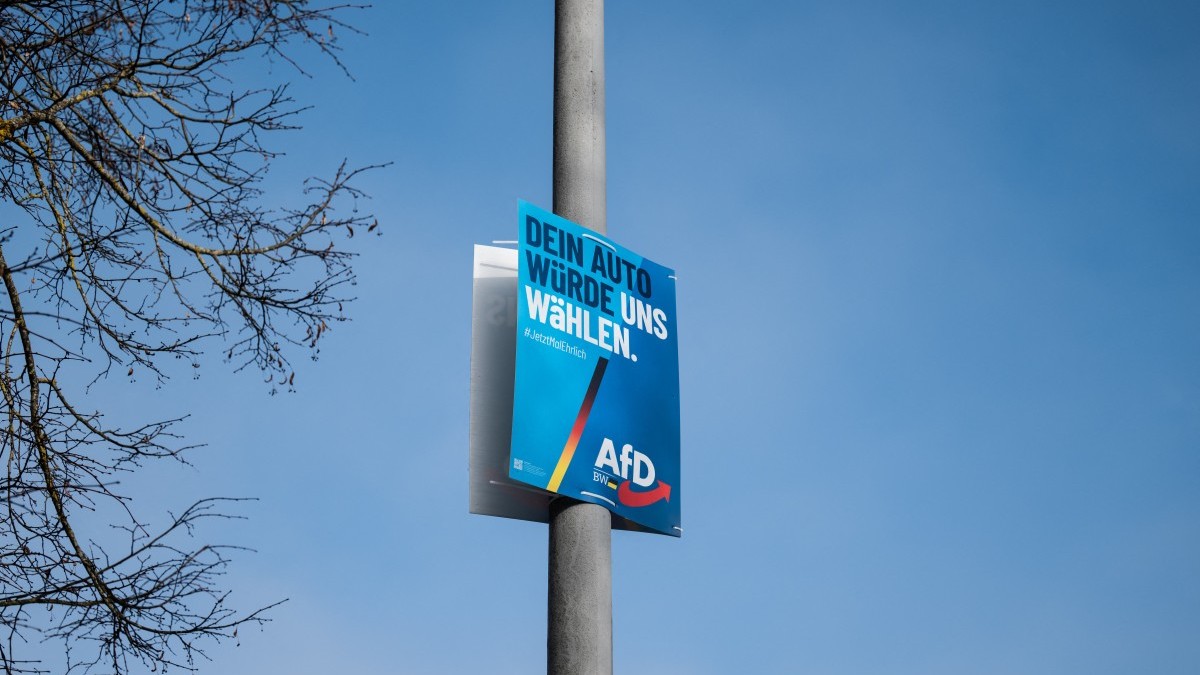
An AfD election poster for the upcoming state election in Baden-Württemberg reading “Your car would vote for us” is seen on the roadside on March 2, 2026 in Villingen-Schwenningen, Germany.
SILAS STEIN / AFP
Friedrich Merz’s party, along with the other mainstream groupings in German politics, constantly brands the populist AfD as the enemy of democracy. But when it suits them, they are more than happy to trample on long-established practices themselves.
The elite late last year ousted a democratically elected deputy mayor from office in North Rhine-Westphalia, simply because she represented the AfD, on the ludicrous pretext that she might have frightened off tourists. In Lower Saxony, it has breached the party’s democratic rights by effectively excluding it from oversight of the Office for the Constitution. And in Nieder-Olm, the AfD has been altogether barred from standing in this year’s mayoral election.
Democracy will next suffer at the hands of the establishment coalition in the Saxony-Anhalt September elections, which we previously identified as having the potential to set a course for the European Union.
The AfD has long polled at around 40% in this region, well above the CDU—the party of Merz, which follows in second place with around 25% of the expected vote. So the constitution and laws are being amended there to hinder the opposition party even in the likely event of ‘victory.’
Süddeutsche Zeitung reports that the CDU, SPD, and FDP, alongside the Greens and the Left faction, are working on legislation they hope will pass in May, to—as the paper put it—“safeguard the most important democratic institutions.” This will make it more difficult for the largest parliamentary group to choose the state parliament president, and reduce its influence on the membership of the state constitutional court.
(Current) officials also want to make it more difficult to abolish the State Agency for Civic Education, which the AfD says has “increasingly developed into a left-wing indoctrination institution.”
Yet AfD lead candidate Ulrich Siegmund claims that “much of what is now being proposed can be reversed through simple legislation or adjusted again later.” Right-wing publication Junge Freiheit suggests he is wrong to be so “unperturbed.”