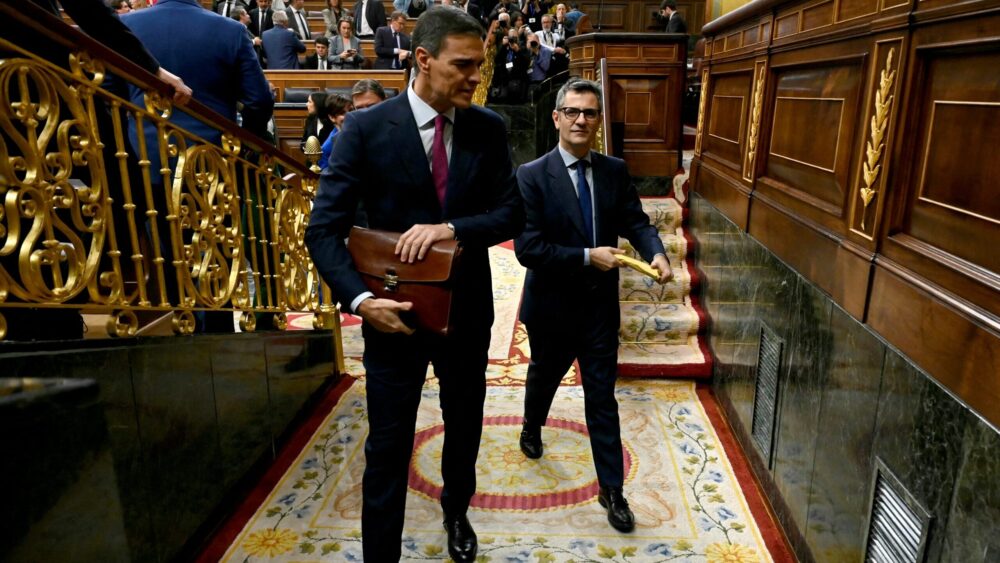
Pedro Sánchez and Félix Bolaños
JAVIER SORIANO / AFP
After more than two years gathering dust, the reform of the Official Secrets Law has suddenly become a top priority for Pedro Sánchez’s Spanish government. In just one week, the Ministry of the Presidency, led by Félix Bolaños, has fast-tracked the drafting process, ignoring objections from the Ministry of Defence and even the National Intelligence Centre (CNI). Behind the apparent eagerness to modernize a 1968 law lies a clear intention: to expand the Executive’s control over information and muzzle the media.
The new draft, renamed the Classified Information Law, introduces fines of up to €2.5 million for those who disclose confidential information, including journalists. Unlike the current law, which only applies to civil servants and security personnel, the new version threatens any citizen with punishment.
Because the law is so broad, it could be used to punish journalists—through fines or criminal charges—for reporting uncomfortable facts. For example, leaks about alleged socialist corruption or Sánchez’s controversial trips on the official Falcon jet—some without any official agenda, such as to the Dominican Republic—could be declared “state secrets” and punished accordingly.
This directly contradicts the EU’s Media Freedom Act, which aims to do precisely the opposite: to ensure independent journalism and protect journalistic sources. At least on paper, this is because it has also become clear that Brussels uses it to censor dissent.
The timing of this law’s revival is no coincidence. The reform was one of PSOE’s long-standing commitments to its separatist allies, who have been calling for the repeal of the Franco-era legislation for years. But the fast-track process—giving ministries only one day to submit observations—reveals that the government’s genuine interest is not to strengthen democracy, but to tighten control over information as political support for the government continues to erode.
The new draft transfers oversight of classified information from the CNI to a body directly under the Ministry of the Presidency. Bolaños is drafting the law and will also decide how it’s applied — a textbook case of power without oversight. Neither the objections from the Ministry of Defence nor warnings about the lack of safeguards in document classification were considered.
The bill now moves to Parliament, where it must be approved by both Congress and the Senate. Although the government hopes to approve it by October, the calendar and pushback from various sectors may delay the debate. This isn’t just about a legal reform—it’s about how much control the government can exert over a free society. A secrecy law used to cover up scandals and silence the press does not strengthen democracy—it weakens it. All the more so when those behind it claim to be champions of free speech.