Photo: @niusde_ on X, 8 April 2025
A German court will this week revisit a controversial conviction over a political meme that has drawn international attention and reignited debate over the limits of satire and freedom of expression in Europe.
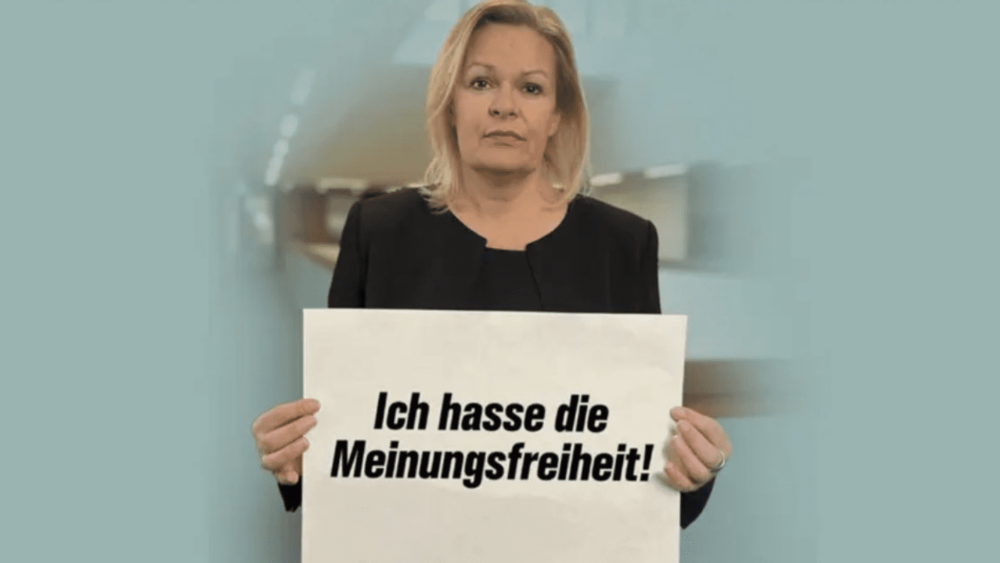
On Wednesday, January 14, 2026, the Bamberg Regional Court will hear the appeal in the criminal case against David Bendels, editor-in-chief and publisher of the Deutschland-Kurier (DK), who was sentenced to seven months’ probation for sharing a satirical meme depicting then–interior minister Nancy Faeser holding a sign reading “I hate freedom of expression.”
The image was based on a real photograph taken during a Holocaust Remembrance Day event, in which Faeser was originally holding a sign reading “We Remember.” The district court ruled that the altered image constituted defamation of a public official under Section 188 of the German Criminal Code.
As part of the original judgment, the court also ordered Bendels to issue a written apology to Faeser as a condition of probation. Prosecutors, who had sought an eight-month prison sentence without probation, have appealed the ruling on the grounds that the punishment does not adequately reflect the seriousness of the offense.
The court said the meme amounted to an untrue statement of fact and argued that its satirical nature would not have been recognisable to an average viewer. Judges also claimed that such content could spread rapidly online and undermine trust in the integrity of the person depicted.
The verdict triggered strong criticism, with commentators describing it as a disproportionate and politically motivated intervention against freedom of expression. Bendels announced immediately after the ruling that he and his legal team would appeal.
The conviction relates to a post Bendels shared on his X account in February 2025. Following the judgment, he said he would “continue the just fight for freedom of the press and freedom of expression, which is indispensable for the continued existence of democracy in Germany.” His lawyers have consistently argued that the image was clearly intended as satire and constituted protected political criticism.
German media outlets also reacted sharply. Die Welt described the ruling as “a verdict reminiscent of a dictatorship,” while Focus referred to Bamberg as a “special judicial zone.” The Christian outlet PRO said the judgment was “so embarrassing that one might almost mistake it for satire,” calling its severity “utterly absurd.”
Both the defense and the prosecution have now appealed the decision, prompting a full review by the Bamberg Regional Court. According to a press release from Deutschland-Kurier, the case has attracted significant international attention, particularly in the United States.
Ahead of the hearing, Bendels said he and his team would “vigorously and courageously defend press and freedom of expression in Germany with all legal means,” adding that the case concerns not only his own situation but the future of independent media in the country.
He has said he will continue the legal fight regardless of the outcome. “Criticism of power and criticism of government are fundamental core duties of a free press,” Bendels said, adding that such criticism must remain permissible even when it is sharp or uncomfortable. “We love freedom of expression—and we will always fight for freedom of speech.”
Bendels is represented on appeal by three defense attorneys, including constitutional law scholar and criminal defense lawyer Professor Ulrich Vosgerau, who has described the case as a “litmus test for freedom of expression in Germany.” Vosgerau has questioned whether the country can still be considered a liberal constitutional state in line with Western democratic standards if the conviction is upheld.
The defense has said it is prepared to pursue all further legal avenues if necessary, including a constitutional complaint and an application to the European Court of Human Rights.