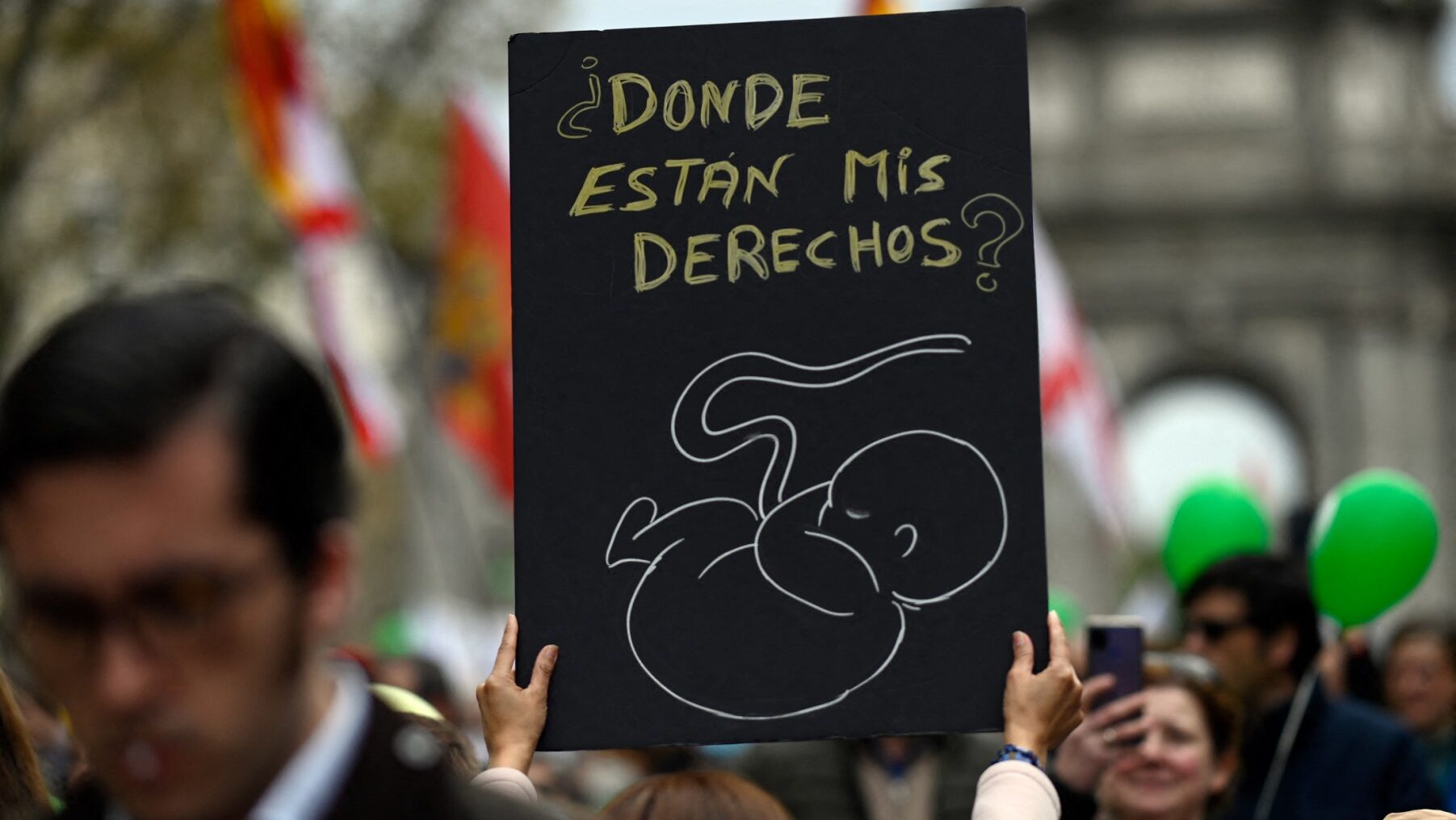
A sign reading “Where are my rights?” during the “Sí a la vida” (Yes to life) march on March 27, 2022, in Madrid
OSCAR DEL POZO and Oscar DEL POZO CAÑAS / AFP
Spain’s socialist government is moving to ban pro-life protests within 200 meters of abortion clinics, an initiative that would prohibit prayer and gatherings near the facilities.
The Ministry of Equality announced this Wednesday that it is considering establishing a “security perimeter” around abortion centers. The measure would restrict pro-life groups from gathering near the facilities, with the stated aim of preventing pressure or coercion.
The minister told Parliament that the Institute for Women is reviewing the proposal as part of a broader effort to “strengthen” the legal protection of abortion.
The government has also said it wants to explore writing abortion explicitly into the Constitution under the article that guarantees the right to health protection.
At the same time, allied parliamentary groups have introduced proposals to amend the Criminal Code and ban pro-life gatherings within 200 meters of the clinics.
For the government, these measures would ensure that women can access the clinics without interference. The proposal also follows a trend seen in other European countries, such as England, where exclusion zones around abortion centers already exist.
In 2023, England and Wales introduced 150-meter exclusion zones around abortion clinics, making certain forms of protest, including silent prayer, illegal within those spaces.
The Spanish government is drawing inspiration from that model. However, British legislation has also sparked legal and ethical debate about the limits of free expression and whether restrictions go too far in public spaces. That debate has now moved to Spain, but in a much more aggressive manner.
Several pro-life associations have strongly rejected the proposal. Their representatives maintain that their activity near clinics is limited to silent prayer, offering information, and providing material or psychological assistance to women in difficult situations.
They argue that Spanish law already punishes coercion and intimidation, making broad restrictions on freedom of expression and assembly unnecessary.
In their view, exclusion zones would restrict constitutional rights in public spaces before any wrongdoing has occurred.
They also stress that the debate should focus on offering greater support for pregnant women in vulnerable situations rather than expanding prohibitions on those who offer alternatives and assistance.
The proposal comes as the government faces mounting political pressure over a series of scandals and investigations. Opposition figures and some civil society groups say the government is leaning into a culture-war issue because it is under pressure elsewhere.