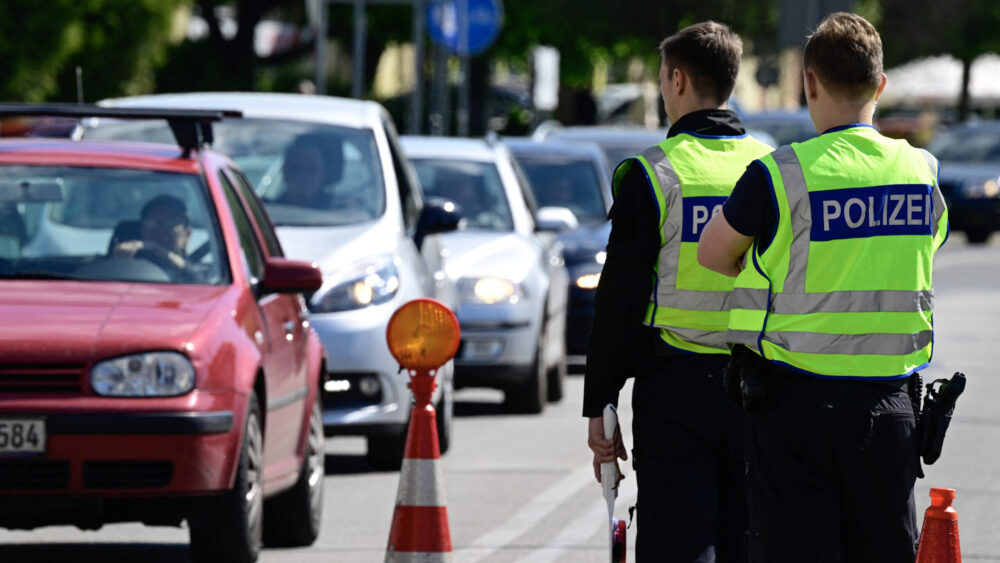
German federal police officers watch vehicles and traffic coming into Germany from Poland at a border control station
John MACDOUGALL / AFP
The German government’s plan to turn back asylum seekers at the border is already facing an internal revolt, as a leading Social Democrat MP claimed the proposed crackdown is illegal and won’t be carried out—raising doubts over Germany’s ability to enforce tougher immigration controls.
Sonja Eichwede called into question the announcement by German Interior Minister Alexander Dobrindt and Chancellor Friedrich Merz about tightening border controls to reduce irregular immigration—a move that does not even amount to a real change in overall immigration policy.
According to Eichwede, the proposed measures—especially the immediate rejection of asylum seekers at the borders—would be illegal and will not be implemented as outlined.
In statements to Deutschlandfunk, the SPD parliamentarian said she does not expect the Bundespolizei to carry out mass rejections at the borders, since her party believes this would violate current legal norms. “From our perspective, this is not legally admissible,” Eichwede asserted, emphasizing that officers will not comply with blanket rejection orders.
She also said that, according to the coalition agreement, any policy on rejections must first be coordinated with European partners. As vice chairwoman of the Social Democratic parliamentary group, she called for a thorough legal review of the plans presented by Minister Dobrindt.
On Wednesday, Dobrindt announced new measures to address the migration crisis, including deploying more federal agents at the borders and refusing entry to asylum seekers who do not meet requirements, with exceptions for children and pregnant women. However, Eichwede’s remarks reveal that political and legal barriers within the government itself could already slow or block the implementation of these measures.
This new political clash confirms what has already been highlighted: despite grand headlines and announcements, Germany will not fundamentally change anything in its migration policy. Dobrindt’s statements are, for the most part, gestures aimed at public opinion, trapped within a European legal framework that severely limits national sovereignty.
Even when there is talk of strengthening borders, final decisions are conditioned by multilateral agreements, international legal obligations, and the internal divisions of the German government itself. Europe remains incapable of asserting real control over its own borders, while migratory pressures grow and political rhetoric turns into mere words without concrete effect.
The clash between Dobrindt and Eichwede is just the latest example of a structural paralysis keeping the country—and the European Union as a whole—locked in political gridlock and unable to act in the face of one of the continent’s most pressing challenges.
The CDU is proposing only timid changes compared to the previous legislative revolution. The SPD raises its voice and confronts the centrists. In the end, the center always—sooner or later—yields, supposedly to avoid conflict. Thus, the pattern continues. Right now, the new German government has already reached phase two in just two days in office.