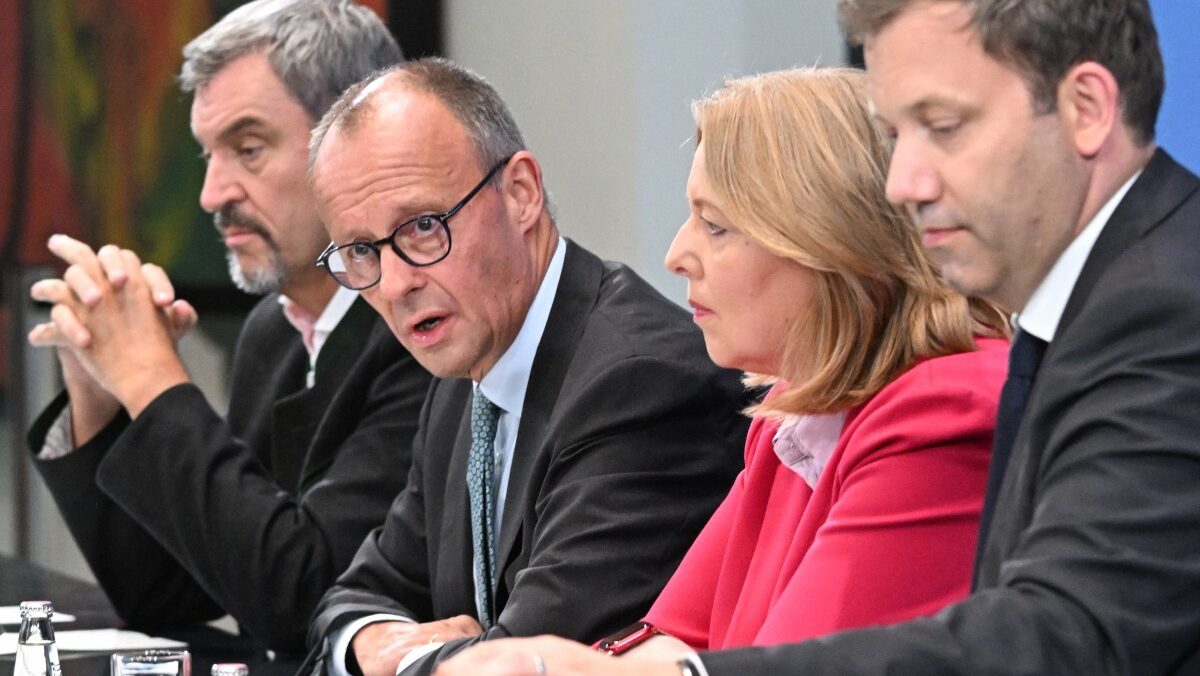
(L-R) Bavaria’s State Premier and leader of the conservative Christian Social Union (CSU) Markus Söder, Chancellor Friedrich Merz, Minister for Labour and Social Affairs Bärbel Bas and Finance Minister and Vice Chancellor Lars Klingbeil address a press conference following a coalition committee meeting at the Chancellery in Berlin on September 3, 2025.
RALF HIRSCHBERGER / AFP
The German Social Democratic Party (SPD) said during its parliamentary group meeting that more immigration is key to solving the economic crisis the country finds itself in. To bring in more workers, SPD co-leader Bärbel Bas said, obstacles to immigration need to be lowered. This marks a clear distancing from the SPD’s coalition partners in the CDU and the CSU, the latter of which has called for a large-scale “deportation offensive” in 2026.
Bas said increased immigration of skilled workers is necessary to finance the German welfare state, resisting calls for reductions to a system she described as essential, “especially in times of upheaval.” Her co-leader Lars Klingbeil agreed, telling Bild, “I will not join the chorus of those who say that with less welfare state we will get more economic growth.”
Instead, SPD wants to increase inheritance taxes, saying it would be an important factor in reducing financial inequality. The party has pushed for higher taxes on high earners, large inheritances, and wealth (e.g., reforming inheritance tax to make it more progressive, higher taxation of corporate inheritances, or targeting the super-rich). On the other hand, the party aims to lower taxes for middle- and low-income individuals “midway through the legislative period,” Stern reports.
The SPD failed to push through higher inheritance taxes in the coalition negotiations but is now making a new attempt.
The next potential development on the issue is expected from an upcoming ruling by the Federal Constitutional Court, which is reviewing the constitutionality of the preferential tax treatment granted to business assets in inheritance and gift tax law.
CDU MP and finance expert Olav Gutting described the SPD’s proposal as “divisive populism,” and the CSU has said the party will “of course” reject it.
Chancellor Merz had, at the time of writing, not commented on the issue, but the cracks in his government are becoming increasingly hard to ignore.